Buffstreams Alternatives: Your Smarter, Safer Playbook for Sports Streaming
If you’re here, you know the moment all too well. The game is tied in the final seconds. You’re leaning forward, heart pounding, and… the screen freezes into a pixelated mess. A pop-up for a dubious “performance enhancer” blots out the action. By the time you find the microscopic “X,” your group chat is exploding with spoilers and the moment is lost.
This isn’t entertainment; it’s a special kind of digital torture. And if you’ve ever scrambled for a Buffstreams link, you’ve paid for that “free” stream with your time, your nerves, and your security.
You’re not just looking for another link. You’re searching for a solution—a reliable, high-quality way to watch the games you love without the anxiety, malware risks, or constant buffering. This guide is that solution. Forget shady lists and endless pop-up ads. We’re going to build you a personal sports viewing system that trades chaos for control and transforms you from a frustrated stream hunter into a strategic fan in command of your game day.
Why Smart Fans Are Building Systems, Not Chasing Links
Clicking random streams on sites like Buffstreams comes with hidden costs that go far beyond just a bad picture. Understanding these is the first step to a better way.
- The “Attention Tax”: You’re not a fan watching a game; you’re an ad exterminator in a browser war. In tests of similar sites, users have had to close over a dozen pop-ups and redirects just to get a stream to load. The actual sport becomes background noise to your battle with the interface.
- The “Anxiety Tax”: Is this sketchy site legal? Could it lead to a warning from your internet provider? Does that “download” button hide malware? This underlying unease taints the entire experience. You shouldn’t need to run a virtual private network (VPN) and antivirus software just to feel somewhat safe watching a basketball game.
- The “Reliability Tax”: The most common word associated with these streams is “unreliable”. Links die without warning, and entire sites can vanish. When your stream falters at the worst possible moment, you’re left frantically Googling while the action unfolds without you.
Choosing to move past this cycle isn’t about being picky; it’s about valuing your time, your security, and your enjoyment of the game itself. The goal isn’t to find one magical, perfect website. It’s to have a smart, layered strategy so you’re never again left staring at a buffering icon when it matters most.
Your Core Playbook: The Three-Channel Framework for Every Game
Think of watching sports like managing a smart investment portfolio. You don’t put all your money in one risky asset; you diversify to protect yourself and maximize returns. Your viewing strategy should be just as intelligent.
This is your Three-Channel Playbook. Channel 1 is your stable, zero-cost foundation. Channel 2 is your premium, high-performance core for must-see events. Channel 3 is your agile, situational tool for when you’re on the move. A savvy fan seamlessly shifts between these channels based on the game, location, and that week’s budget.
Channel 1: The Free & Community Layer (Your Foundation)
This is your zero-dollar, legal, and surprisingly robust first line of defense. We’re talking about 100% legitimate options.
- The Overlooked Gem: The Digital Antenna. For a small, one-time cost, you can pull in crystal-clear HD broadcasts of your local CBS, Fox, NBC, and ABC affiliates. This means NFL Sunday games, the World Series, NBA Finals broadcasts, and major college football—all in perfect quality, completely free, and completely legal. It’s the most reliable technology for local games.
- Free Ad-Supported Streaming (FAST) Platforms. Services like Pluto TV offer dedicated, live sports channels that you can watch just like traditional TV. They’re funded by commercials, not pop-up scams, and provide a structured, “channel surfable” way to catch games and highlights without signing up.
- The Social Backup Plan: The Local Sports Bar. Never underestimate the power of community. For a huge playoff game or when your home setup fails, watching in a crowd of fellow fans is a reliable, high-energy Channel 1 option that costs little more than a drink.
Channel 2: The Official & Premium Layer (Your Core)
When you must see an out-of-market game in HD without a single hiccup, this is your go-to. You’re paying for guaranteed quality and peace of mind.
- League-Specific Apps (The Specialist). Services like NBA League Pass, NFL+, and MLB.TV are built for the die-hard fan of a specific sport. They offer every game (often with options to watch live or on-demand), multiple camera angles, and exclusive content. Be mindful of local blackout restrictions, which are rules that prevent live streaming of local games to protect regional TV deals.
- Live TV Streaming Bundles (The General Manager). Think of these as customizable cable packages. YouTube TV, Hulu + Live TV, and FuboTV bundle local channels with national sports networks like ESPN, Fox Sports, and NFL Network. They are the closest legal alternative to the “all-in-one” experience people often seek from shady streaming sites, and they include essential features like cloud DVR to record games.
Channel 3: The Audio & Data Layer (Your Utility Player)
This channel is for mobility, multitasking, or when video just isn’t an option. It keeps you connected to the game’s pulse.
- Terrestrial & Team Radio Apps. The radio broadcast is often the most vivid, real-time narration you can get. Many local stations and league apps offer free audio streams, providing a reliable, low-data connection to the action with zero buffering.
- Official League Data & Highlight Apps. Apps from the NFL, ESPN, or the leagues themselves provide real-time play-by-play, drive charts, and key stats. For the quickest official highlights, NFL+ and ESPN+ post crucial plays almost immediately after they happen.
By internalizing this three-channel mindset, you stop being a hostage to any single, unreliable source. You become the general manager of your own sports entertainment, with a full roster of options ready for any situation.
Construct Your Personal Game Map for Smarter Sports Viewing
Okay, you have your Three-Channel Playbook. Now, let’s put it to work. This isn’t a random pick-and-choose; it’s about becoming the cartographer of your own sports landscape. Think of it like planning the perfect road trip—you plot your must-see destinations first, then find the best routes to get there.
Your “Game Map” is a simple, personal plan that connects what you want to watch with the most efficient way to watch it. Let’s build it together in three steps.
Step 1: Plot Your “Points of Interest” (Your Non-Negotiables)
Grab a notepad, or just open the notes app on your phone. Ask yourself:
- What is my one must-watch team or league? (e.g., The Denver Broncos, Manchester United, the UFC).
- What’s my secondary sport or event? (e.g., “I always watch the NBA Finals,” or “I follow tennis during Wimbledon”).
These are your Points of Interest (POIs)—the big landmarks on your map. Be brutally honest. Trying to map every single sport is a quick path to getting lost and overwhelmed.
Step 2: Choose Your Routes (Match POIs to Your Channels)
Now, assign each POI to the most logical “Channel” from your playbook.
- Is your team local? Your primary route is almost always Channel 1. A $20 digital antenna could be your golden ticket to every local NFL, NBA, MLB, or NHL game in crystal-clear HD, completely free. Mark it on the map.
- Are you a fan living out-of-market? Your main route is likely Channel 2. You’ll need an official league pass (like NBA League Pass) or a live TV service (like YouTube TV or FuboTV) that carries that team’s regional network.
- Do you just love the atmosphere of big events? Your route might be a mix. Use Channel 1 (antenna or FAST apps like Pluto TV) for championship games on network TV, and Channel 2 for the playoff lead-up on cable channels.
Step 3: Fill In the Terrain (Add Your Flexible Content)
The space between your major POIs is where you explore. This is for everything else—the random Saturday college football game, catching up on highlights, or listening to sports talk.
- This terrain is perfect for Channel 3 (Audio/Data) and the free, discovery-based parts of Channel 1.
- This is where you might fire up a free, ad-supported app to browse, or put on a radio broadcast while you’re doing chores. It’s low-commitment, high-reward territory.
The Magic of the Map: The goal is to look at your finished plan and instantly see where your money and attention should go, and where they shouldn’t. You stop subscribing to a full cable package just for one team. You stop frantically searching for a stream when you already have a perfect, legal antenna signal. Your viewing becomes intentional, not reactive.
The Latency Ladder: How to Watch Big Plays Faster
Let’s talk about the sports fan’s silent nemesis: latency. That’s the technical term for the agonizing delay between something happening on the field and you seeing it on your screen. It’s why you get a text screaming “TOUCHDOWN!!!” while you’re watching the quarterback still lining up.
Not all streams are created equal. Some are almost real-time; others are a full minute behind. Where you watch determines how close to “live” you are. Think of it as a ladder, with the fastest, most reliable experience at the top.
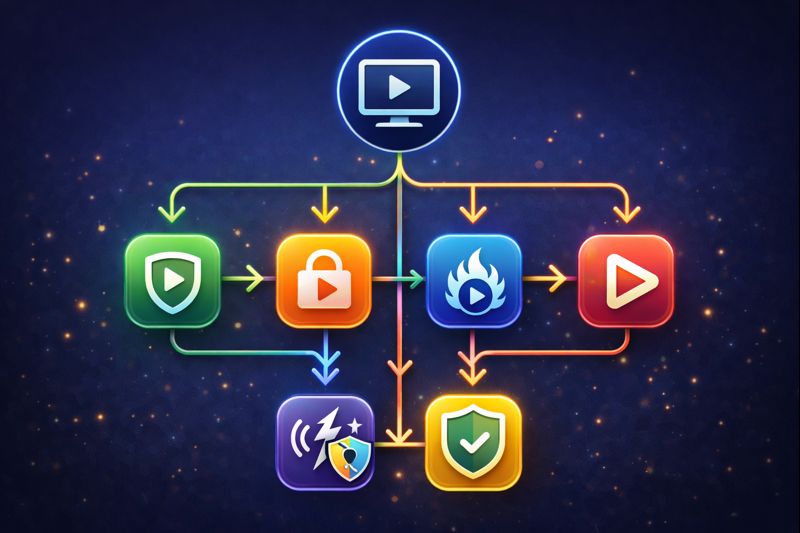
Here’s Your Latency Ladder, from Slowest to Fastest:
- The Basement: Unofficial Free Streaming Sites (30+ seconds delay)
- Middle Rung: Official Streaming Apps & Live TV Services (10-30 seconds delay)
- This includes apps like ESPN+ and streaming bundles like Hulu + Live TV. They’re much more reliable than shady sites, but the process of encoding the video for the internet and sending it through content delivery networks (CDNs) introduces a slight buffer. This is the standard, comfortable trade-off for quality and convenience.
- Top Rung: Over-the-Air Antenna & Traditional Cable/Satellite (Near-Live, <5 seconds delay)
- This is the king of live speed. A digital antenna receives the broadcast signal directly from the local tower with almost no processing delay. Traditional cable and satellite are also very fast. When you’re watching a crucial play, this is where you want to be. It’s the closest experience to being in the stadium.
Your Game-Day Latency Strategy:
Knowing the ladder lets you make a smart play. For the biggest game of the year—the Super Bowl, Game 7, the Champions League final—climb to the top rung. Watch it over an antenna or cable if you can. The peace of mind of knowing you’re seeing it as it happens is unbeatable.
For your regular season game? The middle rung (an official app) is perfectly fine. The minor delay is a worthy trade for the flexibility to watch on any device.
By understanding the Latency Ladder, you take control. You’re no longer a victim of the delay; you’re the director choosing the right tool for the moment, ensuring you never miss the thrill of a live celebration again.
Money-Smart Moves That Remain Legit and Cost-Effective
Let’s talk about the elephant in the room: sports streaming can get expensive. But “legit” doesn’t have to mean “bankrupt.” Being a cost-effective fan is about strategy, not deprivation. It’s knowing when to go all-in and when to walk away. Here’s how to build a budget that respects your wallet and your fandom.
Embrace the Seasonal Mindset
The biggest mistake fans make is paying for a service year-round to watch an 8-month season. Stop thinking in forever subscriptions.
- The Rule: Subscribe for the season, cancel for the offseason. You are not married to YouTube TV or FuboTV. Mark your calendar for the day after the championship game. Canceling is a few clicks, and you can always resubscribe in six months. This one habit can save you hundreds of dollars a year.
The Power of the Single-Sport Pass
Do you live and breathe the NBA but only casually check in on other sports? Don’t buy the whole cable bundle.
- The Play: Go straight to the source. NBA League Pass, NFL Sunday Ticket (for out-of-market games), and MLB.TV exist for you. Yes, they’re an investment, but when you compare the annual cost to a $70/month live TV bundle you only use for one sport, it’s often a smarter, more focused spend. Always check for student, military, or single-team discounts.
Mix, Match, and Rotate (The “Streaming Carousel”)
No law says you need every service at once. Use your Three-Channel Playbook to create a rotation.
- Example Game Plan:
- Football Season: Activate YouTube TV for NFL RedZone and college football.
- Basketball Season: Pause YouTube TV and switch to NBA League Pass.
- Baseball Season: Pause everything and use the MLB.TV audio-only feature (which is often very affordable or even free for some subscribers) for daily games, supplementing with the free MLB Game of the Day on Channel 1.
- The Free Foundation: Never pay for what you can get for free. Your Channel 1 options (antenna for local games, Pluto TV for highlights) should always be your first stop. They dramatically reduce the number of games you need to pay for.
The “Family & Friends” Plan (The Ethical Share)
Most premium services allow multiple concurrent streams (usually 2-3). If you have a trusted friend or family member with similar tastes, consider a formal cost-sharing arrangement. One subscribes to Hulu + Live TV, the other to ESPN+ and Peacock. You share logins formally and split the total cost. This isn’t about widespread password piracy; it’s a deliberate, small-scale partnership that cuts your individual bills in half.
Being money-smart isn’t about missing out. It’s about directing your cash with precision, ensuring every dollar you spend is actively enhancing your fandom, not just leaking out for a service you forgot to cancel.
A Safety Checklist for Not Swimming in Shady Streams
Venturing outside the official apps can feel like walking through a digital back alley. The allure is a free game, but the risks are real: malware that hijacks your computer, phishing scams that steal your passwords, and intrusive ads that track your every move. If you ever consider a third-party stream, run it through this safety checklist first. Think of it as your pre-flight inspection.
The “HTTPS & Padlock” Test
Before you click anything, look at the top of your browser.
- Red Flag: The website address starts with
http://(without the “s”) or shows a “Not Secure” warning. - Green Flag: The address starts with
https://and has a padlock icon next to it. The “s” stands for secure, meaning the connection between you and the site is encrypted. It’s a basic standard for any legitimate site in 2024. No HTTPS, no click.
The “Too-Good-To-Be-True” Scan
Use your common sense as a filter.
- Red Flags:
- Flawless 4K streams of a niche event for free. (Broadcasters themselves rarely stream in 4K for free).
- Zero ads or pop-ups on a site that hasn’t asked for money.
- Requests for you to “disable your ad blocker.” This is often a trap to unleash a barrage of malicious ads.
- Buttons that scream “DOWNLOAD NOW” or “CLICK TO INSTALL PLAYER.” Legitimate streams play in your browser; they don’t require special software.
- The Reality: If it looks and feels like a professional, mainstream website (like ESPN.com), that’s a good sign. If it feels cluttered, aggressive, or like it’s trying to trick you, it probably is.
The “Containment” Protocol
If you decide to proceed, never do it on your main machine.
- The Strategy: Use a dedicated device—an old laptop or tablet you don’t use for banking or email. Better yet, run it in a virtual machine if you’re tech-savvy.
- The Non-Negotiable Tool: Use a reputable paid VPN (like NordVPN or ExpressVPN). A VPN encrypts your internet traffic and hides your real location. This adds a crucial layer of privacy between you and the sketchy site, and it can also help with geographical blackouts on legitimate services.
The “Exit Strategy”
Have a plan before you go in.
- Bookmark Your Legal Fallback: Before you visit a risky stream, have your Channel 1 or Channel 2 backup already open in another tab. If the stream is a disaster, you’re one click away from safety.
- The Golden Rule: Never, ever enter personal information—not an email, not a password, and certainly not a credit card number. Any site asking for this is a phishing operation.
Remember: Your safety and the security of your devices are worth more than any single game. This checklist isn’t about encouraging risky behavior; it’s about arming you with knowledge if you ever find yourself at the edge of that murky water. The safest play, always, is to stick to the official channels outlined in your playbook.
Nothing On the Field To See Here: A General Purpose Framework
By now, you have a toolkit: a playbook, a map, a budget, and a safety protocol. It’s time to put all those pieces together into one universal system that can guide any streaming decision you make, for any sport, at any time.
Think of this as the Swiss Army knife in your streaming arsenal—a simple, three-step checklist you can run through in under a minute.
Step 1: Identify Your Goal
Before you click anything, ask yourself a simple question: “What is the one thing I need from this stream right now?” Your answer will point you directly to one of your Three Channels.
- If the answer is “I need to watch this specific local game in the highest quality,” your Channel 1 antenna is your instant, first-choice tool.
- If the answer is “I need reliable access to this out-of-market league all season,” you’re in Channel 2 territory, looking at official league apps or live TV bundles.
- If the answer is “I just need to know the score or catch the highlights,” Channel 3’s audio and data options are your fastest, most efficient path.
Step 2: Apply Your Filters
Once you know your channel, run the opportunity through your personal filters:
- The Budget Filter: Does this fit within my 70-20-10 budget or my planned “Flex Fund” for the month? If not, can I find a similar experience on a different channel? (e.g., If an NBA League Pass subscription doesn’t fit the budget, could I follow the game via a Channel 3 radio broadcast?).
- The Safety Filter: Is this source on my trusted list? If I’m venturing outside it, does it pass the HTTPS, “too-good-to-be-true,” and common sense tests? Am I prepared with my VPN and containment protocol?
Step 3: Execute and Evaluate
Make your choice and watch. Then, after the game, do a quick 30-second review: Did this source meet my goal from Step 1? Was it worth the cost or the effort?
- If YES: Note it down. This source just earned a permanent spot in your personal “Trusted Toolbox” for that type of game.
- If NO: That’s valuable data. You now know what doesn’t work for you, which is just as important. Cross it off the list and you’re one step closer to your perfect setup.
This framework isn’t about rigidity; it’s about clarity. It cuts through the noise of a hundred different apps and websites and brings you back to your own priorities. Use it once, and you’ll never again find yourself paralyzed by choice at kickoff.
If You’re This Type of Fan, Try This Plan
Theory is great, but action is better. Let’s translate everything into clear game plans for three common fan profiles. Match yourself to the one that fits best, and you have a ready-to-launch strategy.
Plan A: For The Die-Hard Local Fan
- You Are: The ultimate hometown supporter. Your primary mission is to watch every snap, pitch, or period from your city’s teams. You want maximum reliability for local games.
- Your Core Setup (The 70%):
- Primary Tool: A Digital Antenna. This is non-negotiable. It’s a one-time purchase for free, legal, crystal-clear HD broadcasts of local NFL, NBA, MLB, and NHL games on CBS, Fox, NBC, and ABC. It’s the fastest, most reliable Channel 1 option you have.
- Secondary Tool: The Team’s Radio Network. Bookmark the local radio station’s app or stream. It’s your failsafe for listening in the car or if the TV feed has an issue.
- Your Flex Moves (The 20% & 10%):
- Use your Flex Fund for a single-month subscription to a live TV service like YouTube TV or FuboTV only when your team is on a national cable channel like ESPN or TNT that your antenna can’t get. Subscribe for the month, cancel when the stretch is over.
- Your 10% free foundation is Pluto TV or Tubi. Use them for pre-game shows, sports news, and classic replays.
Plan B: For The Out-of-Market Superfan
- You Are: You live in California but bleed for a New York team. You need consistent, legal access to every one of your distant team’s games.
- Your Core Setup (The 70%):
- Primary Tool: The Official League Pass. This is your Channel 2 workhorse. Services like NBA League Pass, MLB.TV, or NHL.TV are designed specifically for you. Be mindful of national TV blackouts, but for most games, it’s your direct pipeline.
- For NFL Fans: NFL+ Premium or the NFL Sunday Ticket add-on (via YouTube TV) is your equivalent.
- Your Flex Moves (The 20% & 10%):
- Your Flex Fund is for the playoffs. If your team makes a deep run, games shift to national TV. Use your fund to get a one-month subscription to YouTube TV or Hulu + Live TV to ensure you catch every moment on ESPN, TBS, or ABC.
- Use free league highlight apps and data trackers (Channel 3) for real-time stats and quick recaps.
Plan C: For The Cord-Cutter on a Strict Budget
- You Are: You want to watch sports, but the total monthly cost must be near zero. You are strategic and value-conscious.
- Your Core Setup (The 70%):
- Primary Tool: Free Ad-Supported Streaming TV (FAST). Your Channel 1 is Pluto TV, Tubi, The Roku Channel, and Xumo. These offer incredible value with dedicated sports news channels, classic games, and sometimes live events like MLB Sunday Leadoff.
- Essential Add-on: A Digital Antenna. If you can swing the one-time ~$20 cost, it massively expands your free, legal access to live local sports.
- Your Flex Moves (The 20% & 10%):
- Your entire budget is your Flex Fund. Use it strategically for short-term passes. For example, Sling TV sometimes offers Day or Weekend passes for as low as $5 to catch a specific game or tournament.
- Your 10% is Red Bull TV for niche/action sports and YouTube for official league highlights and press conferences.