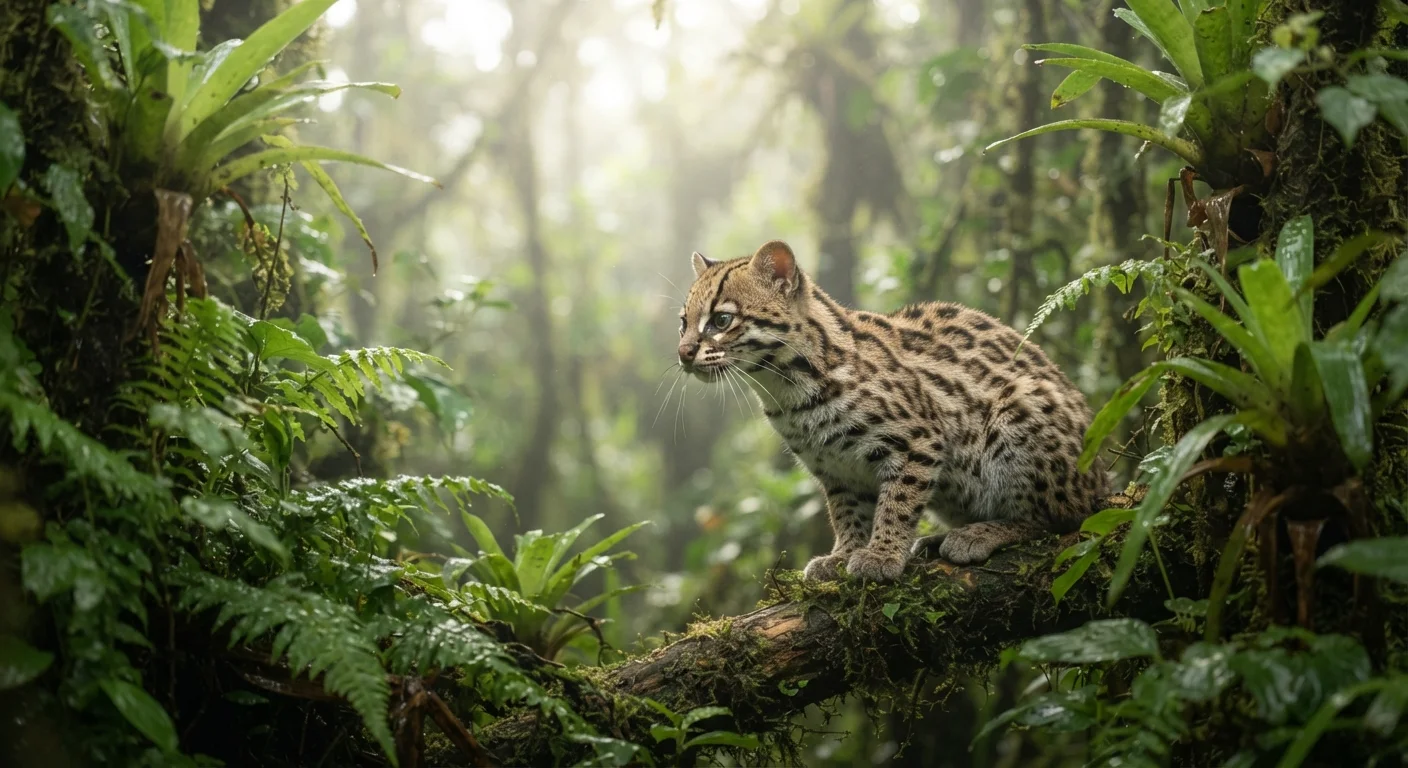
Tilcayo – The First New Wild Cat Species Discovered in a Century
The modern world can frequently feel completely mapped out, fully explored, and thoroughly documented through satellite imagery and global databases. Yet, remote ecosystems continue to harbor extraordinary biological secrets that defy conventional understanding.
For the first time in more than a century, scientists have formally described and named a brand-new living species of wild cat. This milestone breaks a prolonged drought in felid taxonomy that has persisted since the 1920s.
Known to local communities as the tilcayo (Leopardus tilcayo), this elusive creature sheds light on the hidden biodiversity tucked away inside South American cloud forests. Its official recognition marks a watershed moment for mammalian conservation and evolutionary biology.
The Accidental Discovery Behind the Milestone
The remarkable journey of the tilcayo began far away from sterile university laboratories, deep inside a Bolivian wildlife sanctuary. National Geographic explorer and biologist Paola Nogales-Ascarrunz first encountered the animal at the Senda Verde Wildlife Sanctuary.
A local resident had brought the tiny creature in after finding it alone as a kitten near a forest road.Mistaking the wild infant for a standard domestic cat, the family took it home and attempted to care for it.
In a surprising twist of domestic misunderstanding, the family fed the growing carnivore a diet consisting largely of noodles, rice, and eggs.Once the animal’s true wild temperament and unique physical traits became apparent, they wisely surrendered it to the sanctuary.
Dr. Nogales-Ascarrunz initially suspected the animal belonged to a known species of South American tiger cat.However, detailed photographic comparisons revealed that its coat patterns and tail markings did not match any documented regional felid.
This visual anomaly triggered an international genetic investigation.Researchers extracted and analyzed DNA samples from museum specimens and wild cats across the continent, unlocking a revolutionary taxonomic revelation.
Unraveling the Tiger Cat Species Complex Through Genomics
To solve the mystery of the Senda Verde sanctuary cat, researchers launched a massive phylogenomic investigation into the Leopardus genus. For generations, biologists had grouped small spotted cats across Central and South America under a broad umbrella known as the tiger cat species complex.
However, visual classifications often fail when dealing with cryptic species that share remarkably similar physical traits. Researchers knew that external appearances alone could no longer be trusted to map true evolutionary boundaries across challenging terrain.
The breakthrough relied heavily on an innovative scientific approach called museomics.Scientists extracted high-quality DNA from historical museum specimens, including old bones and preserved skins gathered across international archives.
They combined these archival genetic blueprints with newly sequenced modern samples. In total, the team mapped and compared the whole genomes of 38 wild cats spanning multiple regions.
This comprehensive dataset provided the clearest genetic family tree ever constructed for Neotropical small felines. The genomic output delivered a stunning surprise that upended decades of established taxonomic assumptions.
Instead of representing a single widespread species with regional variations, the data proved that the tiger cat complex actually comprises five distinct species. Within this newly reorganized lineage, the Bolivian sanctuary cat stood completely apart as a separate evolutionary branch.
Further genomic modeling revealed that the Leopardus tilcayo lineage diverged from its closest relatives roughly 1.4 million years ago.This split occurred during the Early Pleistocene epoch, when dramatic climate fluctuations and advancing glaciers repeatedly fragmented South America’s montane forests.
As lowland areas dried into savannas, isolated pockets like the Andean cloud forests acted as vital climatic refugia. These ancient atmospheric shifts locked the tilcayo into its own evolutionary trajectory long before human history began.
Expanding the Genus Lineage Across Five Distinct Species
Published in the academic journal Current Biology, the comprehensive phylogenomic evaluation led by evolutionary ecologist Jonas Lescroart of the University of Antwerp and co-author Eduardo Eizirik redefined how science views South American small felines. For decades, researchers treated the broader group as a single flexible category plagued by overlapping physical appearances.
By analyzing whole genomes spanning 38 individual specimens—including historical museum archives and rare samples from the Guiana Shield type locality—the research team proved that the complex actually separates into five distinct species.
Alongside the formal description of the Bolivian Leopardus tilcayo, the comprehensive genomic review officially validated the northern tiger cat (Leopardus tigrinus), southern tiger cat (Leopardus guttulus), eastern tiger cat (Leopardus emiliae), and the clouded tiger cat (Leopardus pardinoides). Furthermore, the study mapped an entirely new subspecies in Peru’s Yungas region designated as Leopardus tigrinus antisuyo.
This monumental taxonomic reorganization highlights how cryptic species can hide in plain sight across dense mountain ecosystems. Documenting these precise genetic boundaries provides a vital baseline for future conservation planning as researchers race to protect rapidly shrinking neotropical habitats.
The Scientific Team and Peer-Reviewed Breakthrough
The formal description of Leopardus tilcayo was officially published in the peer-reviewed scientific journal Current Biology. The landmark research represents a collaborative international effort bridging field biology and advanced genomics.
The study was spearheaded by National Geographic Explorer and Bolivian biologist Paola Nogales-Ascarrunz, who first examined the unusual sanctuary cat and recognized its distinct physical traits. She worked alongside study co-lead author Jonas Lescroart, an evolutionary biologist from the University of Antwerp in Belgium, and senior author Eduardo Eizirik, a leading geneticist at the Pontifical Catholic University of Rio Grande do Sul in Brazil.
By coordinating efforts across multiple institutions, the team analyzed complete genomes from 38 individual wild cats. They successfully filled historical gaps by extracting DNA from preserved museum skins and bones housed across international archives.
This rigorous academic methodology ensured that the taxonomic split met the highest standards of modern mammalian science. It cemented the discovery as a definitive milestone in modern evolutionary biology.
Physical Characteristics and Anatomy of Leopardus tilcayo
Measuring up to physical scales that easily surprise casual observers, the tilcayo is remarkably diminutive.It stands as a tiny, slender predator that is considerably smaller than a standard domestic house cat.
Biometrical analysis shows that an adult individual typically spans roughly 46 to 50 centimeters (18 to 20 inches) from its head to the base of its body.This compact body frame is complemented by a long tail adding another 25 centimeters of length.
In terms of body mass, the species weighs between 1.4 and 2 kilograms, which translates to a mere 3 to 4.4 pounds. This featherlight build makes it one of the absolute smallest wild felids inhabiting the entire South American continent.
Its pelage features a distinctive light-brown background tone overlaid with large, expanded, and irregularly shaped dark rosettes.Unlike some of its taxonomic relatives, its tail lacks heavy, broad ringed bands.
Additional facial markers include short rounded ears, sensitive long whiskers, and a delicate, scrunched-up expression. These specialized traits allowed the animal to blend seamlessly into dense vegetation, helping it evade formal scientific detection for generations.
Habitat Ecology of the Bolivian Yungas Cloud Forest
The natural home of Leopardus tilcayo sits deep within the dramatic and rugged Yungas ecoregion of Bolivia. This environment represents a transition zone where the steep eastern slopes of the Andes descend into the Amazon basin.
Characterized by dense vegetation, high humidity, and near-constant fog, these mountainous cloud forests create an isolated world. The complex topography features steep canyons, rushing rivers, and dense canopies that trap moisture at varying elevations.
Because of these extreme geographic barriers, the Yungas ecosystem functions as a legendary biodiversity hotspot. It supports thousands of endemic species that cannot be found anywhere else on earth.
For small carnivores like the tilcayo, these dense, vertical landscapes provide crucial cover and abundant hunting grounds. However, they also make field research exceptionally difficult for modern biologists.
Initial camera-trap monitoring and limited ecological field surveys suggest that the animal exhibits primarily nocturnal behavior.Scat analyses recovered from the field indicate a specialized diet consisting heavily of small forest rodents.
These predatory habits help regulate local rodent populations within the delicate cloud forest food web. Yet, much of its day-to-day behavioral ecology remains a mystery waiting to be unraveled.
Geographic Precision and Elevation Parameters
Pinpointing the exact environmental boundaries of Leopardus tilcayo requires examining specific field data gathered from the eastern slopes of the Andes. The baseline specimen and related ecological observations trace back to the rugged terrain of the Nor Yungas province within the La Paz department of Bolivia.
Specifically, field evaluations indicate that these cloud forest habitats sit at approximately 1,570 meters (5,150 feet) in elevation. This unique transition zone sits precisely where steep Andean mountain chains drop sharply toward the Amazonian basin.
The local topography features deep river gorges, such as the areas near the Yolosa River surrounding the Senda Verde Wildlife Sanctuary. These dense, mist-laden microclimates create isolated vertical corridors that have historically shielded endemic wildlife from widespread human disruption.
Indigenous Knowledge and Etymology of the Name
While modern science is only recently cataloging the tilcayo, rural communities in Bolivia have recognized the animal for generations. Local families living along the forested slopes of the Yungas frequently encountered the diminutive predator.
When researchers pressed residents about where the distinct moniker came from, they received consistent answers rooted in oral tradition. Locals simply noted that their parents and grandparents used the exact label to set it apart from other small spotted cats.
For a long time, the exact linguistic origins remained shrouded because the word did not map neatly onto standard Spanish or Quechua roots.The term was simply passed down through family units as an inherent piece of regional heritage.
Following the formal species description, native Aymara speakers offered compelling linguistic insights via public channels.They noted that the designation likely stems from the traditional phrase $t’ili$ $kayu$, which translates directly to “tiny foot”.
To honor this rich cultural legacy, researchers purposefully preserved the vernacular term as the official specific epithet. Naming the animal Leopardus tilcayo bridges the gap between empirical zoology and the invaluable generational wisdom of indigenous forest guardians.
Conservation Status and Future Research Directions
Because Leopardus tilcayo has only recently been recognized as a distinct taxonomic entity, it has not yet received an independent official evaluation on the International Union for Conservation of Nature (IUCN) Red List. Previously, related small spotted cats were grouped broadly and collectively listed as vulnerable.
However, splitting the wider complex into individual species means conservation biologists must now re-evaluate localized populations. Researchers have already shared their genomic data with international conservation authorities to prompt an upcoming formal status review.
The urgency for dedicated protection is exceptionally high because the cloud forests sustaining the tilcayo are vanishing rapidly. Agricultural expansion, selective logging, and infrastructure development across the Andean slopes threaten to fragment its native habitats.
Moving forward, field biologists are prioritizing extensive camera-trap surveys across remote corners of Bolivia. These initiatives aim to map the actual geographic distribution range and estimate population densities in the wild.
Safeguarding these fragile mountain ecosystems remains vital. Protecting the mist-shrouded Yungas ensures that newly uncovered Neotropical wildlife can survive and thrive for generations to come.
Frequently Asked Questions About the Tilcayo Cat
What Makes the Discovery of Leopardus tilcayo So Historically Significant?
The tilcayo is the first living species of wild cat formally described and authenticated by science in over a century. It breaks a taxonomic dry spell that has stood since the 1920s, proving that major mammalian discoveries still await detection in complex ecosystems.
How Small Is the Tilcayo Compared to a Domestic Cat?
It is remarkably tiny. An adult tilcayo typically weighs between 1.4 and 2 kilograms (3 to 4.4 pounds) and measures under 50 centimeters in body length, making it noticeably smaller and lighter than the average house cat.
Why Did It Take Scientists So Long to Identify the Tilcayo?
The animal belongs to a cryptic group of small spotted cats sharing near-identical external traits, such as the oncilla. Because visual similarities masked deep genetic differences, its distinct status remained hidden until advanced genomic sequencing was applied.
Where Does the Name Tilcayo Come From?
The name is rooted in local Bolivian heritage and oral tradition. Linguistic insights indicate it derives from the traditional Aymara phrase $t’ili$$kayu$, translating directly to “tiny foot”.
Conclusion: A Reminder of Earth’s Hidden Biodiversity
The formal introduction of the tilcayo (Leopardus tilcayo) to the scientific community serves as an inspiring reminder that our planet still holds profound mysteries. By bridging advanced genomics with generations of local indigenous knowledge, researchers unlocked a hidden chapter of South American evolutionary history.
As we continue exploring the natural world, protecting fragile habitats like the Bolivian Yungas remains essential for safeguarding creatures we are only just beginning to understand.