Context Match Explained: 5 Proven Facts and Costly Errors
Context match is a term that means one thing to a translator, another to a search engineer and a third to a keyboard developer, so the right answer depends on who is asking. The most precisely defined meaning I found is in translation memory software, where it describes a match that is more reliable than an exact one.
This guide sorts the main meanings, explains how the translation version works according to RWS sources, flags weak claims and lists what I could not verify.
A note on method: I read the RWS Studio API documentation, three RWS Trados community threads, a June 2026 Chatboq article, a Keyman developer reference page and search listings for other pages. A Keyman page was readable, but a second article on AI search would not load, so I did not use it. I did not run any software, and several pages with the same name showed only titles, so I did not read them.
What Is a Context Match? The Short Answer
In translation memory (TM) tools such as Trados Studio, a context match (CM) is an exact match that also fits its surroundings. The segment is identical to a stored one, and the segment before it is the same as in a document translated earlier. RWS’s documentation calls it “even more reliable than an exact match.”
Outside translation, the phrase is used loosely for matching on meaning or surroundings, as in AI search, and as a function name in one keyboard tool.
4 Meanings of the Term
| Field | What the phrase means | Source I read |
|---|---|---|
| Translation memory | An exact match confirmed by the preceding segment | RWS Studio API documentation |
| AI search and chatbots | Matching on context, intent and meaning, not just keywords | Chatboq article (vendor) |
| Keyboard software | A deprecated function that checks text left of the caret | Keyman developer reference |
| Other uses | A music release, XML tool and code libraries share the name | Search listings; titles only |
How a Context Match Works in Translation Memory
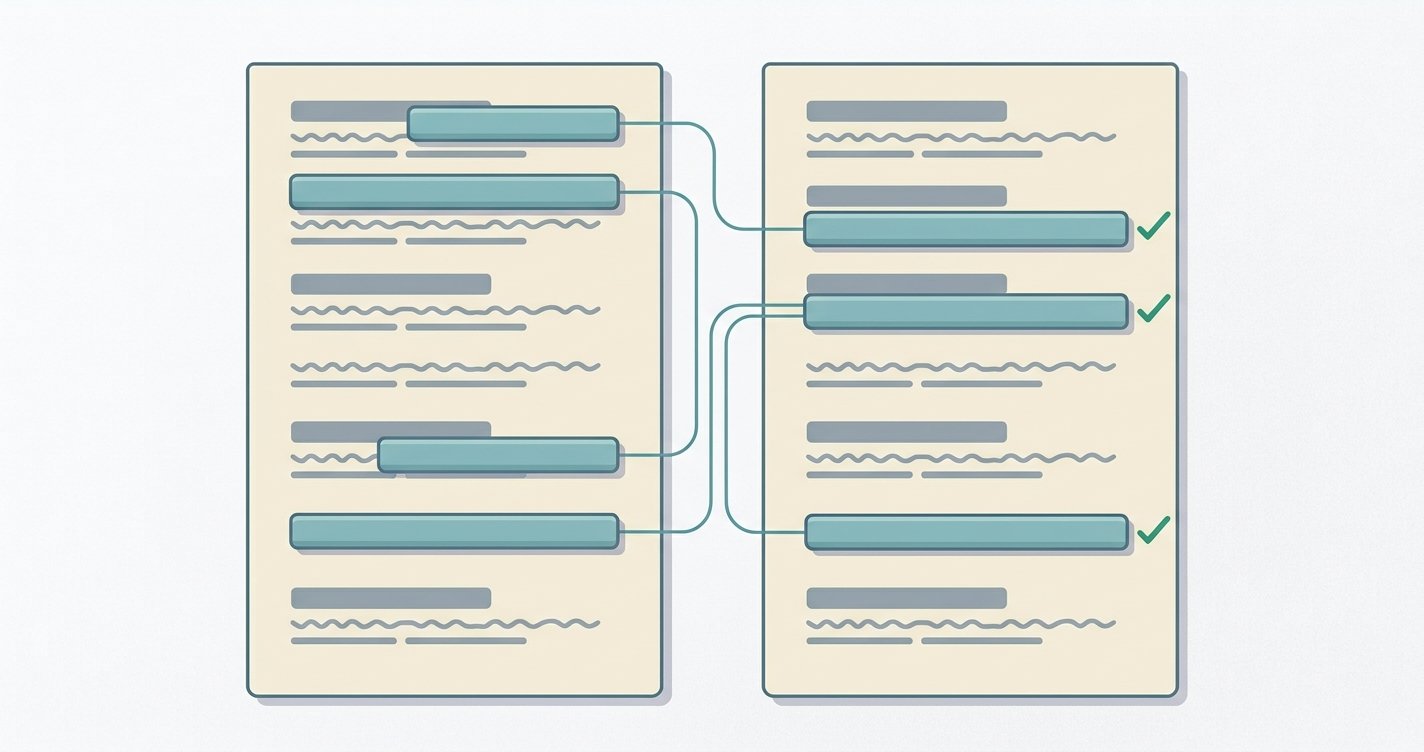
RWS’s API documentation gives the clearest definition. A CM is given when the current segment is identical to one in the TM and is preceded by the same segment as in another document translated before. That preceding segment must also have the same translation.
Context Match vs 100% Match
A community reply by Jerzy Czopik describes the difference this way:
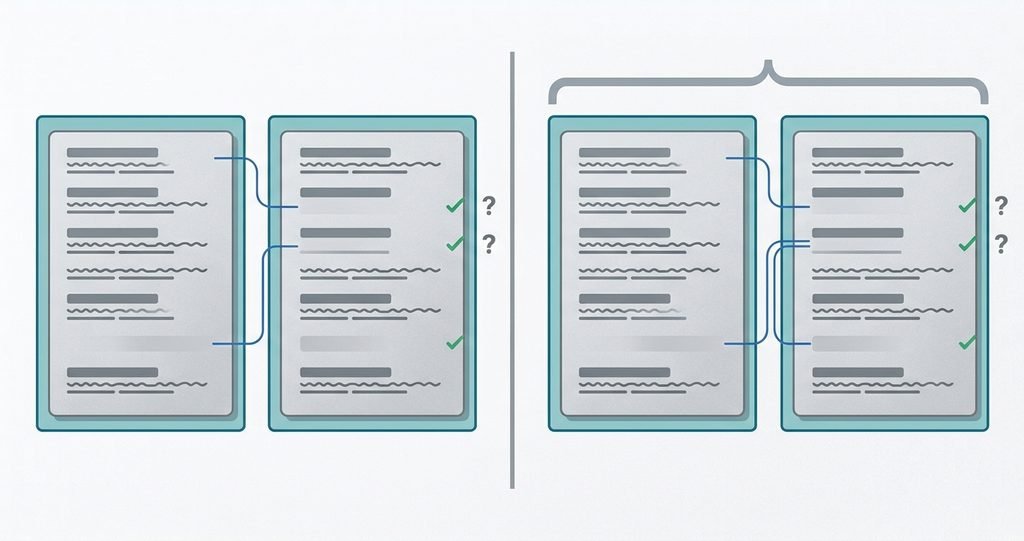
- 100% match: the document segment and the TM segment are identical, with no further conditions.
- Context match: the segment is identical, the document structure level matches and the previous source segment is the same with the same translation.
A second thread adds that when a TM holds several translations of one source sentence, a CM can help choose the right one by comparing neighboring segments and structure, such as a heading or a list item.
Where Sources Disagree on the Rules
Community threads don’t all say the same thing:
- Direction. A reply in an older thread, written for Studio 2015, says the context is “above only.” A newer reply describes neighboring segments before and after. I can’t say which is current.
- Penalties. One RWS reply says a penalty can stop a true exact match from showing as 100%, so two 99% results can still lead to a CM.
- PerfectMatch. Czopik first described it as a surrounding-segment match, and RWS’s Paul Filkin corrected that. He said it compares the file with an earlier version of the same document and needs a Professional license. It is a different feature.
None of these threads gives a formal algorithm, and one links to a 2013 article its own author says may be outdated. Check your own version’s help.
The Term in AI Search and Chatbots
A Chatboq article by Kevin Tan, dated June 19, 2026, calls context match “an approach” for judging relevance by context, intent and meaning. It says the idea appears in translation, search, chatbots and recommendations.
The page cites no outside sources or studies, ends with calls to action for Chatboq’s own product and asserts how big platforms work without references. Its description of translation matches is specific and fits RWS’s definition, but I’d treat its other claims as the vendor’s view.
The Term in Keyman
Keyman’s developer reference lists contextMatch (KCM) as a deprecated KeymanWeb function. It returns true if the text to the left of the caret matches a given value, which lets a rule such as “a” followed by an apostrophe produce an accented letter. For version 10.0 and later, the page recommends fullContextMatch() instead.
This has nothing to do with translation matches. It shares a name only.
5 Costly Context Match Errors to Avoid
- Assuming a CM is a 100% match. The definitions differ, and the RWS threads show cases where they appear differently.
- Mixing it up with PerfectMatch. A Professional license feature that compares document versions is a separate tool.
- Trusting one forum reply for every version. The “above only” answer was about Studio 2015.
- Assuming a price. I found no source on how agencies price a context match, so ask your client or agency in writing.
- Copying vendor claims. A page that gives a “framework” with no source is an opinion.
What Is Verified and What Is Not
| Claim | Status |
|---|---|
| A CM is identical to a TM segment and has the same preceding segment | Stated in RWS API documentation |
| CM is more reliable than an exact match | Stated there |
| Document structure level matters | Stated by a community reply |
| Context is checked “above only” | One older thread, Studio 2015 |
| Neighbors before and after are compared | One newer community reply |
| A formal CM scoring algorithm | Not found |
| Typical pay rates for context matches | Not found |
| Keyman’s KCM is deprecated | Stated on Keyman’s page |
| The AI-search claims on vendor blogs | Unsourced |
How to Check a Technical Term
- Name the field first. The same phrase can mean different things in translation, search and code.
- Read the vendor’s own documentation. RWS and Keyman pages beat blog summaries.
- Check the product version. Behavior can change between releases.
- Look for official staff answers in forums and note when a reply is a user’s guess.
- Test with a small file before relying on a rule.
- Use the same steps elsewhere. We apply them in our guides to active system console, brand name normalization rules and aicot.
Frequently Asked Questions
What is a context match? In translation memory tools, an exact match whose preceding segment also matches an earlier document.
Is it better than a 100% match? RWS calls it more reliable than an exact match, but it is not a different score scale in every tool.
What is the difference between context match and PerfectMatch? PerfectMatch compares a file with an earlier version of the document and is a Professional license feature, per an RWS reply.
Does Trados check segments before or after? Sources differ. An older thread says above only, and a newer one mentions both sides.
Is it used in AI? Some articles use the phrase for relevance by meaning and intent. The one I read cites no sources.
What is contextMatch in Keyman? A deprecated function that checks text to the left of the caret. Use fullContextMatch() from version 10.0.
How much is a context match paid? I found no source. Ask your agency or client.
Where should I check the exact rules? Your version’s Trados help or the RWS documentation.
Bottom Line
Context match is a field-specific term. In translation memory, it is an exact match confirmed by the preceding segment, with the clearest definition in RWS’s API documentation. Community threads disagree on details such as direction and penalties, and AI-search blogs add little that is sourced. Name your field, check your product’s version and treat forum answers as hints until the vendor’s help confirms them.