Fascisterne Meaning: 7 Proven Facts and Misleading Claims
Fascisterne is the Danish word for “the fascists,” and the history behind it is more specific, and more disputed, than the short web pages that rank for it suggest. The word itself is plain grammar. The confusion starts when pages treat it as the name of a single 1930s Danish group, because the sources I could check point to a different organization.
This guide explains the word, where “fascist” comes from, what historians mean by fascism, what the Danish interwar record shows and which claims on competing pages I could not verify.
A note on method: I read Lex.dk’s entries on fascisme and on the Danish Nazi party, Videnskab.dk’s “Hvad er fascisme?”, Store norske leksikon’s entry on fascism, a Danish journal article on the Danish Nazi party, the English Wikipedia page on Cay Lembcke and two web pages that use the word as a topic. Some sources are in Danish or Norwegian, and the translations are mine. I did not review archival records, and I am not a historian.
What Does Fascisterne Mean?
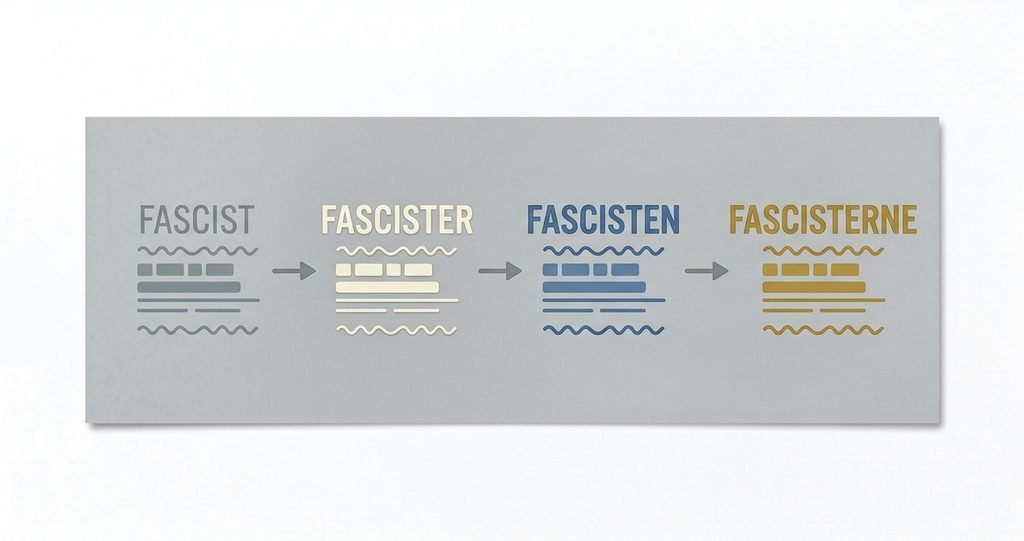
Fascisterne is the definite plural of the Danish noun “fascist,” so it means “the fascists.” One page I read confirms this, and the form follows ordinary Danish noun endings. That grammar point is general knowledge, not something I checked in a Danish grammar.
| Danish form | English meaning |
|---|---|
| fascist | a fascist |
| fascister | fascists |
| fascisten | the fascist |
| fascisterne | the fascists |
| fascisme | fascism |
| fascistisk | fascist (adjective) |
So fascisterne is a word, not a proper name. In a Danish sentence it can refer to Italian fascists, to a political movement’s members or, as a label, to opponents someone dislikes.
Where the Word Fascisterne Comes From
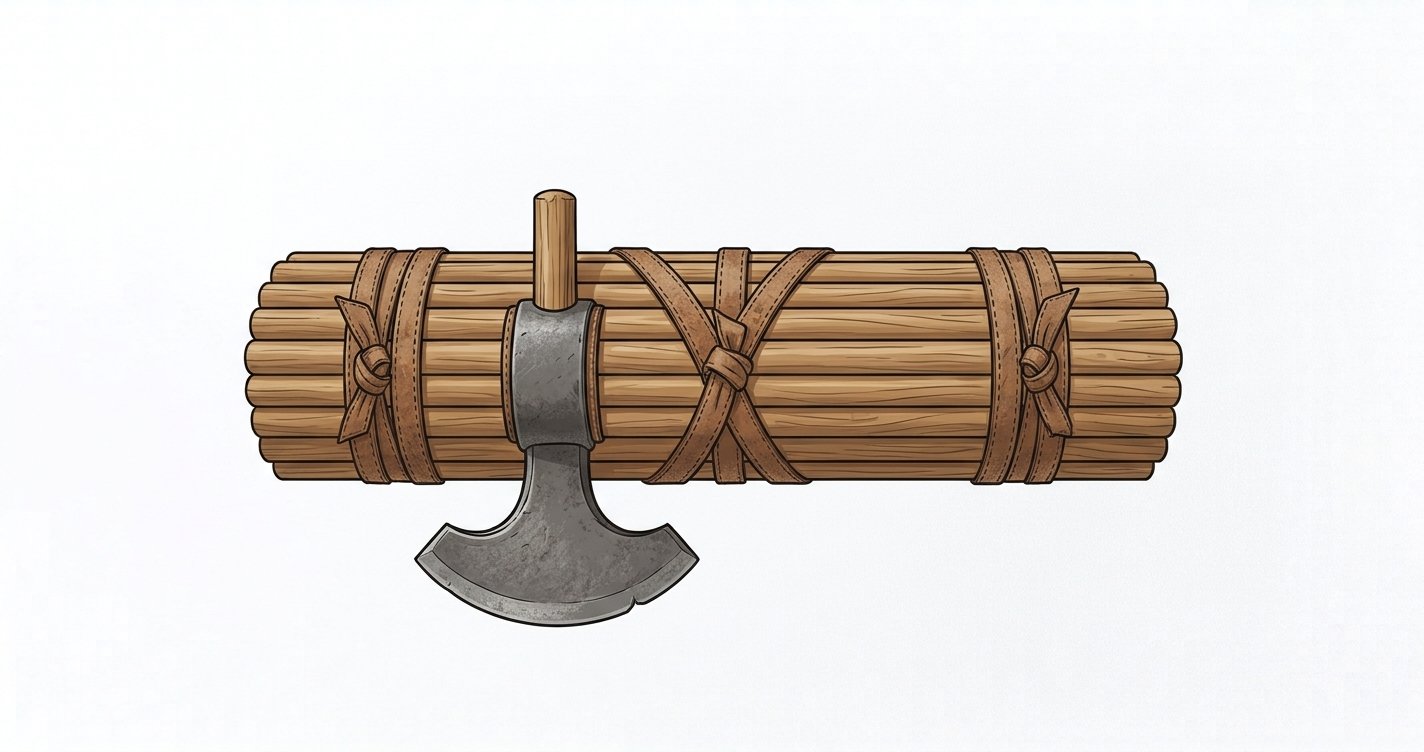
Lex.dk says “fascism” comes from the Italian fascismo, which comes from fascio, meaning “bundle,” which in turn comes from the Latin fasces. In ancient Rome, the fasces were a sign of power and strength, and Italian fascism used them as a symbol. Store norske leksikon describes the fasces as a bundle of rods with an axe in the middle, carried by officials as a symbol of authority and unity.
Italy, 1919 to 1945
The sources give this outline:
- 23 March 1919: Benito Mussolini founded the movement in Milan as I fasci di combattimento, mainly drawing war veterans (Lex.dk).
- October 1922: the Partito Nazionale Fascista (PNF) and fascists entered government after the March on Rome of 28 October (Lex.dk).
- From 1925: the fascists monopolized power and built an authoritarian dictatorship with the PNF as the only permitted party.
- 1943: Mussolini was deposed by the Fascist Grand Council and the PNF was dissolved.
- Spring 1945: the Salò Republic, supported by German forces, fell.
Store norske leksikon says fascism in the narrow sense refers to Mussolini’s movement, which held power from 1922 to 1943. Lex.dk and Store norske leksikon differ slightly on the name of the party’s early stages, which is why I give only the 1919 and 1922 dates both agree on.
What Historians Mean by Fascism, the Idea Behind Fascisterne
Lex.dk calls fascism a nationalist, antidemocratic and antisocialist political movement that used activist and violent methods. Videnskab.dk, by the same author, lists these features:
- The total state (lo stato totale), where individual and class interests were subordinate to the state, summed up in the motto “Nothing above, nothing beside, nothing outside the state.”
- The nation as an organism competing with other nations, with war seen as natural and the highest expression of the nation.
- Corporatism, where unions and employers were to cooperate under the state.
- Imperial ambitions, which Lex.dk links to a war of conquest in Africa from 1934.
Store norske leksikon adds hostility to democracy and human rights, a cult of strong leaders and a masculinity centered on violence and militarism.
Fascism and Nazism
The sources treat the two as related but not identical. Lex.dk says contemporaries, including the German SPD and KPD, saw Nazism as a German form of fascism, and the Nazis at first admired the Italians. Until 1933 the movements shared a similar style. But Nazism’s racism and antisemitism set it apart, and once in power its regime made racism its core ideology, aimed at a racially pure “Volksgemeinschaft.” Lex.dk adds that scholars debate whether all these movements fit under one concept.
A Disputed Label
Videnskab.dk lists movements contemporaries called fascist, including the British Union of Fascists, the Croix-de-Feu in France, the Falange in Spain, the Iron Guard in Romania, the Ustaša in Croatia and Austria’s Heimwehr. In the Nordic countries, it says only Finland’s Lapua movement became significant. An attempt at a “fascist international” in Montreux in 1934 failed, largely because of the movements’ nationalism.
Fascisterne in Danish History: What the Sources Show
Here the popular pages and the sources I could check part ways.
One web page treats Fascisterne as a 1930s Danish group founded in 1931 by former army officer Cay Lembcke, with a newspaper called Fascisten and under 0.2% of the vote in 1932. The page cites no sources. I could not confirm a group by that name, and the sources I read describe Lembcke’s organization differently.
What Lex.dk and Others Say
Lex.dk says the Danmarks Nationalsocialistiske Arbejderparti (DNSAP), the Danish Nazi party, was founded on 16 November 1930 by Cay Lembcke (1885–1965). English Wikipedia says the same date and calls him the party’s first leader. A Danish journal article says it was founded in Copenhagen in November 1930, under the influence of Nazi gains in Germany.
So the founding year and name differ from the web page’s claim:
| Detail | Unsourced web page | Lex.dk and other sources |
|---|---|---|
| Group name | Fascisterne | Danmarks Nationalsocialistiske Arbejderparti (DNSAP) |
| Founded | 1931 | 16 November 1930 |
| Founder | Cay Lembcke | Cay Lembcke |
| Ideology | Italian fascist influence | Copy of Germany’s NSDAP |
I am not saying no other Danish group called fascisterne existed. I am saying the group the page describes isn’t the one the sources I read describe, and the page gives nothing to check.
The Party’s Path
From Lex.dk and the Danish journal article:
- 1933: Frits Clausen replaced Lembcke as leader in July. English Wikipedia says Lembcke was replaced after a disappointing 1932 election result, though I found no vote figure.
- Ideology: Lex.dk calls the party a copy of the German NSDAP in organization (the leader principle), symbols (the swastika) and program, which combined “folkefællesskab” with racial theory and antisemitism.
- 1933 uniform ban: the journal article says Denmark banned political uniforms from April 1933.
- Rallies: annual national rallies from 1934 to 1939, modeled on the Nuremberg rallies.
- Membership: about 5,000 in 1939 and about 21,500 in early 1943 (Lex.dk).
- Elections: Lex.dk says the party won three seats in the Folketing in 1939 and three again in March 1943. The journal article says it never won parliamentary influence, so the sources differ on how to describe its representation. I rely on Lex.dk for the seat counts.
- Occupation: the party hoped to take power with German help but lacked popular support, according to Lex.dk. The journal article says the Germans did not back a takeover in 1940, and that the party recruited several thousand young men for the German Eastern Front, including the Frikorps Danmark unit.
- After 1945: the journal article says many members were interned and that no other Danish party had as many members convicted of harmful activity against the nation.
Fascist Sympathies Beyond DNSAP
The same journal article says some Danish conservatives promoted Italian fascism and that a wing of the youth organization Konservativ Ungdom imitated fascist marches and dress. That means “Danish fascism” in the interwar years wasn’t only one party. I did not research those groups beyond this article.
How the Word Fascisterne Is Used Today
Videnskab.dk’s author says “fascist” is increasingly used as an insult and a label for political opponents. He warns that overusing it is risky, paraphrasing the “wolf is coming” proverb, and argues it should be limited to movements that actually profess fascist ideology. He suggests that “authoritarian” or “dictatorial” more precisely describes many modern leaders.
Store norske leksikon says the broader use is debated and not widely accepted. It notes some draw on Umberto Eco’s 1995 essay on “eternal fascism,” which lists 14 internally contradictory traits. Critics say such a wide definition makes the term too vague.
I am not taking a side on who deserves the label today. The useful point for a reader is that the word has a narrow historical meaning and a broad, disputed everyday one, and that sources should say which they mean.
A Note on Present-Day Politics
Lex.dk says Italy’s Fratelli d’Italia, which it describes as inspired by neofascism, became the largest party in 2022, and that its leader, who leads the government, does not describe herself as a fascist but openly admires Mussolini. I include this only because the source does. Others may describe it differently, and I did not check other views.
What the Top Pages for This Keyword Show
I read two pages that use the word as a topic. They are not scholarly sources, and I describe only what is visible on them:
| Page | What it shows |
|---|---|
| Speculative Chic | A 9-minute article dated October 24, 2025 with no citations, no named historical author and an author bio about AI. It gives two founding dates for the Danish Nazi party (1933 and 1930) and a conclusion that miscounts the word’s mentions. Its numbers, such as the 1932 vote share, have no source |
| Gorod.it.com | A tag page with one cut-off excerpt, no author, no sources and a noindex tag. Its recent posts are unrelated, such as an Everest tour |
Neither page about fascisterne helps you verify a claim. If you need history, go to a national encyclopedia or a university historian.
Common Mistakes About Fascisterne
- Treating it as a proper name. It is a grammatical form, “the fascists.”
- Assuming it means one Danish group. The sources I read describe the Danish Nazi party, not a group called Fascisterne.
- Mixing up fascism and Nazism. The sources treat them as related but different, mainly because of Nazism’s racial ideology.
- Using it as a general insult without saying what you mean, which one historian warns against.
- Trusting unsourced pages for dates, vote shares and membership figures.
How to Research a Term Like Fascisterne
- Break fascisterne into parts. Here that gives fascist, plural, definite ending.
- Check a national encyclopedia first, such as Lex.dk for Denmark or Store norske leksikon for Norway.
- Compare at least two sources. The Danish party’s seat count differs in how it is described.
- Look for dates and numbers with a named source. A page that gives a vote share without a citation is a lead, not a fact.
- Check who wrote it. A history page by an AI-topic author deserves a second look.
- Translate carefully. I translated Danish and Norwegian passages myself, so confirm anything important in the original.
- See how we apply this elsewhere. Our guides to arreed, comerlin and infiltrasjon use the same checks, and our brand name normalization rules show how we handle naming.
What Is Verified and What Is Not
| Claim | Status |
|---|---|
| Fascisterne means “the fascists” in Danish | Stated by one page; matches ordinary Danish endings (general knowledge) |
| “Fascism” comes from fascio and the Latin fasces | Stated by Lex.dk and Store norske leksikon |
| Mussolini founded the movement on 23 March 1919 | Stated by Lex.dk |
| Fascists entered Italian government in October 1922 | Stated by Lex.dk |
| DNSAP was founded on 16 November 1930 by Cay Lembcke | Stated by Lex.dk, Wikipedia and a Danish journal article |
| Frits Clausen replaced him in July 1933 | Stated by Lex.dk and Wikipedia |
| DNSAP had about 5,000 members in 1939 and about 21,500 in 1943 | Stated by Lex.dk |
| DNSAP won three seats in 1939 and three in 1943 | Stated by Lex.dk; another article says it never won parliamentary influence |
| A group named Fascisterne was founded in 1931 | Unverified; one unsourced page |
| It won under 0.2% of the vote in 1932 | Unverified; no source |
| 1932 vote figures for DNSAP | Not found |
| Scholars agree on one definition of fascism | No; Lex.dk says scholars debate the concept |
Frequently Asked Questions
What does fascisterne mean? It is Danish for “the fascists,” the definite plural of “fascist.”
Is Fascisterne the name of a Danish party? I could not verify that. The Danish party I found sources for was the DNSAP, a Nazi party founded in 1930.
Who founded the Danish Nazi party? Cay Lembcke, on 16 November 1930, according to Lex.dk and Wikipedia.
Who replaced him as leader? Frits Clausen, in July 1933.
What does fascism mean? Lex.dk calls it a nationalist, antidemocratic and antisocialist movement that used violent methods, begun by Mussolini in 1919.
Where does the word fascism come from? From the Italian fascio, “bundle,” which comes from the Latin fasces, a bundle of rods that symbolized authority.
Is Nazism the same as fascism, or as fascisterne? The sources call them related but different. Nazism was defined by racism and antisemitism, according to Lex.dk.
How many members did the Danish Nazi party, not fascisterne, have? About 5,000 in 1939 and about 21,500 in early 1943, according to Lex.dk.
Is fascisterne or “fascist” still used today? Yes, but one Danish historian says it is increasingly used as an insult and should be limited to movements that profess fascist ideology.
Why do web pages disagree about fascisterne as a Danish group? Some give no sources and conflict with national encyclopedias, so they should be treated as unverified.
Bottom Line
Fascisterne means “the fascists” in Danish, a plain grammatical form that comes from the Italian fascio and the Latin fasces. The Danish interwar record I could verify centers on the DNSAP, a Nazi party founded in 1930, not on a group called Fascisterne, and the pages that claim otherwise give no sources. Use national encyclopedias for dates and numbers, separate fascism from Nazism, and be careful with the word as a modern label.