Good Afternoon: When to Say It, How to Write It, and What to Say Instead
It’s 11:58 a.m., your cursor is blinking in a new email, and you’re stuck on the first two words. If you hit send in two minutes, is it still “good morning”? And if the person reading it is three time zones away, does either greeting even make sense?
“Good afternoon” looks like the simplest phrase in English, yet it trips up native speakers and learners alike. This guide covers when the switch happens, how to capitalize and punctuate it, how to use it in emails and texts, and what to say when it doesn’t fit.
What “Good Afternoon” Means
“Good afternoon” is a standard greeting used in the hours after midday. Vocabulary.com defines it as a conventional expression of greeting or farewell, and lists afternoon as a synonym and good afternoons as the plural, according to its dictionary entry. In everyday American English it is used almost entirely as a greeting. Using it as a goodbye is far less common, though it does turn up in formal settings and some regional speech.
The phrase is built from after and noon. Noon itself has an interesting past: it comes from the Latin word for the ninth hour of the day, roughly 3 p.m., and slid earlier to mean midday over the centuries. Today it simply means 12 p.m., and “afternoon” is what comes after it.
What Time Does “Good Afternoon” Start and End?
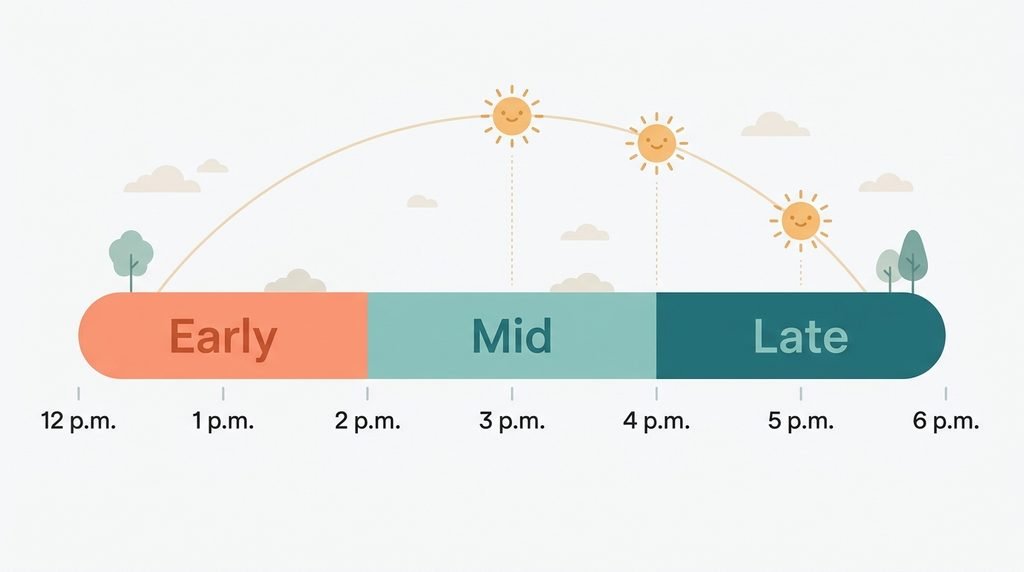
There is no legal or official rule, but the convention is very consistent:
- Starts at 12:00 p.m. (noon). Before that, say “good morning.”
- Ends around 5 or 6 p.m. After that, “good evening” takes over, especially for dinner plans or after the workday ends.
Quillbot’s guide to the afternoon puts the start at 12 p.m. and the end at about 5 or 6 p.m., and it adds a useful point: these boundaries are not precise, so when you are making plans, give an exact time, according to its explainer on what time afternoon is.
The same source breaks the afternoon into three sub-periods:
| Period | Approximate time |
|---|---|
| Early afternoon | 12 p.m. to about 3 p.m. |
| Midafternoon | About 3 p.m. to 4 p.m. |
| Late afternoon | About 4 p.m. to 6 p.m. |
Is 12:00 p.m. Afternoon or Morning?
Twelve p.m. is noon, and “p.m.” stands for post meridiem (“after midday”). So 12:01 p.m. is afternoon. At exactly 12:00 p.m., many people still say “good afternoon,” and nobody will mind either way. The one real rule is to avoid “good morning” after noon.
What About “Good Afternoon” at 5 or 6 p.m.?
This is the gray zone. If you are meeting for dinner or the person has finished work, “good evening” feels more natural. If they are still at work in daylight, “good afternoon” works fine. When in doubt, follow the other person’s lead.
How to Capitalize and Punctuate “Good Afternoon”
Style guides do not fully agree here, so the safest approach is to follow a few simple patterns:
- Start of a sentence or message: capitalize the first word. Good afternoon. The report is ready.
- With a name: put a comma before the name. Good afternoon, Paula. The second word is usually lowercase in modern writing.
- Email salutation: both Good afternoon, team, and Good Afternoon, team, appear in practice. Grammarly’s guidance treats a salutation as something to capitalize, as covered in its article on capitalizing “good morning”, while Quillbot notes that a casual greeting with a name, such as “Good afternoon, Paula,” is not fully capitalized. Pick one style and use it consistently.
- Mid-sentence: use lowercase. I hope you have a good afternoon. She wished us a good afternoon.
Ending a message with “Have a good afternoon” is fine in lowercase. Using the bare phrase “Good afternoon” as a sign-off is considered old-fashioned, so it’s usually better avoided.
How to Use “Good Afternoon” in Emails
In professional writing, the greeting sets the tone before the reader reaches your point. A few practical habits help:
- Match the greeting to when your reader will see it, not when you wrote it. If you write at 9 a.m. but the person will read it after lunch, “Hello” or “Hi” is safer.
- Use a neutral greeting across time zones. “Hello, Sam,” never goes wrong.
- Keep it formal when the relationship calls for it. “Good afternoon, Dr. Patel,” is more formal than “Hi Dr. Patel,”.
- Don’t pair it with “Dear” unless the context is very formal. “Dear Ms. Lee, good afternoon.” sounds stiff in most modern emails.
Example email openings:
- Good afternoon, Ms. Rivera, I’m following up on Tuesday’s proposal.
- Good afternoon, everyone. Here is the agenda for today’s meeting.
- Good afternoon, thank you for contacting support. How can I help?
“Good Afternoon” in Texts and Messages
In casual chat, the phrase is often shortened or swapped for something warmer. Some ideas by tone:
Friendly and short
- Good afternoon! Hope your day is going well.
- Good afternoon. Lunch break yet?
Warm for family or close friends
- Good afternoon! Thinking of you today.
- Hope your afternoon is bright and easy.
Professional but kind
- Good afternoon, I hope your week is off to a good start.
- Good afternoon. Thank you for your help earlier today.
Encouragement to a coworker
- Good afternoon! You’re past the midpoint of the day, so keep going.
Keep greetings genuine. A short, specific line almost always lands better than a generic quote.
What to Say Instead of “Good Afternoon”
Sometimes the phrase doesn’t fit, whether because of time zones, tone, or personal style. Common alternatives:
| Situation | Better choice |
|---|---|
| Unknown time zone | Hello / Hi |
| Very casual chat | Hey / Hey there |
| Late afternoon, end of workday | Good evening |
| Group of colleagues | Hi everyone / Hello team |
| Customer service | Thank you for contacting us |
| Phone call | Hello, this is [name] |
“Good Afternoon” in Other Languages
If you are greeting someone abroad, here are common equivalents:
- Spanish: Buenas tardes
- Portuguese: Boa tarde
- Italian: Buon pomeriggio (many Italians also keep saying buongiorno well into the afternoon)
- French: Bon après-midi (most people just say bonjour until the evening)
- German: Guten Tag (the usual daytime greeting; Guten Nachmittag exists but is less common)
Notice that some languages simply use one all-day greeting. That is a good reminder that English’s strict morning, afternoon, and evening split is a convention, not a universal rule.
If you enjoy untangling words and greetings across languages, our guides to the Danish word sagerne and the Scandinavian-rooted serlig go deeper into how everyday vocabulary travels.
Common Mistakes to Avoid
- Saying “good morning” after noon. This is the most frequent slip, especially in emails read later.
- Writing “good afternoon” at the very end of a message as a sign-off without context. It can read as odd or dated.
- Capitalizing every word mid-sentence. Only capitalize at the start of a sentence or in a salutation.
- Ignoring time zones. A “good afternoon” at your 2 p.m. may land in someone’s midnight.
- Overusing it in text threads. In a continuing chat, you only need to greet once.
Frequently Asked Questions
What time is it okay to say good afternoon? From 12 p.m. until about 5 or 6 p.m., after which “good evening” is more natural.
Is good afternoon formal or informal? It works in both. It reads as polite and slightly formal, especially compared to “hey” or “hi.”
Is “good afternoon” capitalized? Capitalize the first word at the start of a sentence or message. Mid-sentence, use lowercase. In email salutations, both “Good afternoon” and “Good Afternoon” are seen, so be consistent.
Can I say good afternoon at 12 p.m.? Yes. Noon is the dividing line, and at 12:01 p.m. it is definitely afternoon.
Can “good afternoon” be used as a goodbye? Vocabulary.com lists it as both a greeting and a farewell, but in modern American English it is used almost only as a greeting.
What is the difference between “good afternoon” and “good evening”? Afternoon runs from noon to about 5 or 6 p.m. Evening starts after that and continues into the night.
How do I reply to “good afternoon”? Return the greeting and add a short follow-up: “Good afternoon! How are you?”
Bottom Line
“Good afternoon” is the standard greeting from noon until the early evening, roughly 12 p.m. to 5 or 6 p.m. Capitalize it at the start of a sentence, keep it lowercase mid-sentence, and when you are writing across time zones, fall back on a neutral “hello.” Small details like these are what make a greeting feel natural instead of automatic.