ABS Testauslösung: What It Means and How the ABS Test Works
If you have seen the German term ABS Testauslösung in a diagnostic menu, a workshop report, or a car forum, it simply means an ABS test has been triggered. “Testauslösung” translates as “test activation” or “triggering a test”, and in cars it means the anti-lock braking system is being checked — either by itself every time you start the car, or deliberately by a technician with a diagnostic scanner.
The short version is this: your car runs a small ABS self-test on every drive, and you usually notice it only as a brief clunk or a small pulse in the brake pedal. A workshop test goes further. With the car parked, a scan tool commands the ABS pump and valves to run so the technician can confirm they work, bleed air out of the system, or find out why the ABS warning light is on. Both kinds of test are normal. What is not normal is a warning light that stays on, a test that keeps repeating, or a pump that stays silent when it should run.
The Short Answer
ABS Testauslösung is the German name for triggering an ABS test. There are two kinds. The first is the automatic self-test your car runs at startup and at low speed, which checks the pump, the valves, and the wheel speed sensors. The second is a diagnostic actuator test, where a technician uses a scan tool to switch the ABS pump and solenoid valves on and off while the car is parked. The test confirms the hydraulic unit works, helps bleed trapped air out of the brakes after a repair, and helps find the cause of an ABS warning light. You should never try to trigger a moving test on a public road, and the diagnostic test itself is a workshop procedure for a qualified person.
What ABS Testauslösung Means
ABS stands for Anti-lock Braking System. In German it is called the Antiblockiersystem. “Test” means test, and “Auslösung” means triggering or activation. Put together, ABS Testauslösung means “ABS test activation”.
You will meet the term most often in German diagnostic software. Much factory diagnostic software for European cars was written in German, so menus in tools such as VCDS, ISTA, and Xentry use the German wording. When a technician selects ABS Testauslösung, the scan tool sends a command to the car’s ABS control module, and the module then runs the hydraulic pump and opens and closes the solenoid valves to prove they work.
It helps to know that the same words are also used for two completely different things. In mountaineering, ABS is the brand name of an avalanche airbag backpack, and its Testauslösung is the test firing of that airbag. In medicine, the FTA-ABS test is a blood test used to detect syphilis. This article is only about the car braking system, and the short section near the end explains the other meanings so you do not mix them up.
What ABS Does Before You Test It
To understand the test, it helps to know what the system does in normal driving. ABS exists to stop your wheels from locking when you brake hard. A locked wheel slides instead of rolling, and a sliding wheel gives you almost no steering control and often a longer stopping distance.
The system has four main parts:
- Wheel speed sensors. One sensor at each wheel measures how fast that wheel is turning, many times every second. Most modern cars use Hall-effect or magneto-resistive sensors that read a toothed tone ring on the wheel hub or axle.
- ABS control unit (ECU). This is the brain of the system. It compares the speeds of all four wheels and works out when one wheel is about to lock.
- Hydraulic control unit (HCU). This contains the electric pump motor, the solenoid valves, and the brake pressure channels. It raises or lowers the brake pressure at each wheel.
- Wiring, fuses, and relays. These connect the sensors, the control unit, and the hydraulic unit.
When you brake hard and a wheel starts to slow much faster than the others, the control unit predicts a lock-up. It closes the inlet valve to stop the pressure rising, and if needed it opens the outlet valve so the pressure falls and the wheel starts turning again. Then the pressure is restored. This build-hold-release cycle repeats around 15 to 20 times per second, which is why you feel a fast pulsing in the brake pedal during a real ABS stop. The diagnostic test electronically simulates this same hydraulic work while the car stays parked.
The Startup Self-Test: The Test Your Car Runs on Its Own
The test most drivers meet is the automatic one. Your car runs it on every drive, and it has two stages.
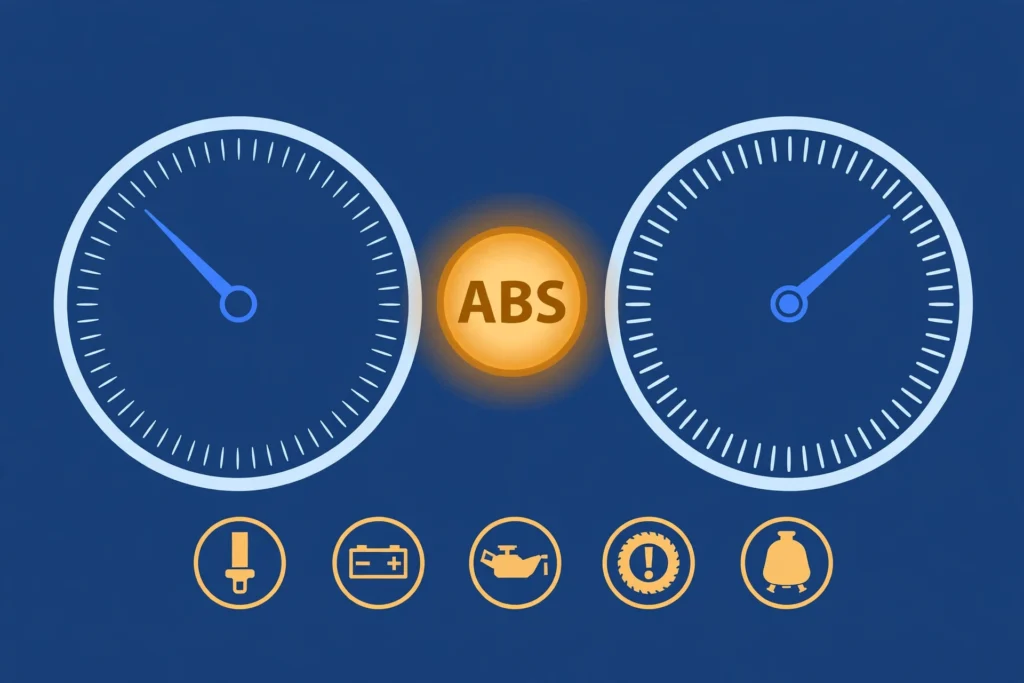
First comes the power-on self-test. When you switch the ignition on, the ABS warning light comes on for a few seconds — usually about 3 to 5 seconds — and then goes out. That light is partly a bulb check, and partly the control unit confirming it can talk to its components. During this stage the control unit checks the pump motor by briefly cycling it, sends electrical pulses to the inlet and outlet solenoid valves for each wheel, and checks that the wheel speed sensors are present and their wiring is intact.
Then comes the rolling check. Once you start moving at low speed, the system runs a second check. Nissan describes it in its owner’s manual this way: the computer tests the system each time you start the engine and move the vehicle at a low speed in forward or reverse. Volvo describes a short test automatically after the engine has started when the driver releases the brake pedal, and a further automatic test when the car reaches 10 km/h. Other makers use similar speeds, often around 4 to 12 miles per hour for this rolling check.
What you notice is small. You may hear a brief “clunk” or buzzing noise from the ABS pump, or feel a short pulse in the brake pedal. Both are normal. The Nissan manual states this directly: when the self-test occurs, you may hear a “clunk” noise and/or feel a pulsation in the brake pedal, and this is normal and does not indicate a malfunction.
What the self-test means depends on what the warning light does:
- The light comes on briefly, then goes out. The system passed its check. Everything is normal.
- The light stays on after startup, or comes on while you drive. The control unit found a fault and switched the ABS off. Your normal friction brakes still work, but you have no anti-lock assistance. Have the car checked soon.
- The light never comes on at all. The bulb or the warning circuit may be faulty, which means the check itself cannot warn you. That also needs attention.
One important point: the self-test only checks that the parts are present and respond electrically. Full verification of the wheel speed sensors only happens once the car is moving and the sensors produce real speed signals.
The Diagnostic Test: How a Workshop Triggers ABS Testauslösung
The second kind of test is the one the German term usually refers to in a workshop. It is an actuator test. Instead of waiting for an emergency stop to prove the ABS works, the technician commands the system to run while the car is stationary.
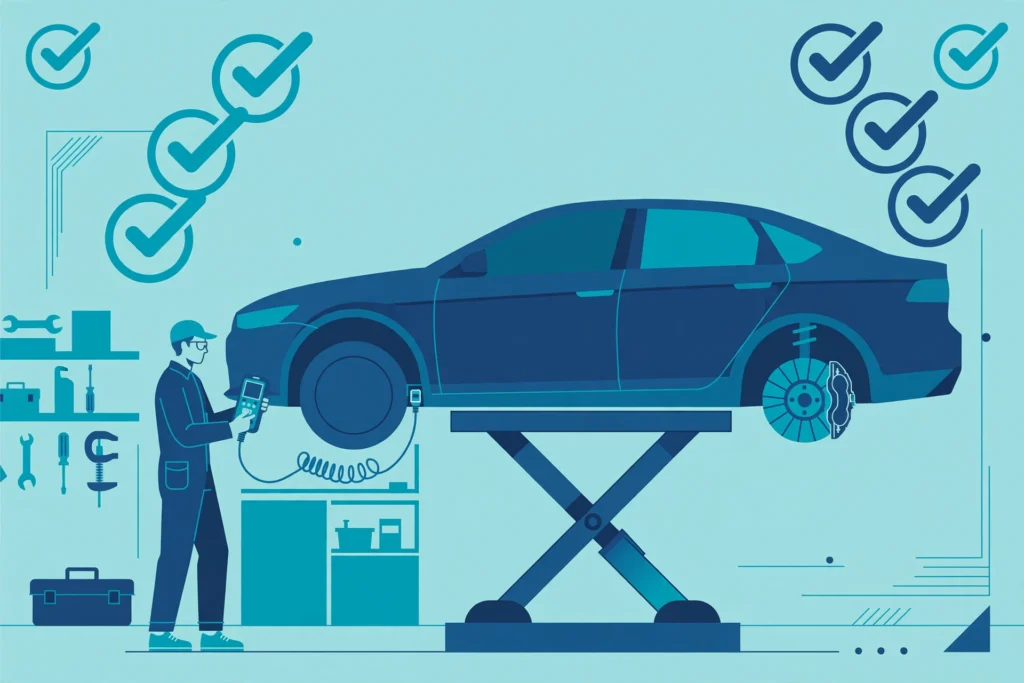
A basic OBD-II code reader is usually not enough for this. A standard reader can often only read engine codes, and ABS codes live in a separate control module. The test needs a scan tool that can talk to the ABS module and send it commands — a bidirectional scan tool. Common examples by brand are:
- Volkswagen and Audi: VCDS, ODIS, or OBDeleven
- BMW: ISTA, INPA, or Tool32
- Mercedes-Benz: Xentry, or the older DAS software
- Toyota and Lexus: Techstream, which includes an Air Bleeding Utility
- Most other brands: Autel, Launch, or Snap-on professional tools, or the maker’s own factory equipment
Technically, the scan tool talks to the ABS control module over the car’s communication network — usually the CAN bus on modern cars, or the older K-Line on earlier models. On newer cars using the UDS protocol (Unified Diagnostic Services), the scan tool asks the control unit for control of the hydraulic unit. Older cars using the KWP2000 protocol do the same job through a different set of commands. Either way, the result is the same: the tool can switch the pump motor and each solenoid valve on and off on command.
A real workshop example shows how exact this is. The factory procedure for a 1997 Volkswagen Passat, called Output Diagnostic Test Mode (Function 03), works like this. The car is raised until all four wheels are free to turn, and a second technician is needed to check each wheel by hand. The technician connects the VAG 1551 scan tool, switches the ignition on, and selects address word 03 for brake electronics, then function 03. The ABS hydraulic pump must run. The ABS warning light flashes twice per second and the brake system warning flashes four times per second while the test runs. The scan tool then steps through each wheel in turn: it activates the inlet valve, then the outlet valve, and the second technician confirms whether that wheel is locked or free. The pump starts and stops on command, and the brake pedal must drop slightly at the right steps and hold firm at others. At the end, both warning lights go out. If the ABS warning light does not go out, the system has a malfunction.
A general workshop flow follows the same pattern on most cars:
- Connect the scan tool and select the ABS module.
- Read the stored fault codes and write them down.
- Select the actuator test or brake bleeding function.
- Follow the on-screen steps exactly, opening the bleeder screw when the tool says so if bleeding is part of the job.
- Confirm the pump runs and each valve responds.
- Read the fault codes again to confirm nothing new appeared.
Ford’s own workshop manual gives a simpler version of the same idea: the technician uses the scan tool’s active commands to switch the ABS pump motor on, and checks that it runs for about two seconds. That short check is often enough to prove the pump circuit works.
What Happens During the Test
If you are standing next to the car while a technician runs the test, here is what you will notice.
First, you will hear the pump. It makes a steady buzzing sound, often described as a long “BRRRRR”, followed by rapid clicking as each solenoid valve opens and closes. Those sounds are a good sign. They mean the hydraulic unit is responding.
Second, the brake pedal may behave oddly. If the technician is pressing it, the pedal may drop slightly and then push back against the foot as the pump builds pressure. On some procedures the pedal must hold firm at certain steps and give perceptibly at others, and the technician checks both.
Third, the dashboard lights will do their test routine. During the VW procedure above, the ABS warning light flashes twice per second and the brake system warning flashes four times per second. When the test finishes normally, the lights go out.
What the technician is watching for is simple: the pump runs when commanded, each valve clicks, the pedal behaves as the procedure expects, and the scan tool reports each actuator responding. If one valve stays silent or the pump does not run, the hydraulic unit likely has an internal fault, and the technician has found the problem without hours of guessing.
When Is an ABS Test Needed?
Workshops do not run this test only when a warning light appears. There are several routine reasons to trigger it.
After bleeding the brakes. Modern hydraulic units trap air inside internal passages, and even pressure bleeding cannot always remove it. Running the test cycles the pump and valves, which lets hidden air bubbles escape. Without this step, the driver may notice a soft brake pedal, long pedal travel, or poor braking feel. Many Volkswagen, Audi, BMW, and Mercedes procedures specifically require ABS activation after hydraulic repairs.
After replacing an ABS module. A used or new module often needs coding and adaptation, then hydraulic bleeding, then the test. Skipping these steps commonly leaves a soft pedal or recurring fault codes.
When the ABS warning light is on. The technician activates each valve one at a time. If one valve fails to click or the pump stays silent, the hydraulic unit itself is the likely fault. That saves hours of unnecessary troubleshooting.
When the brake pedal feels soft after service. The test helps separate trapped air in the hydraulic unit from a faulty master cylinder, a failing ABS pump, or improper bleeding.
When checking wheel speed sensors. Some wheel bearings have integrated magnetic encoder rings. If one is fitted incorrectly, the wheel speed readings go wrong. During testing, the technician can watch live wheel-speed data. If one wheel reports zero speed while the others turn normally, the sensor or the encoder ring is the likely problem.
During a pre-purchase inspection. A two-minute actuator test can confirm the pump works, the valves operate, the control unit communicates, and no hidden electronic fault exists. That can prevent a very expensive surprise after buying a used car.
Safety Rules: Read This First
ABS testing is a workshop procedure, and brakes are safety-critical. These rules come first, before any test.
Keep the car stationary for the actuator test. Manufacturers prohibit actuator testing while the car is moving, because cycling hydraulic valves while driving can produce unpredictable braking. Most factory diagnostic software refuses to start the test if the car is moving at all, typically above about 3 km/h. A road test of ABS is a different thing, and it belongs only on a closed course or an empty, straight stretch of road, with a qualified driver, a seatbelt on, and no passengers.
Keep the battery voltage up. ABS pumps draw a lot of current. A weak battery can interrupt the test, cause communication errors, or set low-voltage fault codes. Voltage should stay above 12.4 volts, and many factory tools recommend about 13 volts throughout the procedure. Workshops normally connect a battery maintainer before starting.
Check the brake fluid level. Never let the reservoir run low. If the pump draws air into the system, bleeding becomes much harder. Check the level before, during, and after the test.
Do not run the pump continuously. ABS pump motors are built for short bursts. Running one continuously for more than about a minute can overheat it. A common workshop guideline is about 10 seconds of operation followed by 30 seconds of cooling.
Be careful around rotating wheels. When the car is raised on a lift, wheels can move unexpectedly during some actuator tests. Keep hands away from rotating parts, secure loose clothing, and make sure the car is safely supported.
Know that an old unit can fail during the test. Worn pump motors and sticking valves sometimes stop working the first time they are activated after a long rest. The test does not damage healthy parts. It reveals a weakness that was already there. Many repair shops warn customers about this before they start.
If you are not a qualified technician, do not attempt the diagnostic test yourself. Book a workshop. The safe checks you can do on your own are listed near the end of this article.
What a Failed Test Means
A passed test is easy to recognise: the pump runs, the valves click, the warning lights go out, and no fault codes come back. A failed test usually shows up in one of these ways: the pump stays silent, one or more valves do not click, the ABS light stays on, or the same fault codes return after clearing.
The most common causes, in the order a technician would normally check them, are:
- Dirty or failing wheel speed sensors. Each sensor reads a toothed tone ring as the wheel turns. Brake dust, metal shavings, and road grime can coat the sensor tip and produce erratic signals. Cleaning the sensor often fixes it.
- Damaged tone rings. The toothed ring can crack, bend, or rust, especially in areas where road salt is used. When it does, the sensor loses its reference points.
- Low battery voltage or a weak alternator. Voltage dips can trick the control unit into thinking a sensor has failed, so it runs repeated self-tests. With the engine off, a healthy battery reads about 12.4 to 12.6 volts. With the engine running, expect about 13.7 to 14.7 volts.
- A faulty brake light switch. This small switch above the brake pedal tells the system when you are braking. A worn or misaligned switch sends false signals.
- A pump motor fault. Typical fault codes include C0110 for the pump motor circuit, and on some Ford models C1095 and C1096 for pump motor circuit failure. If the scan tool commands the pump on and nothing happens, the pump, its relay, or its wiring is the likely fault.
- Wiring and communication faults. Corroded connectors, damaged harnesses in the wheel wells, and CAN bus communication errors can all stop the test.
- A failed ABS module. Internal solder cracks, bad capacitors, or water damage can kill the module. This is the expensive answer, so a good technician rules out every external cause first.
If your ABS light is on, the base brakes still work normally — you can stop the car — but the anti-lock function is off, so the wheels can lock in a hard stop or on a slippery road. Have it checked promptly, and drive with extra care in the meantime. Clearing the fault codes without fixing the cause does not help: the light will return within a few drive cycles.
ABS Testauslösung vs a Real ABS Activation
The two things sound similar, but they are different events. This table sums it up.
| Diagnostic test (Testauslösung) | Real ABS activation | |
|---|---|---|
| What triggers it | A scan tool command, or the startup self-test | Hard braking when a wheel is about to lock |
| Is the car moving? | No, parked and stationary | Yes, during braking |
| Purpose | Prove the pump and valves work, bleed air, find faults | Keep the wheels turning so you can steer |
| What you feel | Buzzing pump, clicking valves, small pedal movement | Fast pedal pulsing, about 15 to 20 times per second |
| How long it lasts | Seconds to a couple of minutes | A fraction of a second per cycle |
Two more facts are worth knowing. First, ABS normally does not intervene below about 10 to 15 km/h, by design — at very low speeds the system stays out of the way. Second, ABS does not always shorten your stopping distance. On gravel or snow, locked wheels can dig in and stop shorter, but you lose steering. ABS trades a little distance for control, and that trade is usually the right one.
The Same Words, Different Machines
Because the term is German, you may meet it outside the car world. In mountaineering, ABS is the brand name of an avalanche airbag backpack, and its Testauslösung is the test firing of the airbag after use or during a routine check, when the empty cartridge is replaced and the trigger handle gets a new seal. In medicine, the FTA-ABS test is a blood test that looks for antibodies linked to syphilis. Neither has anything to do with car brakes. If you searched for the term and landed on avalanche or medical pages, that is why — and the braking system meaning is the one this article covers.
How to Check Your ABS Yourself
There are a few safe checks any driver can do without special tools or training:
- Watch the light at startup. It should come on briefly, then go out. If it stays on, or never comes on, book a workshop.
- Listen at low speed. A short clunk or a small pedal pulse in the first few metres of driving is the normal self-test.
- Read the fault codes — with the right tool. A basic OBD-II reader often cannot reach ABS codes. You need a scanner that can access the ABS module. Note the codes and their descriptions before clearing anything.
- Check the battery voltage. With the engine off, expect about 12.4 to 12.6 volts. With the engine running, expect about 13.7 to 14.7 volts. Low readings point at the battery or the alternator, not the brakes.
- Look at the obvious things. Check the brake fluid level, look for damaged wiring near the wheels, and make sure all four tyres are the same size and correctly inflated. Mismatched tyre sizes can confuse the wheel speed readings.
Anything beyond that — opening brake lines, running actuator tests, replacing the hydraulic unit — belongs to a qualified technician with the right diagnostic tool and the manufacturer’s procedure.
Frequently Asked Questions
Is the clunk or pedal pulse at startup normal?
Yes. The self-test cycles the pump and valves once, and you hear a short clunk or feel a small pulse. It is normal and does not mean anything is broken.
Can I trigger an ABS test myself?
The startup self-test happens on its own. The diagnostic actuator test needs a bidirectional scan tool that can command the ABS module, and it is a workshop procedure. Do not try road tests on public roads, and never trigger actuator tests while the car is moving.
Is it safe to drive with the ABS warning light on?
Your normal brakes still work, but the anti-lock function is off, so the wheels can lock during hard braking or on slippery roads. Drive carefully and have it checked promptly.
Why does the ABS test keep triggering again and again?
Repeated self-tests usually point to a dirty or failing wheel speed sensor, a damaged tone ring, low battery voltage, or a faulty brake light switch. Read the fault codes with an ABS-capable scanner and check the battery voltage first.
Does ABS always shorten my stopping distance?
No. On dry roads it usually helps, but on gravel or snow a locked wheel can sometimes stop shorter. ABS is designed to keep the wheels turning so you can steer, and that control matters more than a small difference in distance.
What does Testauslösung mean in English?
It means “test activation” or “triggering a test”. In car diagnostics it means deliberately activating the ABS pump and valves to verify the system works.
How long does a workshop ABS test take?
The actuator test itself usually takes only a few minutes. Reading the fault codes and checking the results takes a little longer, so a full ABS check is normally a short workshop job.
Bottom Line
ABS Testauslösung is simply the German name for triggering an ABS test, and it covers two things you should know about. The first is the automatic self-test your car runs at startup and at low speed — a brief light, a clunk, a small pedal pulse — which is completely normal. The second is the diagnostic test a technician triggers with a scan tool while the car is parked, which proves the pump and valves work, clears trapped air after brake work, and finds the cause of a warning light. If your ABS light stays on, your normal brakes still work, but you have lost the anti-lock safety net, so get the car checked promptly. And if you ever need the diagnostic test itself, leave it to a qualified workshop: it is a short, safe procedure in trained hands, and brakes are not the place to learn by trial and error.