Dough Moulding Compound (DMC): What It Is, What It Is Made Of, and Where It Is Used
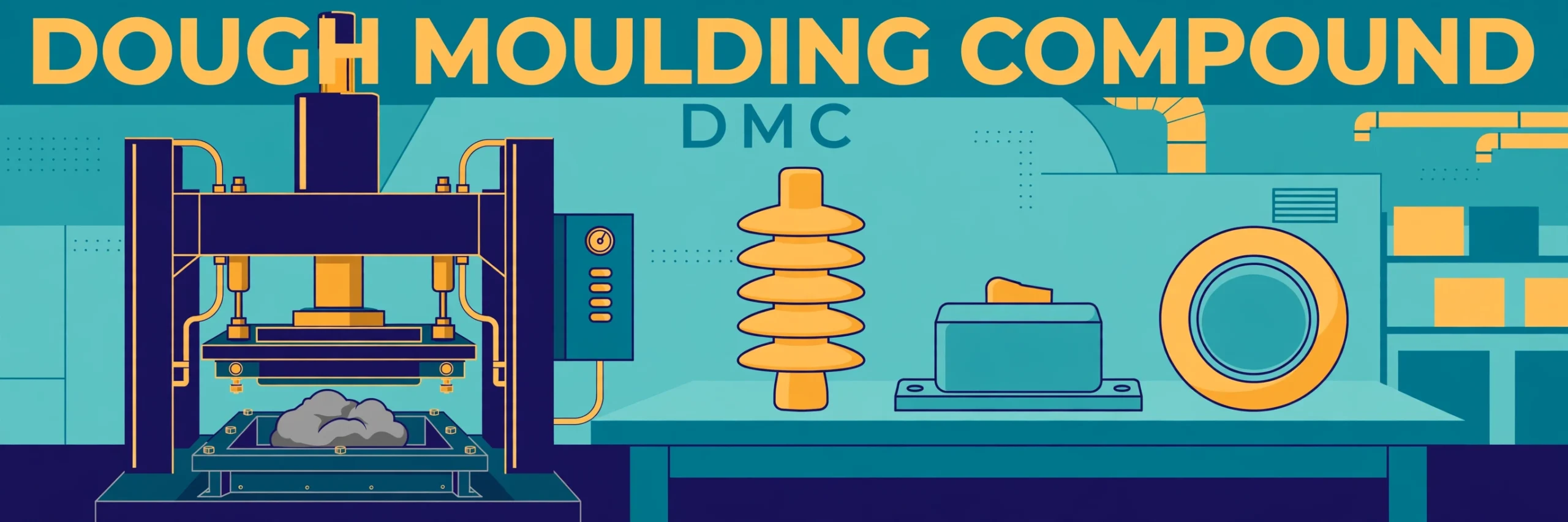
Dough moulding compound, usually shortened to DMC, is a dough-like material that factories press into hard, heat-resistant plastic parts. If you have ever opened a circuit breaker, a meter box or an old car headlight, there is a good chance the rigid housing inside was made from it. Before it is moulded it looks and feels like stiff modelling clay, and it comes out of the mould as a solid part that keeps its shape under heat, carries no electric current, and does not melt when things get hot.
This article explains what dough moulding compound is, what it is made of, its key properties, how it is moulded, where it is used, and how it compares with its close relatives, sheet moulding compound (SMC) and bulk moulding compound (BMC). The figures in this article come from published material guides and standards, and any number that belongs to one specific grade is labelled as such, because DMC is a family of formulations, not a single fixed recipe.
The Short Answer
Dough moulding compound is an uncured, dough-like thermoset compound made mainly from unsaturated polyester resin, chopped glass fibre, mineral filler and small amounts of additives such as a catalyst, a release agent and pigment. It is shaped by compression moulding, transfer moulding or injection moulding in a heated mould, where heat cures it into a hard, rigid part. Its main strengths are electrical insulation, heat resistance, dimensional stability and the ability to form complex shapes with metal inserts in a single step. It is used mostly for electrical components, car parts and appliance housings. In many markets it is sold under the same name as bulk moulding compound (BMC), and the two terms are often used interchangeably in trade, though a buyer should always check the exact grade specification before assuming they are identical.
What Is Dough Moulding Compound?
Dough moulding compound is a ready-to-mould composite material. It is a thermoset, which means it hardens permanently when it is heated in the mould. Unlike a thermoplastic, which softens again every time you heat it, a cured DMC part cannot be melted and reshaped. That one fact explains most of its uses: it is chosen where a part must stay rigid and insulating at temperatures that would soften ordinary plastic.
The material arrives at the factory as a soft, sticky, putty-like mass. Workers weigh out a measured lump, called a charge, place it in a heated mould, and close the mould under pressure. The heat first softens the dough so it flows into every corner of the mould, and then it cures the resin, turning the dough into a hard solid. The whole cycle usually takes about two to three minutes for a compression-moulded part.
DMC was first used in West Germany and the United Kingdom in the 1960s, and it developed greatly in the United States and Japan in the 1970s and 1980s. Today it is a standard material for electrical insulation parts and small, detailed mouldings, and it has largely replaced glass and ceramics in many insulating applications.
You may also see the same material called bulk moulding compound, or BMC. The two names describe the same kind of product in most trade usage: a dough-like bulk charge of resin, fibre and filler. The current standard ISO 8606:2025 treats BMC and DMC as types of preimpregnated moulding product. Even so, suppliers do not all define the terms in exactly the same way, so the abbreviation alone does not tell you the formulation, the fibre content or the performance of a particular grade. Always ask for the full grade designation and data sheet.
What Is Dough Moulding Compound Made Of?
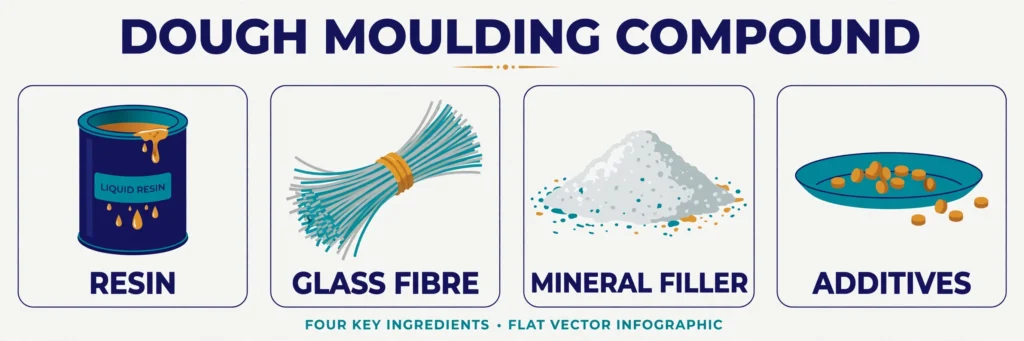
DMC is a mixture of four ingredient groups, and each one does a different job. The exact proportions change from grade to grade, because a compound made for a circuit breaker housing needs different properties from one made for a car headlight reflector. The list below is the standard composition described across the material guides.
- Resin. The base is usually an unsaturated polyester resin, which glues everything together and hardens during curing. Vinyl ester, phenolic and melamine resins are also used for special grades. Common base resin systems are orthophthalic (lower cost), isophthalic (better heat, chemical and toughness properties) and maleic (better surface finish).
- Chopped glass fibre. Short glass fibres give the material its mechanical strength. Typical DMC grades contain 10% to 30% glass fibre, with fibre lengths of about 3 to 25 mm, and some guides put the usual maximum at 12.5 mm. Longer fibres give higher strength, while shorter fibres let the compound flow into more complex shapes.
- Mineral filler. Inert fillers such as calcium carbonate and aluminium hydroxide make up a large part of the compound. They add stiffness, cut shrinkage, control cost, and, in the case of aluminium hydroxide, help with fire retardancy. Fillers are usually the largest single ingredient by weight.
- Additives. A catalyst (initiator) starts the curing reaction, a release agent helps the finished part leave the mould cleanly, and pigments give the compound its colour. Other additives can improve flow, flame resistance or surface finish. DMC is available in many colours and can be mass-coloured, so parts often need no paint at all.
One published example shows how the proportions can look in a real industrial product. In a 2019 research paper, the DMC used as a test material was a uniform mixture of 21% unsaturated polyester, 8% methyl ethyl ketone peroxide, 1% styrene, 50% calcium carbonate and 20% short glass fibres. That is one product’s recipe, not a universal standard, and your supplier’s grade will differ. The point of the example is the balance: about half filler, about a fifth fibre, about a fifth resin, and a small amount of curing chemicals.
DMC is made in batches. The resin, initiator, colourant, release agent and part of the filler are first mixed in a high-shear mixer until the temperature reaches about 50 °C, forming a resin slurry. The slurry then goes into a heavy-duty mixer, the dried chopped glass fibre is added, and after 10 to 15 minutes of mixing the dough is poured out and extruded into strips or pellets. After drying it is sealed in polyester film and stored until it is needed. Unlike SMC, which is made as a continuous sheet and matured for about 48 hours, DMC needs no thickening or maturing step and can be used as soon as it is mixed.
Key Properties of Dough Moulding Compound
DMC is not chosen for one property alone. It is chosen because it combines several useful properties in one material: strength, insulation, heat resistance and dimensional accuracy. The figures below are typical values from published material guides. They describe the material family, not a guarantee for any single grade, so always confirm the numbers on the data sheet of the grade you plan to buy.
Mechanical strength
DMC is much stiffer and stronger than ordinary thermoplastics, and its creep resistance — its ability to hold its shape under a steady load over time — is better too. Its tensile, bending and impact strength are higher than those of unreinforced plastics, which is why it works for housings and supports that carry loads and hold metal inserts. Typical published flexural strength values for glass-filled polyester moulding compounds fall broadly in the range of 100 to 200 MPa on standard test bars at room temperature, and heat deflection temperatures are commonly reported between 150 and 250 °C depending on filler loading and test stress. These are laboratory figures on standard specimens and should be treated as comparative data, not as design values for a specific part.
One standardised comparison shows how much the grade matters. Under the Chinese national standard GB/T 23641-2018, two 25% glass-fibre grades are specified side by side: UP-SMC-25a (a sheet compound) and UP-BMC-25a (a bulk compound). Both specify the same glass content and the same minimum electric strength of 22 kV/mm, yet the SMC grade specifies a tensile strength of at least 60 MPa and a flexural strength of at least 180 MPa, while the BMC grade specifies at least 30 MPa and 90 MPa. The lesson is not that one material is always better, but that two grades with the same fibre content can still be very different parts.
Electrical insulation
Electrical insulation is DMC’s standout property. Good grades reach a proof tracking index (PTI) of 600 V or more, which puts them in Material Group I, the highest class for tracking resistance under the IEC 60112 test. Their arc resistance under the ASTM D495 test reaches about 190 seconds, which is outstanding among moulding compounds and is one of the main reasons DMC is used for circuit breaker parts, insulators and meter housings. The dielectric strength of typical electrical grades is at least 20 kV/mm, and surface resistivity is often around 10¹² ohms.
It is important to read these ratings correctly. A PTI of 600 V is a result from a defined surface-tracking test, not a working-voltage rating for a finished part. Arc resistance in seconds is a material screening test, not a reproduction of a real circuit-breaker interruption. Flame ratings are separate again: UL 94 V-0 allows an afterflame of 10 seconds or less per flame application with no burning drips, and it is a small-flame bench classification tied to the tested thickness, not a guarantee that a finished assembly is fire safe. Judge the three ratings together, and always ask the supplier for the test report behind each one, including the specimen thickness.
Heat resistance and dimensional stability
DMC handles heat far better than most plastics. Its heat deflection temperature is typically 200 to 280 °C, and it can be used at 130 °C for a long time. It keeps its shape and dimensions at temperatures that would soften or warp a thermoplastic, and its linear expansion coefficient of (1.3 to 3.5) × 10⁻⁵/K is very close to that of steel and aluminium, which is why DMC parts can be combined with metal inserts and frames without the two materials pulling apart as temperatures change.
Shrinkage is very low, between 0 and 0.5%, and it can be tuned with additives. Grades are often described as no-shrink (under 0.05%), low-shrink (0.05 to 0.3%) or high-shrink (0.3 to 0.5%). Low shrinkage plus good flow is what lets DMC fill detailed moulds and hold tight tolerances, and it is one of the reasons the material is used for precision electrical parts.
Water, chemical and ageing resistance
DMC resists water, ethanol, aliphatic hydrocarbons, grease and oil well, and its water absorption is low — its insulation performance stays good even after being soaked for a day. It is not resistant to ketones, chlorinated hydrocarbons, aromatic hydrocarbons, or strong acids and bases, so check chemical compatibility before using it in a harsh environment. Moisture does affect its dimensions: DMC expands after absorbing water, so parts should be stored dry and sealed.
Ageing resistance is very good. Indoors, DMC parts can last 15 to 20 years, and after 10 years of outdoor exposure the strength retention is over 60%, according to published material data. One small drawback is odour: the styrene cross-linking agent leaves about 0.1% residue after curing, which can smell when the part is heated. Grades intended for food-contact items such as microwave tableware should use a resin with no residual styrene monomer.
| Property | Typical DMC value | What it means for you |
|---|---|---|
| Specific gravity | 1.3 to 2.1 | Heavier than most plastics, lighter than metal |
| Glass fibre content | 10% to 30% | Strength rises with fibre content and length |
| Fibre length | About 3 to 25 mm | Shorter fibres flow into finer detail |
| Heat deflection temperature | 200 to 280 °C | Keeps its shape at high temperatures |
| Long-term service temperature | About 130 °C | Safe for continuous hot use |
| Linear expansion coefficient | (1.3 to 3.5) × 10⁻⁵/K | Close to steel and aluminium |
| Moulding shrinkage | 0 to 0.5% | Very accurate dimensions |
| Arc resistance (ASTM D495) | About 190 seconds | Excellent for electrical parts |
| Tracking index (PTI/CTI) | 600 V or more, Group I | Top class for tracking resistance |
| Dielectric strength | At least 20 kV/mm | Strong electrical insulation |
| Flame rating (UL 94) | HB, V-0 or 5VA by grade | Check the class and thickness |
| Water absorption | Low, under 0.2% in graded specs | Insulation holds up when wet |
All values in this table are typical figures from published material guides and grade specifications. They vary by formulation, so confirm them on the data sheet of the grade you buy.
How Dough Moulding Compound Is Moulded
DMC can be shaped by three main processes: compression moulding, transfer moulding and injection moulding. The right choice depends on the size of the part, how detailed it is, and how many you need to make.
Compression moulding
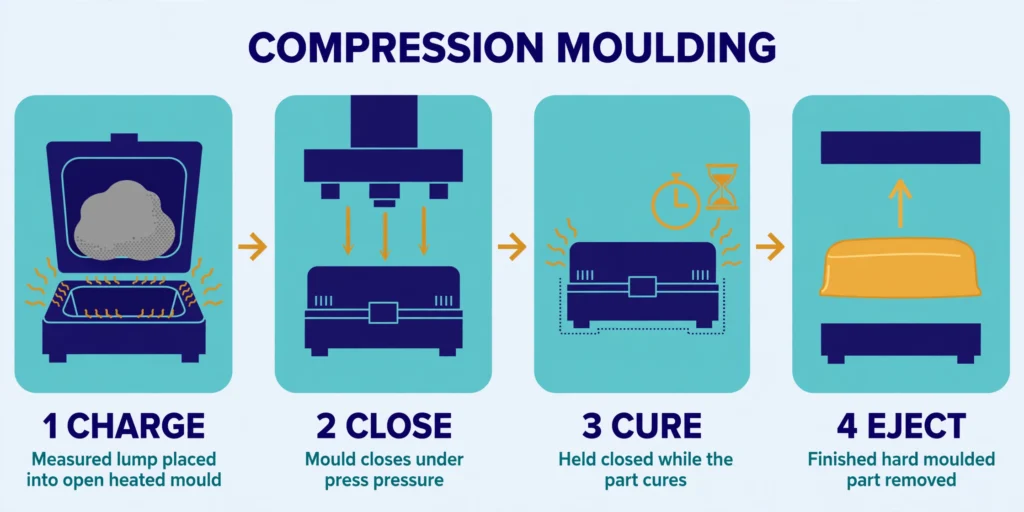
Compression moulding is the classic DMC process and the one most guides describe first. It has four stages, and the whole cycle usually takes about two to three minutes.
- Charge. A measured amount of DMC is placed into the heated female half of the mould.
- Close. The heated male half, called the plug, closes and forces the compound into every part of the mould. The heat first softens the dough so it flows accurately into ribs, bosses and fine detail, then it starts to cure it.
- Cure. The mould stays closed while heat hardens the compound. Curing takes about 30 to 60 seconds per millimetre of wall thickness at a moulding temperature of 135 to 145 °C. As a rough guide, a part with a 3 mm wall cures in about 3 minutes, a 6 mm wall in 4 to 6 minutes, and a 12 mm wall in 6 to 10 minutes.
- Eject. Once the part has hardened enough, it is ejected from the mould.
Typical compression moulding conditions are a moulding pressure of 3.5 to 7 MPa for ordinary products, rising to 14 MPa for products with high surface-finish requirements, a mould temperature of about 145 °C, and a mould closing time under 50 seconds. Compression moulding is an excellent way to make large numbers of identical parts, and it handles big parts and metal inserts well.
Transfer moulding
In transfer moulding, the compound is first heated and softened in a separate chamber, called a pot, and then forced through a runner into the closed mould cavity. The equipment is usually the pot type or the auxiliary piston type, with the auxiliary piston type being the more common. Transfer moulding suits parts with fine detail and thin sections, because the material enters the mould already softened and flows more easily than a cold charge.
Injection moulding
Injection moulding is the main method for smaller, complex DMC parts. The lump material is forced into the barrel of the machine by a feeder, carried forward by a screw, and then injected into the mould cavity, where it solidifies. Because DMC is a thermoset, the barrel must stay cool enough that the compound does not start curing before it reaches the mould: the barrel temperature is generally set to about 60 °C so the material keeps flowing, while the mould itself runs at 135 to 185 °C.
Injection moulding needs higher pressure than compression moulding, generally 80 to 160 MPa, because DMC flows poorly and solidifies fast. The injection speed is usually kept low, about 1.8 to 3.5 metres per minute, to protect surface quality and limit fibre damage while still filling the mould. If a screw machine is used, the screw speed is kept low, generally 20 to 50 revolutions per minute, with a low back pressure of 1.4 to 2.0 MPa, again to avoid breaking the glass fibres. Injection time is generally 2 to 20 seconds, with a holding time of 10 to 20 seconds. Plunger-type machines are also used: their injection volume is accurate and constant and they damage the fibres less, though venting is less convenient.
Where Dough Moulding Compound Is Used
DMC turns up in places you rarely notice, because it is usually hidden inside a housing or a casing. Its biggest markets are electrical equipment, cars and appliances, with smaller uses in machinery, chemical equipment, construction, transport and defence.
- Electrical components. This is DMC’s home ground: insulators, switchgear parts, circuit breaker casings and covers, terminal blocks, meter boxes, busbar supports and standoff insulators, and the casings of household and commercial electrical products. The combination of insulation, arc resistance and tracking resistance is hard to beat at this price.
- Automotive parts. Headlight reflectors are a classic DMC application, along with valve covers, bumpers, rear doors, speaker casings, intake pipes and gearbox components. The material’s heat resistance and dimensional stability matter under a bonnet, and its vibration-damping effect helps with noise.
- Appliances and equipment. Meter casings, audio equipment housings, radio and instrument cases, and the housings of household appliances. DMC’s good surface finish and mass colouring mean these parts often need no paint.
- Other uses. Chemical equipment parts, construction components, furniture fittings and transport parts, anywhere a small, rigid, heat-resistant and insulating moulding is needed.
One practical note: DMC suits small to medium-sized parts. Large, highly loaded structural parts are usually made from SMC instead, because its longer fibres give higher strength and impact resistance. Choosing the wrong compound for the part size is one of the most common mistakes buyers make.
Dough Moulding Compound vs SMC vs BMC
The three names describe one family of materials, and the differences are about form, fibre length and handling, not about completely different chemistry. All three are built from the same basic ingredients: thermosetting resin, chopped glass fibre, mineral filler and additives.
| DMC (Dough Moulding Compound) | BMC (Bulk Moulding Compound) | SMC (Sheet Moulding Compound) | |
|---|---|---|---|
| Supplied form | Dough-like bulk charge | Bulk, log, lump or charge form | Prepared sheet, usually carried between films |
| Fibre | Short chopped glass fibre, about 3 to 25 mm | Short chopped glass fibre, commonly shorter than SMC | Longer chopped fibres than BMC/DMC grades |
| How it is made | Batch mixing, then extruded into strips or pellets | Batch mixing, same family as DMC | Continuous in-line process, matured about 48 hours |
| Moulding routes | Compression, transfer, injection | Compression, transfer, injection | Mainly compression moulding |
| Best for | Small, thick, detailed or insert-rich parts | Detailed three-dimensional parts, bosses, ribs, embedded metal | Larger-area or structural parts where stiffness and impact matter |
| Main limitation | Lower strength than SMC grades | Shorter fibres can reduce structural performance | Harder to fill very fine detail and tight tolerances |
The most important point in this comparison is that DMC and BMC are closely related, and in trade the two terms are often used interchangeably. Some suppliers and regions treat them as synonyms, while a specification may distinguish them by formulation, thickening method or handling consistency. ISO 8606:2025 treats BMC and DMC as types of preimpregnated product, so neither name by itself defines the thickening method, the fibre, the resin or the performance. If a drawing or a purchase order says DMC, confirm how the supplier defines the term and get the complete grade specification.
SMC is the more clearly different member of the family. Because it is supplied as a sheet, it can be cut and stacked to guide flow across a broad mould, which suits large panels and structural parts. Its longer fibres generally give higher tensile and impact strength: in the GB/T 23641-2018 example grades quoted earlier, the SMC grade specified a tensile strength of at least 60 MPa and a flexural strength of at least 180 MPa, against at least 30 MPa and 90 MPa for the equivalent BMC grade, with Charpy impact strength of at least 75 kJ/m² against 30 kJ/m². But those are two specific grades, not a universal law, and a well-chosen BMC/DMC grade can still be the right answer for a compact, detailed part that SMC cannot fill properly.
Advantages and Disadvantages of DMC
Advantages
- Short cycle and mass production. The moulding cycle is short, the process suits automation, and it needs no highly skilled operators, which saves labour.
- Complex parts in one step. Inserts, holes, platforms, ribs and grooves can all be formed at the same time, so a part that would need several operations in metal can come out of the mould finished.
- Heat, insulation and stiffness. Compared with ordinary thermoplastics, DMC parts have higher heat resistance, better insulation and a higher elastic modulus.
- Accurate dimensions. Very low shrinkage and high dimensional stability mean parts come out of the mould close to size, with good surface finish.
- Cheap to colour and finish. A large amount of filler can be added for flame retardancy and stability at low cost, and parts can be mass-coloured, so no paint is needed. The material is available in many colours and tolerates powder spraying or water-based paints.
- Long tool life and quiet parts. Moulds last longer than aluminium tooling in comparable use, and the material damps vibration, which reduces noise.
- Cost. One published course guide puts the total cost saving at about 50% compared with cast aluminium for comparable parts, thanks to the single-step process and cheaper tooling.
Disadvantages
- Limited size and strength. DMC is only suitable for small products with modest strength requirements. One supplier guide puts BMC strength at about 30% lower than SMC, so large or highly loaded structural parts belong to SMC or another material.
- Flash and finishing. Moulding times can be long for thick parts, and the process leaves large burrs, or flash, on the product that must be removed.
- Machine cost. Injection moulding machines for DMC cost more than ordinary thermoplastic machines, because they need special feeding and temperature control.
- Styrene odour. The styrene cross-linking agent leaves about 0.1% residue after curing and gives off an odour when heated.
- Moisture and chemical limits. DMC expands after absorbing moisture, and it is not resistant to ketones, chlorinated or aromatic hydrocarbons, or strong acids and bases.
- Not recyclable like a thermoplastic. Once cured, a DMC part cannot be melted and remoulded, so scrap and end-of-life parts cannot be reprocessed the way thermoplastics can.
How to Choose the Right Compound
Choosing between DMC, SMC and BMC is not a matter of picking the strongest data sheet. It is a matter of matching a defined grade and a defined moulding route to a defined part. Use the checklist below when you talk to a supplier.
- Start from the part, not the material. Write down the size, wall thickness, ribs, bosses, inserts, tolerances and surface finish the part needs. Small, thick, detailed or insert-rich parts point toward DMC or BMC; broad, load-bearing panels point toward SMC.
- Ask for the full grade designation. Get the resin family, fibre content and length, filler system, colour and approved supplier in writing. A material name alone is never a substitute for a grade-specific data sheet.
- Read the test evidence, not just the headline numbers. Ask for the CTI/PTI test report with specimen thickness, the ASTM D495 arc-resistance result, and the UL 94 flame class at the stated wall thickness. Check the test method, the specimen thickness and the pass rules for every rating.
- Check the electrical ratings together. CTI, arc resistance and flame rating answer three different questions. A strong arc number does not make up for a low CTI, and a V-0 rating says nothing about tracking.
- Confirm the moulding route. Make sure the grade you buy is approved for the process you will use, whether compression, transfer or injection moulding, and confirm the mould temperature, pressure and cure time with the supplier.
- Verify the moulded part. A data sheet describes a test specimen, not your part. Check dimensions, surface quality, insert pull-out and electrical performance on real moulded parts before approving a grade for production.
- Ask about storage and handling. DMC should be stored sealed and dry, since it absorbs moisture and expands. Ask the supplier for the storage conditions and usable life of the grade you buy, and keep opened material sealed.
How to Check a DMC Grade Before You Buy
If you are comparing two or three grades, the fastest check is to put their data sheets side by side and look for the same five lines on each one: glass fibre content and length, CTI or PTI with the specimen thickness, arc resistance in seconds with the test standard, UL 94 flame class with the tested thickness, and heat deflection temperature with the test stress. Any grade that is missing one of these lines has not given you enough to judge it, so ask the supplier for the missing test report before you decide.
Next, ask for a small sample quantity and mould a few trial parts. Check the dimensions against the drawing, look for voids, incomplete fill, cracks or exposed fibres, and test the electrical properties on the moulded part rather than on a flat specimen. A compound that looks good on paper can still fail in a real mould if the charge placement, venting or cure control is wrong, so a trial run is worth far more than another round of data sheet comparison.
Finally, confirm the paperwork chain: part drawing, material designation, moulded lot, test evidence and finished assembly. A certificate for a resin plant or an ISO 9001 certificate supports one link in that chain, but none of them proves the whole chain on its own. For a safety-related part such as a circuit breaker housing, the finished device still needs its own verification under the applicable product standard.
Frequently Asked Questions
What is dough moulding compound?
Dough moulding compound, or DMC, is an uncured, dough-like thermoset material made mainly from unsaturated polyester resin, chopped glass fibre, mineral filler and additives. It is pressed or injected into a heated mould, where it cures into a hard, rigid part with good electrical insulation and heat resistance.
Is DMC the same as BMC?
In trade the two terms are often used interchangeably, and ISO 8606:2025 treats BMC and DMC as types of preimpregnated moulding product. But they should not be assumed identical in a technical specification, because suppliers can define them differently by formulation or handling. Always confirm the exact grade with the supplier.
What is dough moulding compound made of?
The standard mix is unsaturated polyester resin, chopped glass fibre (typically 10% to 30%, about 3 to 25 mm long), mineral fillers such as calcium carbonate and aluminium hydroxide, plus a catalyst, a release agent, pigments and other additives. One published industrial example used 21% resin, 50% calcium carbonate, 20% glass fibre, 8% peroxide initiator and 1% styrene.
What is DMC used for?
Mostly electrical components such as insulators, circuit breaker casings, terminal blocks and meter boxes, plus car parts such as headlight reflectors, valve covers and speaker casings, and appliance and instrument housings. It suits small, detailed, insulating parts.
How is DMC moulded?
By compression moulding, transfer moulding or injection moulding. In compression moulding a measured charge is placed in a heated mould, the mould closes under pressure, the compound flows and cures in about two to three minutes, and the finished part is ejected. Typical mould temperatures are 135 to 185 °C.
Is dough moulding compound heat resistant?
Yes. Its heat deflection temperature is typically 200 to 280 °C, and it can be used at about 130 °C for a long time. It keeps its shape and dimensions at temperatures that would soften most thermoplastics.
How do you choose between DMC, SMC and BMC?
Start from the part: small, thick, detailed or insert-rich parts point toward DMC or BMC, while large, load-bearing panels point toward SMC. Then compare full grade data sheets — fibre content, CTI, arc resistance, flame class and heat deflection temperature — and verify the choice on real moulded parts before approving it for production.
Bottom Line
Dough moulding compound is a simple idea that solves a hard problem: it takes a soft dough of resin, glass fibre and mineral filler and turns it, in a few minutes in a heated mould, into a hard part that insulates electricity, resists heat and holds its shape. Its strengths are electrical insulation, arc resistance, dimensional stability and the ability to form complex, insert-rich parts in a single step, which is why it is the standard choice for circuit breaker housings, insulators, meter boxes and many car and appliance parts. Its limits are just as clear: it suits small parts rather than large structural ones, it leaves flash to trim, and it cannot be melted and remoulded once cured. If you remember one rule, make it this one: do not choose DMC, SMC or BMC by name alone. Choose a defined grade for a defined part, check the test evidence behind the numbers, and prove it on a real moulded part before you commit to production.