FintechZoom.io Courses and Stock Market Course: What the Web Says, and What You Can Actually Verify
Before you pay for any stock market course, answer three questions. Who is teaching it, with a name and a track record you can look up? What exactly does it cost, including renewals? And who checks the claims it makes about results?
Apply those three questions to the pages describing a “FintechZoom.io stock market course,” and the picture gets murky fast. Here is what the web claims, where those claims contradict each other, and how to decide whether any paid investing course is worth your money.
The Short Answer
Several websites describe FintechZoom.io courses covering stock investing, trading, crypto and financial literacy. I could not confirm a course catalog, instructor list or pricing from an official, verifiable source, and the pages that describe the courses disagree with each other on basic facts like price, certification and length. Treat the course as unverified until you can see these details on the platform itself.
That is not an accusation. It is a reminder to check before you pay.
What the Pages Describing It Claim
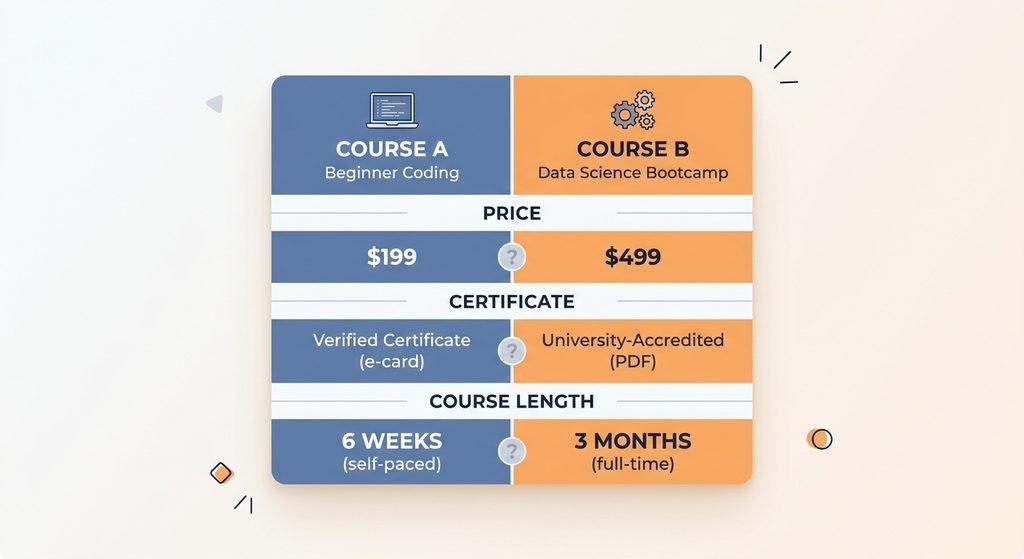
Two of the pages that rank for this keyword give very different pictures.
Version one describes four course tracks: financial literacy (budgeting, credit scores, debt), stock market investing (ETFs, diversification), stock market trading (swing versus day trading, candlestick charts, stop-losses) and crypto basics. It says introductory courses are free, advanced modules start at $149 a year with a 30-day money-back guarantee, and that finishers get a digital certificate. It does not name a single instructor, and the certificate is not tied to any accredited body.
Version two describes a five-module stock market course: introduction to the market, fundamental analysis, technical analysis, risk management and portfolio construction. It gives no real price (it labels it “aggressive”), does not mention a certificate, lists course length as both 10 to 20 hours and 2 to 4 months, and mentions a refund guarantee with no terms. It also contains stray sentences that have nothing to do with investing, such as references to a “health kick” software and a beach resort, which strongly suggests the text was auto-generated or poorly edited.
Both pages share the same weaknesses:
- No named instructors or credentials
- Testimonials with first names only or none attributable
- Unsourced claims about “real-time” data and “AI tools”
- Effectiveness claims with no data behind them
- Hosting on domains with no obvious connection to finance education, as shown in search results
When two descriptions of the same product disagree on price, length and whether a certificate exists, at least one is wrong, and you can’t tell which.
Why the Domain Situation Matters
If you have read our breakdown of FintechZoom.io versus FintechZoom.com, you already know the two domains are described very differently by different sources. The .com is generally described as a financial news and market-data site. The .io is described inconsistently, and its own homepage language includes claims about clients who “became millionaires” and offers to advise visitors on where to invest. That is a point to be cautious about, and it is the main reason to look hard at any course attached to that name.
Our guide to FintechZoom.io’s Nasdaq coverage covers what the platform’s market data does and does not include. The same rule applies to courses: use it as a starting point at most, and cross-check anything that affects your money.
How to Judge Any Stock Market Course
You don’t need a verdict on one specific platform to protect yourself. These checks work on any course, free or paid.
1. Find the Instructor and Verify Them
A credible course names its teachers and links to something you can check. The SEC’s Office of Investor Education recommends researching investment professionals for free through the SEC’s Investment Adviser Public Disclosure website and FINRA’s BrokerCheck, as described in its investor bulletin. FINRA says BrokerCheck shows work history, qualifications and disciplinary records for registered professionals and firms, according to its investor tools page.
Not every good teacher is registered, because teaching is different from giving personal advice. But a course that sells “expert-led” content and gives you no names at all has given you nothing to evaluate.
2. Get the Full Price in Writing
Look for the total cost, whether it renews automatically, and the exact refund terms (how many days, what conditions, how to request). “Money-back guarantee” with no terms is a marketing phrase, not a policy.
3. Watch for Red Flags in the Sales Language
The SEC’s bulletin lists warning signs that apply to courses as much as to investments:
- Promises of high returns with little or no risk
- “Can’t miss” or “guaranteed” results
- Appeals to wealth you don’t have yet
- Claims that other savvy investors are already in
- False urgency, such as “limited seats”
If a course page says students “became millionaires” or implies you will profit, that is a reason to step back, not to enroll.
4. Check Whether the Content Is Specific
Real curriculum pages list lessons, topics and learning outcomes in concrete terms. Good signs include a module list with lesson titles, sample lessons you can preview, and clear statements of what the course does not teach. Vague phrases like “your roadmap to success” tell you nothing.
5. Be Skeptical of Certificates
A digital certificate from a private platform usually has no accreditation behind it and does not count as a professional credential. Don’t pay extra for one unless you know who will recognize it.
6. Separate Education From Trading Signals
Education explains how markets work. Signals and “AI tools that flag trades” are a different product, with different risks. Be clear about which one you are buying.
What a Good Beginner Curriculum Usually Covers
Whatever provider you choose, a sound beginner course tends to include:
- How markets work: exchanges, stocks, ETFs, indexes and how orders are placed
- Risk and diversification: why concentrating money in one stock is risky and how funds spread that risk
- Costs and taxes: fees, taxes on gains and account types
- Reading basic financial information: earnings, price-to-earnings and company filings
- Behavior: avoiding panic selling, hype and overtrading
- Scam awareness: recognizing fraud and checking registrations
If a course skips risk and costs but spends most of its time on predictions, that is a mismatch.
Free Places to Learn First
You can build a strong foundation before spending a cent. FINRA lists smart investing courses, quizzes and calculators among its free tools, as shown on its investor tools page, and the SEC’s Investor.gov publishes plain-language guides on fees, diversification and fraud warning signs. Starting there helps you judge any paid course more clearly, because you will know what basic material should look like.
Should You Enroll?
A fair way to decide:
- If you can verify instructors, price, refund terms and curriculum on the platform itself, and the sales language stays modest, a low-cost beginner course may be reasonable.
- If you can’t verify them, or if the page leans on income claims and urgency, skip it and use free regulator resources until you can.
This article is general information, not financial advice, and I’m not a financial advisor. For decisions involving your own money, consider speaking with a licensed professional.
Frequently Asked Questions
Does FintechZoom.io have a stock market course? Several websites say it does, but they disagree on the details, and I could not confirm a catalog, instructors or pricing from an official source. Check the platform directly before paying.
Are FintechZoom.io courses free? One description says introductory courses are free and advanced modules cost $149 a year. Another gives no price. Neither is verified.
Does the course give a certificate? One page says yes, another does not mention one. Even if offered, a private-platform certificate is not an accredited credential.
Is FintechZoom.io the same as FintechZoom.com? They are described differently. The .com is generally described as a financial news and data site, while the .io is described inconsistently.
How do I check whether an investment teacher or adviser is legitimate? Use FINRA BrokerCheck and the SEC’s Investment Adviser Public Disclosure website, both free, to see registration and disciplinary history.
What are the warning signs of a bad investing course? Guaranteed returns, “can’t miss” claims, no named instructors, unclear refund terms and heavy time pressure.
Where can I learn the stock market for free? FINRA’s investor tools and the SEC’s Investor.gov offer free beginner material.
Bottom Line
The web describes FintechZoom.io courses in conflicting ways, with no named instructors, no verifiable pricing and no outcome data behind the success claims. Until those basics are confirmed on the platform itself, treat the course as unproven. The same checklist works for any stock market course: verify the teachers, get the price and refund terms in writing, watch for guaranteed-return language, and start with free regulator education before you spend money.