GlaadVoice.com: 7 Essential Facts Before You Trust It or Pitch It
You searched for glaadvoice.com, and the name alone probably gave you a picture in your head.
Glaad, plus Voice, sounds like an advocacy voice. It sounds like a campaign, a media watchdog, or a platform speaking up for a community. If that is what you expected, you need to stop right there, because that is not what the live site shows.
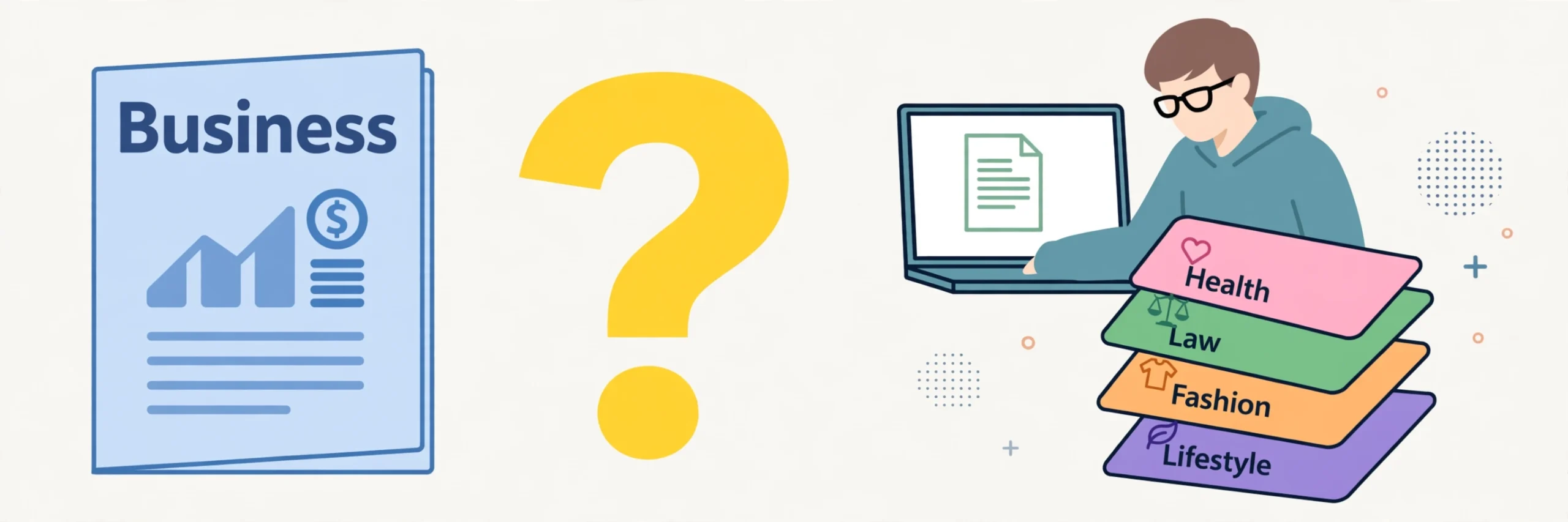
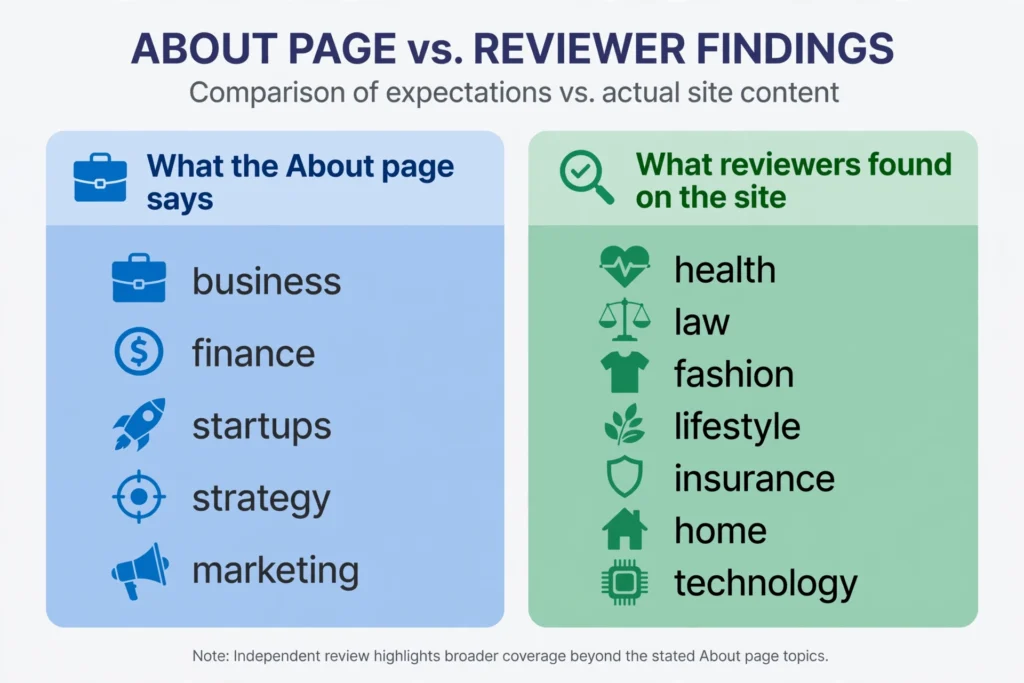
What loads at glaadvoice.com is a general publishing blog with a business label on the front door. Its own About page calls it a dedicated business media platform for entrepreneurs, professionals, and decision-makers. But when reviewers opened the actual articles in September 2026, they found business posts sitting next to health guides, law posts, fashion pieces, and lifestyle articles.
That gap — between the name, the business branding, and the content itself — is the whole story. It explains why so many review pages exist, why they disagree with each other, and why a guest-post buyer can easily pay for the wrong thing: a link on a broad, general blog, bought as if it were a placement on a focused business authority site.
This article separates what was observed from what was not. It does not call the site a scam, and it does not call it an authority either. It gives you the checks that let you decide for yourself, whether you are a reader, someone looking for the real GLAAD organisation, or a marketer thinking about paying for a placement.
A note on method
This article is based on a full reading on 30 October 2026 of GlaadVoice’s own About Us and Terms and Conditions pages, plus the full text of the strongest recent reviews of the site.
What was checked:
- The GlaadVoice About Us page itself, including its stated focus, mission, and contact email, and its update date of 8 September 2026.
- The GlaadVoice Terms and Conditions page itself, including its disclaimer that content is for general information only and is not professional advice.
- A September 2026 hands-on review that visited the homepage, read the About, Contact, and Disclaimer pages, checked published articles directly, and compared guest-post marketplace listings.
- Two other full-length 2026 reviews that inspected the site’s categories, authorship, and trust signals in detail, and a further review that treated the site more cautiously as a real but limited-transparency platform.
- A third-party safety-checker page for the domain, used only for its reported domain creation date, registrar, and blacklist checks, not as proof of editorial quality.
- The real GLAAD organisation’s own advocacy pages, to confirm what that separate organisation actually does.
What could not be verified in this reading, and is therefore not claimed as fact in this article:
- The legal owner, parent company, founder, company address, or editorial team behind glaadvoice.com.
- A current Domain Authority score, traffic figure, or backlink profile for glaadvoice.com. Third-party estimates are reported as estimates, and conflicting ones are flagged as conflicting.
- A verified guest-post price list, acceptance policy, link policy, retention policy, or sponsored-content labelling standard from the publisher itself.
- A complete technical safety audit, malware scan, or privacy review carried out by this article.
- Whether the site’s homepage currently carries the free business tools (such as an invoice generator or profit-margin calculator) that one recent guide reports, since other reviews do not mention them. That may reflect different snapshots in time, and you should check the live homepage yourself.
- Any relationship between glaadvoice.com and similarly named pages or review sites that use its name.
Where reviews disagreed, this article says so. A disagreement between two reviews is not proof that either one is lying. It is proof that you should not repeat the claim as settled fact.
The Short Answer
GlaadVoice.com is a free-to-read, multi-topic publishing blog.
You can browse articles about business, finance, startups, marketing, and digital growth, alongside health, law, technology, fashion, lifestyle, e-commerce, education, and insurance topics, without, on the evidence read, needing an account or a subscription to read.
That is where the confident part ends.
It is not GLAAD, the LGBTQ media advocacy organisation, and no verified connection between the two exists. It is not a business-only blog in practice, whatever its About page says. Ownership is not publicly disclosed. Author bylines exist, but no author bios or credentials were found. Guest posting is discussed by third-party marketplaces, but no publisher price list or link policy was verified. And authority claims about the site conflict sharply between sellers, so you should not pay based on a quoted score alone.
So use it the way you would use any small, general-interest site: fine for a quick overview, not a final source for a health, money, or legal decision, not a place to find LGBTQ advocacy work, and not a placement to buy until you have asked direct questions and received clear, written answers about the specific page, link, and price.
What Is GlaadVoice.com?
What it says about itself
GlaadVoice’s own About Us page (https://glaadvoice.com/about-us/) calls the site “a dedicated business media platform built for entrepreneurs, professionals, and decision-makers who want clear, practical, and timely insight into the world of business.”
That page lists five stated areas: startups and entrepreneurship, finance and funding, business strategy, marketing and digital growth, and industry trends. Its mission, in its own words, is to simplify complex business topics — funding rounds, market trends, growth strategies, leadership insights — into content that any founder, manager, or curious reader can actually use.
It also makes a point of saying what it is not trying to do. In the “Why GlaadVoice” section, it says: “We’re not trying to cover everything under the sun — we’re building a platform people turn to specifically for smart, no-fluff business content.”
That is a clean, focused promise. The problem is that the published site does not keep it.
What it actually publishes
The main navigation menu, as reported by the September 2026 hands-on review, lists only business categories: Business, Industry, Business Strategy, Finance, Entrepreneurship, E-commerce, and Digital Marketing. That is the pitch you see first.
But once you look past the menu and into the actual published posts, the picture changes. Here is what that reviewer found live on the site:
- Business and finance — startup guidance, supplier tips, business loans, and IPO coverage, including Indian stock market news priced in rupees
- Health — lime water benefits, fertility habits, dermaplaning, and mood disorder symptoms
- Law — car accident attorneys, personal injury claims, and insurance claim denials
- Lifestyle and fashion — jewelry manufacturing guides and general lifestyle pieces
- Home and insurance — solar energy adoption and care strategy articles
Other full-length reviews, working from slightly different snapshots, add education (including IELTS coaching in one specific Indian city and UK e-learning platforms), technology (including learning-management software, digital verification tools, and background checks), and Singapore compliance and checking-account topics under finance. One guide also reports USA-focused articles about Houston, New York, Reno, and Illinois, and a guide to au pair agencies for families in the USA.
None of this makes GlaadVoice.com a bad site. It does mean the “dedicated business blog” framing on the About page oversells what is actually there. If you are a reader who wants a business-only publication, you will be scrolling past a lot of unrelated content to find it.
How it works for a reader
For a reader, the path is straightforward:
- Browse the homepage feed or pick a category.
- Open an article and check its title, date, author, and sources.
- Follow any important claim back to its original source, rather than trusting a summary alone.
- Compare important claims before acting on them, especially for health, money, or legal topics.
No subscription step, paywall, or forced sign-up for ordinary reading was documented in the reviews read. If you ever hit a login wall, a forced sign-up, a download prompt, or a payment request on a page claiming to be GlaadVoice.com, stop and check the exact domain first. That behaviour was not described as part of the publishing site in the reviews read.
How it earns money, on the evidence read
The September 2026 reviewer reports that the site is monetised through Google’s Site Kit, meaning it runs ads and tracks traffic through Google’s own tools. It also sells homepage banner ad space directly, with a “Book Your Ad Space Now” button in the sidebar that opens a pre-filled email to the site’s Gmail address.
That is the same basic model used by most content blogs: the site earns money from readers viewing content and from advertising on its own pages, rather than charging readers to read. It does not, on the evidence read, run a reader subscription, a paid membership, or an advertiser dashboard.
The Name Problem
Why the name creates the wrong expectation
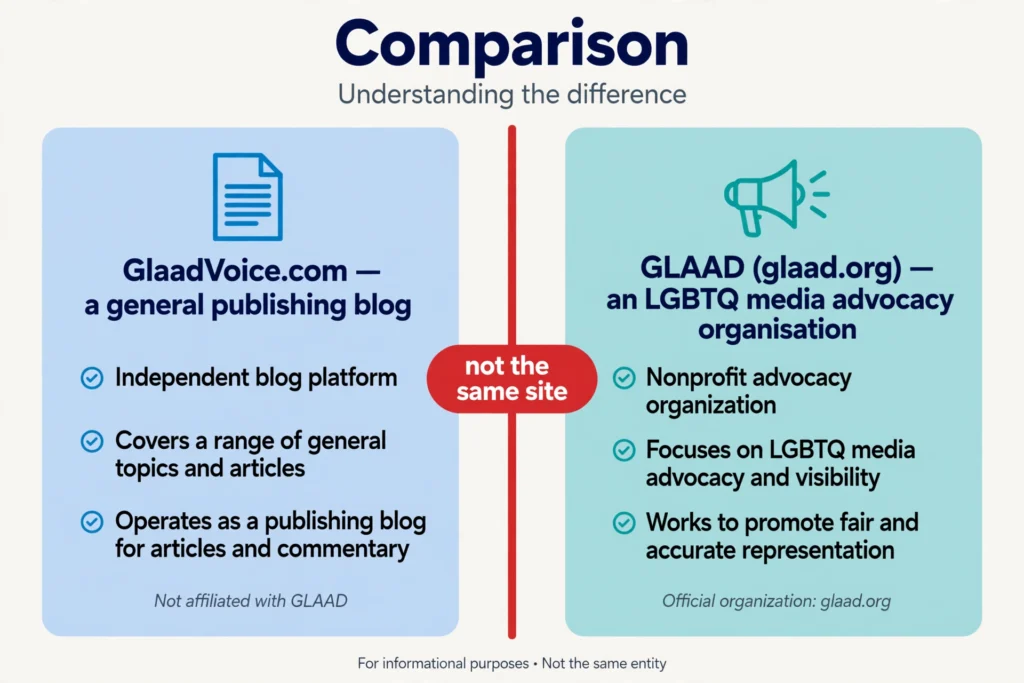
“GLAAD” plus “Voice” reads like the name of a media watchdog or an advocacy campaign. That is why so many people arrive at glaadvoice.com expecting LGBTQ media advocacy content, and why so many review pages have had to correct that expectation.
The real GLAAD is a separate, well-known American media monitoring organisation, founded in 1985, whose work is about fair, accurate, and inclusive representation of LGBTQ people in media. Its own advocacy and accountability pages (https://glaad.org/advocacy-and-accountability/) describe monitoring coverage, responding to misinformation, and providing research to news outlets and entertainment media. It operates at glaad.org, not glaadvoice.com.
GlaadVoice.com shows none of that. There is no shared branding, no cross-linking, no advocacy mission statement, no campaign tools, and no nonprofit registration on the site, according to every detailed review read for this article. Instead of activism content, you get skincare tips, small-business guides, and legal round-ups. The spelling is the only overlap.
If you came here looking for LGBTQ media advocacy work, this is the wrong site. Go to the official GLAAD organisation directly, at glaad.org.
Why some review pages get this badly wrong
This is where you need to be careful about the search results themselves, because not every page ranking for “glaadvoice.com” actually describes the live site.
Some older review-style pages describe glaadvoice.com as a digital hub for LGBTQ advocacy, media accountability, campaigns, and storytelling, or as a community-driven outlet for LGBTQ voices and achievements. Others describe fresh features such as enhanced guest submission portals, targeted ad analytics, a 35% uptick in user engagement, a creator dashboard for tracking revisions, and 48-hour editorial feedback.
Those claims conflict directly with what the live site shows. GlaadVoice’s own About page, updated in September 2026, describes a business media platform, not an advocacy platform. Its published articles are business, health, law, and lifestyle posts, not campaigns or advocacy tools. No dashboard, analytics suite, or 48-hour turnaround promise was verified on the site itself in this reading.
The most likely explanation is the one the stronger reviewers point to: some pages are reading the name and writing what the name suggests, rather than opening the site and reporting what is actually there. Once one page does that, other pages can repeat the same description without independently verifying it, and after enough repetition, an assumption can begin to look like an established fact.
Do not count reviews. Check the site. Open the About page, open a category page, and open one article in the topic you care about. That takes two minutes, and it settles the advocacy question immediately.
The homepage’s own odd details
The September 2026 reviewer also noticed details that should make you pause before treating the site’s self-description as polished corporate copy.
On the day of that visit, the top story on the homepage was an article titled “GlaadVoice.com – A Dedicated Business Blog for Entrepreneurs, Startups, and Growing Companies.” It was published on the site’s own domain, under its own byline, praising the site itself as “worth bookmarking” and “a reliable resource” for entrepreneurs. It reads like a press release the site wrote about itself, not an independent piece of journalism.
Other reviewers report a smaller but telling slip: at one point, the homepage title tag advertised “Sports” coverage, yet no sports category existed anywhere in the live navigation. That kind of mismatch does not prove dishonesty, but it is a useful signal about editorial oversight. A tightly managed publication usually keeps its title tag, its menu, and its categories in agreement with each other.
The same reviewer also found spam comments still live in the homepage’s “Recent Comments” widget, including a message in Swedish promoting a Binance cryptocurrency referral link and a generic “demo” comment linking to a WordPress theme demo site. On its own, that is a small issue. Together with the self-promotional top story, it suggests comment moderation is not a priority, and that the site is managed more loosely than its business-publication branding implies.
Who Runs GlaadVoice.com?
What is actually known
Here is the honest answer: very little, publicly.
The site’s About page names no founder, no company, no editor, and no editorial team. Its Terms page is governed, it says, by the applicable laws of India, but that is a governing-law clause, not a company address or a named legal entity, and this article does not treat it as proof of where the operator is based.
The contact route is a single Gmail address, glaadvoice@gmail.com, listed on the About page and the Terms page for everything: story ideas, partnership inquiries, advertising, collaboration requests, guest post submissions, press releases, corrections, and general questions. A Gmail-only contact is not automatically a red flag for a small independent site, but it is worth knowing before you send over a contract or a payment for a placement. Larger, more established publications usually run contact and editorial inquiries through a branded domain email.
Domain records do not fill the gap. A third-party safety checker reports the domain was created on 19 August 2022, with Hostinger as registrar, and with the owner details hidden behind privacy protection. Other reviewers report the same pattern: standard WHOIS privacy keeps the registrant’s name and contact details out of public records. That is common practice for small independent blogs, and on its own it proves nothing bad. It does mean you cannot verify the operator from registration records alone.
Authors: named, but not verifiable
The September 2026 reviewer found three bylines across recent posts: Ethan Wilson, who writes most of the health, law, and lifestyle content; Varun Saxena, who covers finance and IPO news; and Devin Haney, credited on a couple of older nutrition and business posts.
None of those authors, that reviewer reports, has a visible bio page with credentials, work history, or subject-matter expertise listed anywhere on the site. Other reviewers agree: bylines exist, but they rarely link to a verifiable profile, and there is no named editorial team or standards page to check against.
That does not mean every article is wrong. It means you should judge each article on its own evidence: what it cites, how specific it is, how current it is, and whether its claims hold up elsewhere. This matters most when the topic matters most. A general lifestyle tip and a claim about a medical treatment, an investment, or a legal step do not carry the same risk, and they should not receive the same level of trust.
Why the ownership gap matters more here than on a hobby blog
On a personal blog about a hobby, an anonymous author is a minor detail. On a site that publishes health, law, and finance content, and that also sells guest posts and banner ads, it matters more, because there is no public person or company to hold accountable if an article is wrong, outdated, or quietly promotional.
That is also why the site’s own Terms page matters. Its Terms and Conditions (https://glaadvoice.com/terms-and-conditions/) state plainly that content, including business, finance, health, and legal topics, “is provided for general informational purposes only and does not constitute professional advice” and that you should “always consult a qualified professional before making decisions based on our content.” Take that warning seriously. It is the site itself telling you not to treat its articles as expert advice.
Is GlaadVoice.com Legit and Safe to Visit?
The short version: real, low-risk to browse, not an authority
Yes, as far as the evidence read goes, the site is real and low-risk to browse. It loads over a secure HTTPS connection. The September 2026 reviewer found no pop-ups, forced downloads, or anything that looked like malware or phishing during that visit. It has the standard trust pages you would want to see: About Us, Contact Us, Privacy Policy, Disclaimer, and Terms and Conditions, all publicly linked in the footer.
A third-party safety checker, last checking the domain in November 2025, gave it a safety score of 95 out of 100, reported a valid SSL certificate, reported that no security engine had blacklisted the domain, and found it in no scam directory it checked. That same checker also noted the site is “not popular” and that very few users visit it, which is a useful counterweight to any claim that it is a major publication.
So “is it a scam” is not really the right question here. It is a real, low-risk content site. The better question — the one this whole article is really about — is whether it is the authority it presents itself as. Based on what was found, it is not quite. It is a general content platform that leads with business branding.
What HTTPS does and does not prove
A valid SSL certificate protects your connection to the site. It does not protect you from bad information. Safety and accuracy are two completely different things.
HTTPS does not certify who operates the site, prove that its content is accurate, or guarantee that every page and third-party element is harmless. No complete malware, phishing, redirect, or download test was completed for this article, so no permanent “safe” verdict is justified here either. The safety-checker score above is that checker’s algorithm at the time it ran, not a permanent safety certificate, and its own disclaimer says the same: conduct your own research before drawing conclusions.
For ordinary browsing, that is enough to say the site is low-risk. For a health, money, or legal decision, it is not enough at all. That decision needs a named, checkable source, not just a secure connection.
When not to rely on it alone
Do not base a consequential decision on a single general-interest article from this site.
That includes:
- Medical decisions, diagnosis, treatment choices, or urgent symptoms.
- Significant financial decisions, investments, taxes, or lending.
- Legal decisions, contracts, or compliance questions.
- Any claim where a wrong answer would cost you time, money, or security.
For those topics, use GlaadVoice.com, if at all, to learn the vocabulary and the questions to ask. Then check a primary source, an official document, a qualified professional, or an established specialist publication. That extra step is not a criticism of one site. It is good practice for any general-interest site, and it is exactly the approach used in Tech2Explore’s guide to checking whether a website is a scam.
7 Essential Facts About GlaadVoice.com
Fact 1: It is a multi-topic blog, not a business-only site
The About page promises a dedicated business media platform. The live site’s own content shows a much wider mix: business and finance alongside health, law, lifestyle, fashion, home, insurance, and education topics. Read it as a general-interest site, not a specialist business publication.
Fact 2: It is not GLAAD, and it is not an advocacy site
GlaadVoice.com has no verified connection to GLAAD, the American LGBTQ media advocacy organisation. There is no shared branding, no cross-linking, and no advocacy mission on the site. If you arrived looking for GLAAD’s work, you are in the wrong place — and you should go to glaad.org directly.
Fact 3: It is free to read, with no account system found
No subscription step, paywall, or forced sign-up for ordinary reading was documented in the reviews read. Reading is free and open. That also means there is no reader account, membership, or login system to judge — the site’s trust signals have to come from its content and its published policies, not from a community or subscription model.
Fact 4: Ownership, founder, and company details are not publicly verified
The About page names no founder, no company, and no editorial team. The only contact route published is a Gmail address. Domain ownership is privacy-protected, and the domain was created on 19 August 2022. That does not prove anything bad — many small sites are run this way — but it does mean you cannot verify who is accountable for the content.
Fact 5: Authors are named only in a limited way, and credentials are not shown
Recent posts carry bylines — Ethan Wilson, Varun Saxena, and Devin Haney were the names found — but none of those authors, as reported, has a visible bio page with credentials, work history, or other published work to check. Judge each article on its own evidence and sources, not on the byline alone.
Fact 6: Guest posts are discussed, but no complete publisher policy was verified
Reviewers mention guest posts, submissions, and a “Write for Us” style route, and one older review even claimed a guest submission portal. No verified price list, acceptance policy, link policy, retention policy, or sponsored-content disclosure was found in this reading. If you are pitching, do not assume a price, a link type, or a turnaround time until the site confirms it in writing.
Fact 7: Safety, traffic, and SEO value cannot be settled from HTTPS, a scan score, or a single authority number
A 95-out-of-100 safety score, a valid SSL certificate, and a claim of Domain Authority are not the same as traffic, editorial quality, or link value. Third-party authority scores also disagree with each other, and no current traffic figure or backlink profile was verified in this reading. Treat any single number — especially one quoted by a seller or a review page — as a starting point for checking, not as proof.
How to Check It Before You Trust It
A practical check for any single article
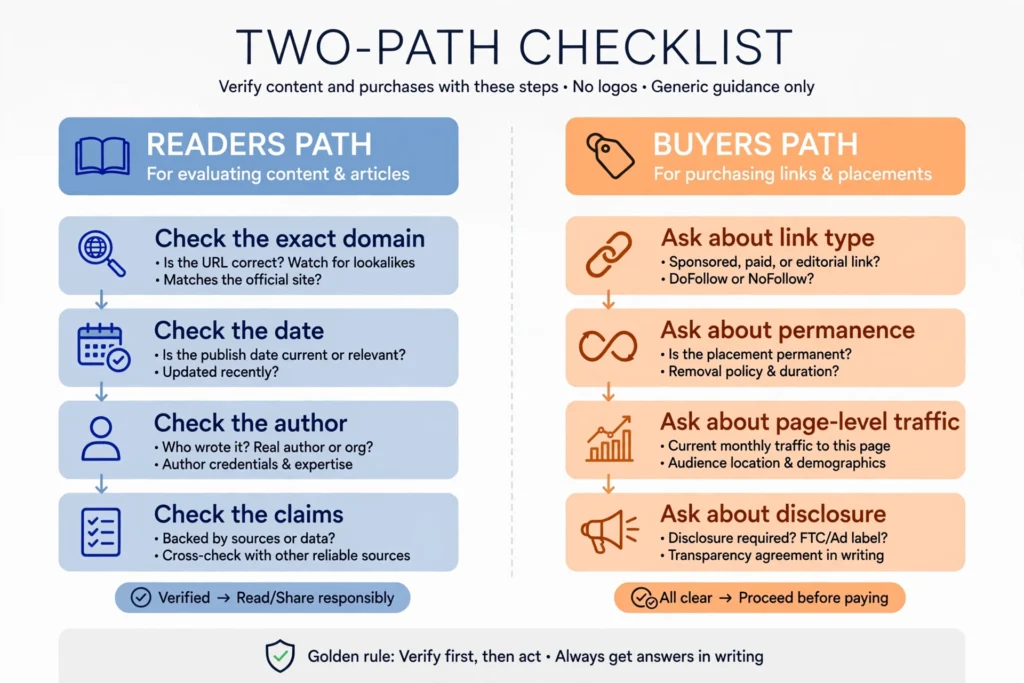
Before you trust or share a specific GlaadVoice.com article, run through these six steps:
- Check the exact domain. Make sure you are on glaadvoice.com, not a lookalike domain, a similarly named review site, or a page that only uses its name.
- Check the date. Is the article current, or is it an old post that search results have surfaced as if it were new?
- Check the author. Is a byline given, and can you find that author anywhere else with credentials or other work?
- Check the claims. Are important statements backed by a named source, a study, an official document, or data you can open yourself?
- Cross-check elsewhere. Search the key claim on at least one independent, reputable source before you act on it.
- Ask what the article is for. Is it informing you, or is it ranking, selling, or promoting something — and does it say so clearly?
If an article fails several of those checks, treat it as a starting point, not as evidence.
How to check any website in five minutes
The same approach works for any unfamiliar site, not just this one:
- Open the About page and the Contact page. A real, accountable site usually names someone, somewhere, and gives a working contact route that is not only a free email address.
- Check the domain. Use a public WHOIS lookup, such as https://lookup.icann.org, to see when the domain was created and whether its ownership is hidden. A very new domain, or one with no accountable owner, is not proof of fraud — but it is a reason to be more careful.
- Compare the site’s claims with its content. Open three or four articles across different categories. If the categories do not match the site’s stated focus, that gap is itself a finding.
- Search for independent coverage. Look for the site on reputable review platforms, news sources, or specialist publications — not just on pages that repeat its own marketing.
- Be suspicious of single-number claims. A safety score, a traffic estimate, or an authority score is only useful if you know who produced it, when, and from what data.
A note on reporting suspected fraud
Nothing in this article accuses GlaadVoice.com of fraud. But if you ever do suspect a website of scamming users — for example, if it takes payment and delivers nothing, impersonates a known organisation, or harvests personal data under false pretences — do not just leave a comment and move on.
In the United States, you can report suspected fraud to the Federal Trade Commission at https://reportfraud.ftc.gov. In other countries, use your national consumer protection or cybercrime reporting service. Keep screenshots, URLs, dates, and any payment or email records, because those details are what make a report useful.
GlaadVoice.com for Writers and Marketers
This section is for you if you are considering a pitch, a guest post, or a paid placement. It is written for the reader who wants a placement that is actually useful, not just a link on a page.
How a pitch would realistically work, on the evidence read
On the evidence read, there is no dedicated public submission form or published “Write for Us” process with clear rules for glaadvoice.com itself that could be verified on the live site.
What does exist is older and indirect. A “Write For Us” post on the site itself dates from March 2023, and the site’s contact route lists guest post submissions among the inquiries it accepts by email. Third-party marketplaces also advertise paid publication on the domain. That is an indication that inquiries or paid placements may be possible. It is not proof that unsolicited guest articles are accepted today, that every writer is eligible, that publication is free or paid, or that a submission will be published.
The realistic path, therefore, is informal: contact the publisher or the seller through the route they actually publish, use a clear subject line, and explain what you are proposing — topic, word count, whether the piece is sponsored, and what you hope to receive in return.
That informality cuts both ways. It can be faster than a large publication’s formal pipeline. It also means you are negotiating from scratch each time, with no public rate card, editorial guideline, or service level to point to if something goes wrong.
Do not send a complete draft, payment, or sensitive business information before you have the terms in writing. A short, specific inquiry first is cheaper than a dispute later.
What a guest post reportedly includes — and what is not verified
The September 2026 reviewer, working from third-party marketplace listings rather than from a test submission, reports that contributors typically get one to two contextual links inside the article body, plus an author bio link, and that articles are placed within relevant categories rather than dumped into a general “Blog” catch-all.
That same reviewer reports two marketplace rules that matter for your draft: titles and anchor text cannot use words like “Best,” “Review,” “Buy,” “Cheap,” or “Top,” and non-English text is not accepted unless it is part of a brand name. Footer and sidebar links, that reviewer reports, are not sold, but homepage banner placements are available for a minimum three-month booking.
Treat all of that as reported marketplace terms, not as the publisher’s own published policy. The reviewer is explicit that no test post was submitted for that review, so turnaround time and acceptance rates could not be confirmed firsthand. Other review pages make stronger claims — 48-hour editorial feedback, a creator dashboard, dofollow backlink exchanges, real-time reporting — but none of those was verified on the live site in this reading, and some of them appear on the same pages that wrongly describe the site as an advocacy platform. Do not build a pitch or a budget around them until the publisher confirms them directly.
What a guest post actually costs — and why the numbers conflict
Here is where you need to be most careful, because the numbers floating around for this site do not agree with each other.
The September 2026 reviewer found two separate marketplace listings selling guest posts on GlaadVoice.com around the same time. One priced a placement at roughly $184 and listed the site’s Domain Authority as “none.” Another priced a nearly identical package at about $199 and listed the Domain Authority as 55.
Those two numbers cannot both be right. A Domain Authority of “none” and a Domain Authority of 55 describe two completely different sites in terms of authority. And neither price is necessarily the publisher’s price: a marketplace price is a seller’s price on the day it was listed, and it can change, include a reseller margin, or bundle different terms.
The reviewer is also upfront about a further gap: no live, verified Domain Authority or organic traffic number for GlaadVoice.com could be pulled during that review, and given how much the resellers disagree with each other, any number you see quoted elsewhere should be treated with real caution until you check it directly.
The practical advice is simple: do not trust a marketplace’s authority claim at face value. Pull the number yourself from a tool like Moz, Ahrefs, or Semrush before you pay for anything, on this site or any other, and ask the seller what exactly that price buys on the specific page you would appear on.
What to ask before you pay or submit
Ask these questions directly, and keep the answers in writing. If a seller cannot answer them, or answers only with a ranking promise, that is information in itself.
Link type: dofollow, nofollow, or sponsored?
Ask exactly how any link will be marked. A normal, unmarked link, a nofollow link, and a sponsored link are not interchangeable.
Google’s published guidance on links, paraphrased here, is that links that are advertisements or paid placements should be qualified, with sponsored preferred and nofollow also acceptable. You can read that guidance in full in Google’s SEO Link Best Practices (https://developers.google.com/search/docs/crawling-indexing/links-crawlable), which also explains why good anchor text should be descriptive and relevant, not stuffed with keywords. An unmarked paid link that passes ranking credit is a link-spam risk, not a clever shortcut.
Do not choose a placement solely because a seller promises a dofollow link. Ask what the link will actually be, where it will sit in the article, and whether it will stay that way.
Permanence and removal: how long will it stay live, and what happens if it is removed?
Ask whether the article will remain online permanently, whether it can be edited after publication, and what happens if you request a change or removal. Ask who owns the content after publication, and whether you may republish it elsewhere.
A placement that disappears, changes its links, or gets buried after payment is not the same product as a permanent editorial article, even if the first screenshot looks identical. “Permanent” on a marketplace listing should be understood as a stated intention, not a guarantee, since no publisher can promise that a domain or a specific URL will exist indefinitely.
Editorial review and disclosure: who edits, who approves, and will sponsorship be disclosed?
Ask whether every article goes through editorial review, who makes the final decision, and how rejection or revision works. Ask whether sponsored or paid content will be labelled as such for readers, and whether affiliate or commercial relationships will be disclosed in the article itself.
A publisher that retains the right to reject inaccurate or unsuitable material is a good sign. A process that publishes anything, for anyone, without review, is not editorial coverage. It is inventory.
Page-level traffic, not domain-level traffic: what will this article actually receive?
Ask for evidence scoped to a comparable existing article, not to the whole domain. That means a dated view of impressions, clicks, or sessions for an article in the same category, over several months, not a single monthly domain estimate.
Cross-check a handful of the site’s ranking keywords against the actual content on the page ranking for them. Check whether similar posts in the target category rank for non-branded keywords, or whether most visible traffic comes from people searching for the site’s own name. Check whether the target category is active, or whether it holds noticeably fewer posts than business or lifestyle.
If you cannot get page-level evidence, you are not buying a verified placement. You are buying a promise about a placement.
No ranking guarantee: what will not be promised?
Ask what outcome is actually being sold. A legitimate placement can offer audience exposure, a relevant page, and a properly qualified link. It cannot honestly guarantee a ranking, traffic volume, sales, or indexing outcome for your page.
Treat any guaranteed ranking, guaranteed traffic, or guaranteed sales claim with scepticism, whoever makes it. Ranking depends on your page, the query, competition, and many other factors beyond one link. A seller who guarantees it is selling certainty that no single placement can deliver.
Is a GlaadVoice.com backlink worth it for SEO?
Here is an honest take, based on everything above.
A link from GlaadVoice.com is a real, indexed link from a real, active WordPress site, on the evidence read. You cannot guarantee that a particular backlink will never have a negative effect. But it should not be treated as a premium, high-authority placement either. The conflicting authority numbers alone tell you the site’s authority is not well established or consistently tracked yet.
If you are building a diversified backlink profile and this fits your budget and niche, it is a reasonable, low-risk addition as one link among many. If you are expecting one placement here to move rankings on its own, that is not a realistic expectation for a site at this stage. Judge it the same way you would judge any other general blog placement: on relevance, article quality, placement, link qualification, audience evidence, and commercial terms, not on a quoted score.
That is also why the category matters so much here. A business article placed in a business category on a site that also publishes health, law, and fashion content is not the same as a business article on a focused business publication, even if the headline looks similar. Check the neighbouring content in the category you would appear in, and ask yourself whether you would be comfortable beside it.
A note on third-party sellers
Third-party services and marketplaces currently advertise placements associated with GlaadVoice.com, according to reviewers. That tells you the domain is part of the broader content-marketing ecosystem. It does not tell you that the publisher endorses a particular seller, that the seller’s price is the publisher’s price, or that the seller’s link promise matches what the publisher will actually publish.
Always confirm, with the publisher or seller where possible, who you are paying, what you are receiving, and what happens if the placement changes. If a seller will not let you verify those basics, walk away, even if the price looks attractive.
How this compares with other verification pieces
The pattern here will feel familiar if you have read other site-verification work on Tech2Explore. A name that suggests one thing, a homepage that says another, and an archive that shows a third is not unique to this site. The method that protects you is the same in each case: check the exact domain, read the site’s own pages on the day you check, judge one article at a time, and get commercial terms in writing before you pay. That is the same discipline behind checking whether a website is a scam, and behind deciding whether to trust it or pitch it when the site is a general blog rather than a specialist publication.
For writers weighing guest posts more broadly, the same caution applies to any site that accepts guest posts without publishing a clear policy. A placement is only as good as the page it lands on, the link terms attached to it, and the disclosure around it, and none of those can be assumed from a marketplace listing alone.
Frequently Asked Questions
What is glaadvoice.com?
GlaadVoice.com is a free-to-read, multi-topic publishing blog. Its stated focus is business, startups, finance, strategy, and marketing, but its published content also covers health, law, technology, fashion, lifestyle, education, e-commerce, and insurance topics. It is best described as a general-interest publication you read, not as a tool, an app, or a subscription service.
Is glaadvoice.com connected to GLAAD?
No. There is no verified connection between glaadvoice.com and GLAAD, the LGBTQ media advocacy organisation that operates at glaad.org. The two share a similar name and nothing else that could be verified: no shared branding, no cross-linking, no advocacy mission, and no partnership notice on either site’s pages as read for this article. If you are looking for LGBTQ media advocacy work, go to glaad.org directly.
Is glaadvoice.com legit?
That question needs to be split into two questions.
As a functioning website, it is real: it has a live homepage, category pages, dated articles, and standard policy pages, and a third-party safety checker found no blacklist or scam-directory listing for it. As a trusted authority, legitimacy is not settled by existence alone. Ownership is not publicly disclosed, author credentials are not shown in a checkable way, and no complete guest-post policy was verified in this reading. Treat it as a smaller, less-established source, not as an authoritative outlet, until stronger transparency evidence appears.
Is glaadvoice.com safe to visit?
For ordinary browsing, yes, on the evidence read. The site loads over HTTPS, the September 2026 reviewer found no pop-ups, forced downloads, or malware signals during that visit, and a third-party checker reported a valid SSL certificate and no blacklist flag. That is not a permanent safety certificate, and HTTPS alone does not prove that content is accurate. Avoid clicking third-party ad pop-ups, and never enter personal or payment details on a page using this name that asks for them unexpectedly.
Who owns glaadvoice.com?
Not publicly known. The site names no founder, company, or editorial team on its About page, and domain records are hidden behind standard WHOIS privacy protection. The only public contact route found is glaadvoice@gmail.com. Do not repeat an ownership claim about this site unless you have primary evidence for it.
When was glaadvoice.com created?
A third-party safety checker and a domain-profile page both report a domain creation date of 19 August 2022, with Hostinger as registrar. That is a reported registration date, not a verified WHOIS lookup run for this article, and it is not the same as a founding date for the current publication. The site’s About and Terms pages were published in March 2026 and updated in September 2026, which tells you when those pages were refreshed, not when the publication began. Do not quote any single date as the site’s founding date without checking it yourself.
Is glaadvoice.com really a business-only blog?
No, not in practice. Its navigation menu and About page focus on business topics, but the actual published content also covers health, law, lifestyle, fashion, insurance, home, technology, and education topics. The business label is accurate as a statement of intent, not as a description of the full archive.
Does glaadvoice.com accept guest posts?
Guest-post inquiries are accepted through the site’s contact route, and third-party marketplaces advertise paid placements on the domain, but no complete, verified publisher policy was found in this reading. That means eligibility, topics, word counts, link numbers and types, fees, review, labelling, and timing all need to be confirmed directly, in writing, before you prepare a full draft or pay anything. Marketplace terms reported by reviewers — one to two contextual links plus a bio link, and title restrictions on words like “Best,” “Review,” “Buy,” “Cheap,” and “Top” — are reported terms, not a published policy.
How much does a glaadvoice.com guest post cost?
No publisher price could be verified. Two marketplace listings found around the same time by a September 2026 reviewer priced a placement at roughly $184 and about $199, with conflicting authority claims attached to each. Treat those as seller prices on the day they were listed, not as an official rate card, and verify the current price and authority metrics yourself before paying.
What is glaadvoice.com’s Domain Authority?
No single, reliable number could be verified. Two marketplaces checked by the same reviewer listed completely different figures for the same site — “none” on one listing and 55 on the other. Check a tool like Moz, Ahrefs, or Semrush yourself before treating any quoted figure as accurate, and remember that a domain score alone does not prove traffic or ranking outcomes for a specific page.
Is a glaadvoice.com backlink good for SEO?
It is a real link from a real, active site, so it can be a reasonable, low-risk addition as one part of a diversified link profile. It should not be treated as a high-authority, standalone placement, and it cannot guarantee a ranking, traffic volume, or sales outcome. Judge the specific page, category, link type, and commercial terms, not a quoted score, and make sure any paid link is qualified as sponsored or nofollow under Google’s guidance.
Bottom Line
GlaadVoice.com is not what its name first suggests, and it is not quite what its About page promises either.
It is not GLAAD. It is not an advocacy platform, a campaign tool, or a nonprofit. It is a real, free-to-read, general publishing blog that leads with business branding and publishes far more widely than that branding admits: business and finance, yes, but also health, law, fashion, lifestyle, technology, education, and more.
That makes it useful for light, casual reading and for getting a quick overview of a topic, and it makes it a plausible low-risk addition to a diversified link profile if the page, category, link terms, and price check out in writing. It does not make it a business authority, an expert source for health, money, or legal decisions, or a placement worth buying on the strength of a quoted score alone.
Read it casually. Verify anything that counts. And before you trust it or pitch it, check the exact domain, the date, the author, and the terms — because on this site, the label on the front door is the least reliable guide to what is actually inside.