What Does the Colour Green Mean on a Mood Ring?
If your mood ring is green right now, you are looking at the most common color it will ever show you. On most traditional mood ring charts, green means you are calm, balanced, and normal.
That is the short version. The fuller version matters, though, because a mood ring does not actually read your emotions. It reads the temperature of your finger, and a chart made by a jewelry company then turns that temperature into a mood label.
So green does not prove you are calm. It tells you that your finger is at a fairly average, resting temperature — and that, on most charts, is the temperature linked to feeling calm and settled.
In this guide, you will learn what green traditionally means on a mood ring, how the ring produces that color, what the different shades of green mean, and how to read your own ring without overtrusting it.
The Short Answer
What does the colour green mean on a mood ring? On most traditional charts, green means average, calm, and balanced.
It is the baseline color. It sits in the middle of the scale, between the cooler colors (amber, yellow, gray, and black) and the warmer colors (blue-green, blue, and violet).
In plain terms, green usually means:
- You are at rest, not stressed and not highly excited
- Your finger temperature is around its normal, everyday level
- Nothing dramatic is happening with your body temperature right now
Some charts word it slightly differently. You may see green described as “average,” “calm,” “normal,” “balanced,” or “alert and awake.” Those words sound different, but they point to the same idea: an ordinary, settled state, not an extreme one.
One important warning belongs right here at the start: these meanings are traditional, popular interpretations. They are not science. No scientific body standardized mood ring colors, and no two brands are required to use the same chart. Always check the chart that came with your own ring first.
How a Mood Ring Actually Works
To understand green, you first need to understand what your ring is really measuring. The answer is temperature, not feelings.
Thermochromic liquid crystals do the color changing
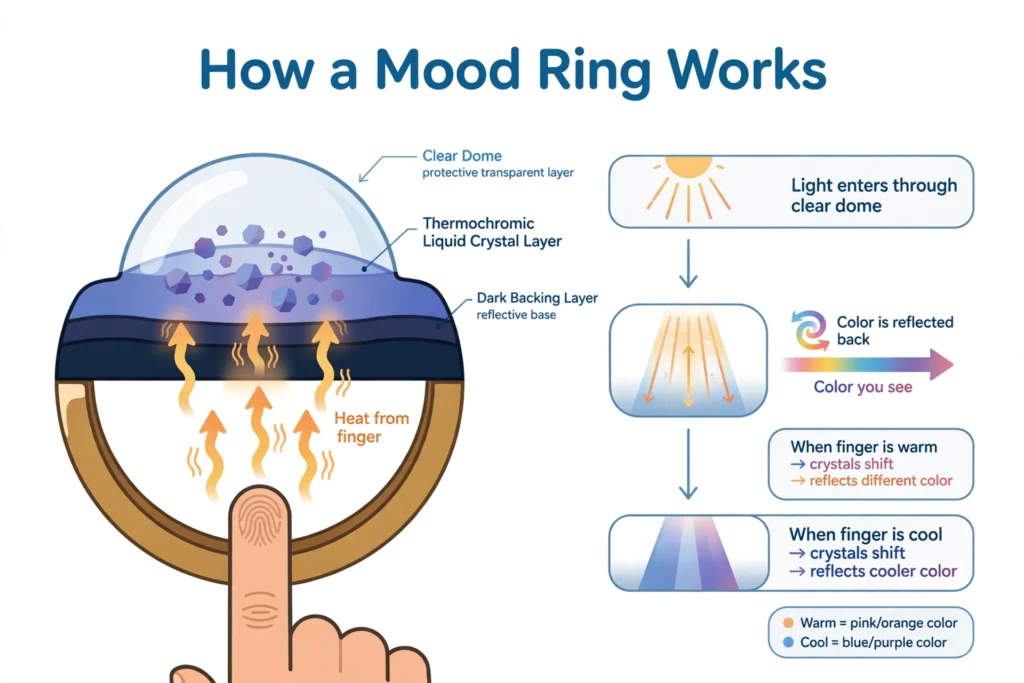
Inside the “stone” of a mood ring is a thin layer of thermochromic liquid crystals, sealed under a clear glass or quartz dome. Thermochromic simply means the material changes color when its temperature changes.
When your finger warms or cools, the crystals twist and shift their arrangement. That shift changes which wavelengths of light they reflect back to your eyes. You see that change as a different color.
This is the same basic idea behind some liquid crystal thermometers. A mood ring is, in effect, a small thermometer you wear on your finger.
Why temperature is linked to mood at all
There is a loose, real connection between feelings and finger temperature, and it runs through your blood flow:
- When you relax, blood flows more freely to your hands and fingers, and your fingers get slightly warmer.
- When you feel stressed or anxious, your body often pulls blood toward your core organs, and your fingers get slightly cooler.
That is the whole scientific basis for mood rings. It is real, but it is very indirect. Many other things change your finger temperature too, including room temperature, exercise, caffeine, how tightly the ring fits, and whether you just came in from the cold.
So a mood ring measures temperature well enough to be fun. It does not measure emotions directly, and it cannot tell you exactly how you feel.
Where green sits on the temperature scale
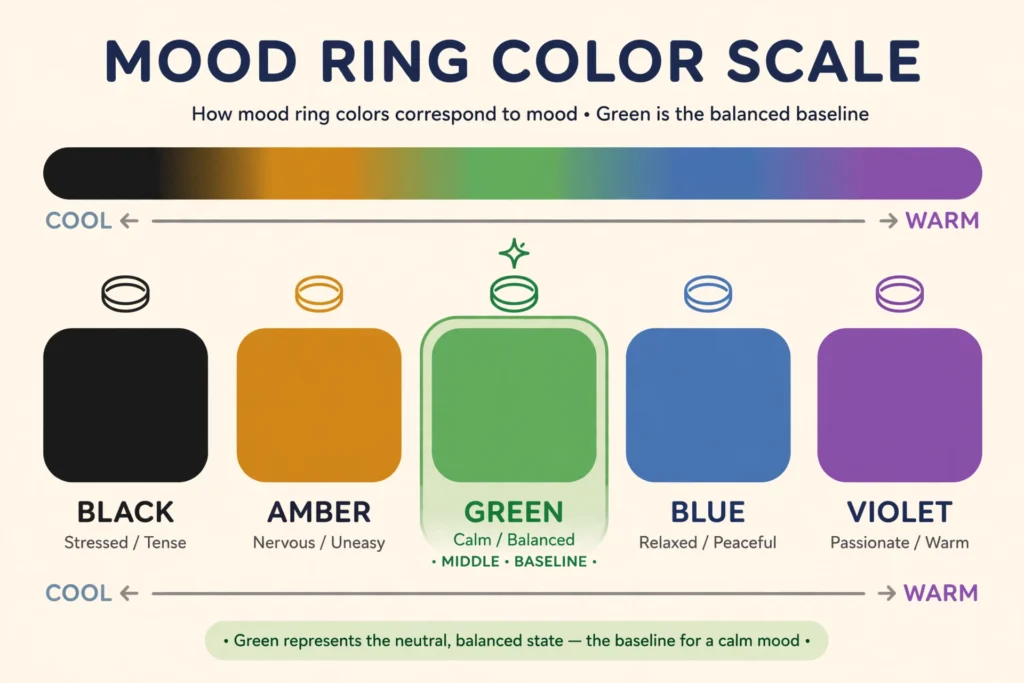
On the classic 1970s-style chart, the scale runs roughly like this, from coolest to warmest:
- Black or gray: Coldest — listed as tense, stressed, or anxious (or a damaged ring)
- Amber or yellow: Cool — listed as nervous, unsettled, or unhappy
- Green: Middle — listed as average, calm, and balanced
- Blue-green: Mildly warm — listed as relaxed and comfortable
- Blue: Warm — listed as calm, happy, and relaxed
- Violet or purple: Warmest — listed as passionate, excited, or very happy
Green is the middle of that scale on purpose. Many rings are calibrated so that their neutral color shows at around average skin temperature on a resting hand, and green is the color most makers chose for that neutral point.
You will see different temperature numbers quoted for green in different guides — some say around 91–93°F (about 33–34°C), while others give much lower figures. Those numbers conflict because different brands use different crystal formulas, and some guides mix up finger surface temperature with body temperature. Do not trust a single exact number for your ring. Treat green as “around your normal resting finger temperature” and check your own ring’s chart for anything more specific.
What Green Means in Detail
Green means calm, not bored
A common misunderstanding is that green means you feel nothing. It does not.
Green means your body is in a settled, everyday state. You might be focused on work, chatting with a friend, reading, or just sitting comfortably. You are neither wound up nor drained. Think of it as your body’s “all normal here” signal.
Some charts add extra shades of meaning to green, such as:
- Balanced: Your energy is steady, not swinging high or low
- Comfortable: You feel at ease in your surroundings
- Interested and alert: You are awake and paying attention, without stress
- In control: You are handling things calmly rather than reacting strongly
None of these are proven readings. They are the friendly labels that chart makers attached to the middle of the temperature scale.
Green is the color your ring is designed to show most often
If you wear a mood ring all day, you will probably see green more than any other color. That is not a coincidence.
Makers calibrate most rings so that green appears at normal, comfortable conditions. If your ring almost never turned green, it would feel broken or confusing. Green is the resting state, so it is also the most frequent state.
If your ring is green for hours at a time, that is normal. It does not mean your ring is stuck, and it does not mean your mood never changes. It just means your finger temperature has stayed in the same middle range.
Green does not mean you are happy or sad
Green sits below blue on most charts, and blue is usually the “happy and relaxed” color. That does not make green a negative color.
Green is neutral-positive. It means things are fine and steady. Blue means warmer and more relaxed. Violet means warmer still. Green is simply one step before those warmer, more energized states — not a sign that something is wrong.
The Different Shades of Green (and What They Mean)
Not all greens on a mood ring are the same. This is where many readers get confused, because a light green, a deep green, and a yellow-green can mean different things on different charts.
Here is how the shades are usually read:
Plain green
This is the classic baseline. It means calm, normal, and balanced. If your chart lists only one green, this is it.
Dark or deep green
Some charts treat a deeper green as a slightly calmer, more grounded version of plain green. Others do not distinguish it at all. Unless your own chart lists dark green separately, read it the same way as plain green: calm and settled.
Light green
Light green is the shade most likely to cause confusion. Some charts list it as a slightly stressed or alert state — a step toward yellow. Others list it simply as calm. One guide even links light green to feeling a little jealous, as in “green with envy,” but that is a playful folk association, not a standard chart meaning.
If your ring shows light green, the safest reading is: slightly cooler than plain green, so possibly a little less relaxed, but still close to normal. Do not read jealousy or any specific emotion into it unless your own chart says so.
Yellow-green
Yellow-green sits between green and yellow on most charts. It usually means mixed emotions, a little unsettled, or slightly nervous. Your finger is a bit cooler than it is at plain green, so the chart treats it as a step away from calm and toward tension.
Blue-green (teal)
Blue-green sits between green and blue. It usually means relaxed, comfortable, and slightly alert — a warmer, more positive version of green. If your ring moves from green to blue-green, your fingers have warmed up a little, and most charts read that as a move toward greater relaxation.
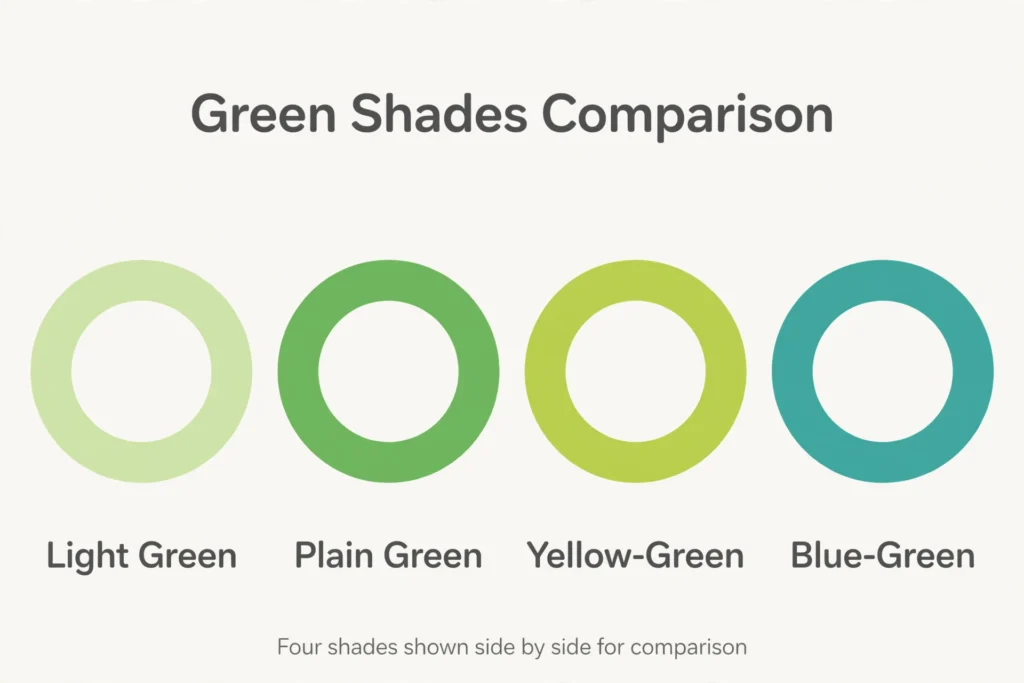
A quick shade guide
- Yellow-green: Mixed, slightly unsettled — a little cooler than plain green
- Light green: Calm, or slightly alert depending on the chart — near green, possibly a touch cooler
- Plain green: Calm, normal, balanced — average resting finger temperature
- Dark green: Calm and grounded — around the same range as plain green
- Blue-green (teal): Relaxed and comfortable — a little warmer than plain green
Remember: these shade meanings vary more than the plain green meaning does. Two brands can easily disagree on light green or yellow-green. Your ring’s own chart wins over any general guide, including this one.
Why Your Ring’s Chart Might Disagree With This Guide
If you search for mood ring meanings, you will notice the charts do not all match. That is not a mistake in one guide. It is how mood rings work as a product.
Here is why:
- No standard exists. No scientific or industry body ever set official mood ring colors. Each company invented its own chart, and no two mood ring brands are required to use the same chart.
- Different crystals, different colors. Modern rings use different thermochromic materials. One ring might be green at a temperature where another ring is blue or yellow.
- Colored domes change the color. A yellow glass or plastic dome over a blue crystal can make the stone look green. The color you see is the combination, not the crystal alone.
- Some rings cycle through colors. Some modern pigments repeat colors as temperature rises, so the same color can appear at two different temperatures.
- The 1970s charts are not universal. The classic chart in this article is the traditional one, but many modern sellers use their own version.
This is why green is best understood as a general, traditional meaning — calm and normal — rather than a precise measurement. If your ring’s chart says green means something slightly different, follow your chart. It was made for your ring’s specific crystal formula.
How to Interpret Green on Your Own Ring
Use this simple process instead of guessing from a single glance:
1. Wait for the ring to settle
Give the ring a minute or two on your finger before you read it. A ring straight out of a drawer or jewelry box is at room temperature, not skin temperature, and its first color means very little.
2. Wear it snugly, indoors, at rest
A loose ring reacts more to the air than to your skin. A snug fit gives a more consistent reading. For the most meaningful reading, check it indoors at a normal room temperature, not right after coming in from hot or cold weather, exercising, or washing your hands.
3. Compare green to your own baseline
Your baseline is the color your ring shows most often when you feel fine and comfortable. For most people, that baseline is green or blue-green. Once you know your baseline, a shift away from it is more informative than any single color.
For example:
- Green after a stressful morning, when your ring was gray or amber, may mean you have settled down.
- Green after blue, when you were feeling very relaxed, may mean you have cooled down slightly and returned to normal.
- Green all day, every day, probably just means your ring’s neutral point matches your normal finger temperature well.
4. Look at the direction of change, not just the color
A ring moving from amber toward green is warming up. A ring moving from blue toward green is cooling down. The direction often tells you more than the single color, because it shows whether your hands are warming or cooling over a few minutes.
5. Check what else could explain the color
Before you decide green means you are calm, ask yourself:
- Is the room comfortable, or is it warm or cold?
- Have you just exercised, eaten, or had caffeine?
- Is the ring sitting snugly, or is it loose?
- Have you been outside recently?
If any of those answers explain the temperature, they explain the color too. That does not make the ring useless — it just means you should not treat it as a mind reader.
6. Keep a short note if you want to learn your ring
If you enjoy mood rings and want to understand yours better, jot down the color and how you actually feel a few times a day for a week. You will quickly learn whether your ring’s green matches your calm moments, or whether it just matches comfortable room temperature. That personal pattern is far more useful than any generic chart.
What Green Does Not Mean
It is worth clearing up a few claims you may see online:
- Green does not diagnose stress, anxiety, or any health condition. A mood ring is a novelty item, not a medical device.
- Green does not tell you what someone else is feeling. You cannot read another person’s mood from their ring, especially since hand temperature varies from person to person.
- Green does not mean you are in love, or not in love. Love and attraction are not measured by finger temperature, and no chart can claim otherwise with any scientific backing.
- Green does not mean your ring is working perfectly. A damaged ring can get stuck on one color, including green or black. If your ring never changes color at all, even between a cold room and a warm hand, the crystal layer may have degraded.
- Green is not a “good” or “bad” grade. It is a middle, neutral reading. You do not need to try to turn your ring blue or violet, and staying green is not a failure.
When Green Might Actually Mean Something Is Wrong With the Ring
Green is usually a healthy, normal reading. But a few situations are worth checking:
Your ring is always green and never changes
Try this test: hold the ring in a warm hand for a minute, then hold it against something cool (not ice-cold water, which can damage it). A working ring should shift color, at least a little. If it never changes, the liquid crystal layer may be worn out.
Your ring turned green after being black for weeks
That can simply mean your hands are warmer now, or the weather changed. It can also mean the ring is recovering from cold exposure. Either way, it is not a cause for concern on its own.
Your ring shows green on one finger and a different color on another
That is normal. Fingers run at slightly different temperatures, and a ring fits differently on each finger. It does not mean one hand is calm and the other is not.
Your ring went black and will not come back
Black is the usual sign of a cold ring, but a ring stuck on black or dark brown is also the classic sign of water damage or a degraded crystal layer. Mood ring crystals are easily damaged by water, heat, sunlight, and harsh chemicals. If your ring stays black indoors on a warm hand, it may be worn out rather than reading a mood. Once the crystal layer breaks down, it cannot be repaired or recharged.
To keep a mood ring working longer, keep it dry, avoid showers and swimming while wearing it, store it in a cool, dry place, keep it out of long direct sunlight, and clean it only with a soft, dry cloth.
Buying a Mood Ring? What to Look For
If you are buying a mood ring because you like the green color and the idea behind it, a few practical points help:
- Check whether the seller includes a color chart. Since charts vary, a ring without its own chart is harder to interpret. Ask for the chart before you buy if it is not shown.
- Do not pay extra for “accurate emotion detection.” No mood ring can detect emotions accurately. Sellers who promise exact mood readings are overselling a novelty product. The same caution applies to any online seller making a bold claim — it is worth checking whether a website is a scam before you trust an unfamiliar store with your money.
- Expect green to be the default. A good ring should show green at normal room temperature on a resting hand. If it shows black or violet under those conditions, its calibration is unusual, and its chart will be harder to use.
- Treat water resistance claims carefully. Many mood rings are still damaged by water, even if a listing calls them durable. When in doubt, take the ring off before washing your hands, showering, or swimming.
- Buy it for fun, not for self-analysis. A mood ring is at its best as a conversation starter, a nostalgic accessory, and a small prompt to pause and notice how you feel. It is at its worst when treated as a test you can pass or fail.
A Brief History of the Mood Ring
Mood rings became a craze in 1975. The most commonly credited inventors are New York inventors Maris Ambats and Josh Reynolds, who launched their version in August 1975. Some accounts also credit New York jeweler Marvin Wernick, who reportedly began working on a similar idea in 1974 after reading about liquid crystals in medical thermometers. The inventor credit is one of the facts sources disagree on, so you will see both names depending on which history you read.
The original rings were expensive for novelty jewelry — around $45 for a silver-plated version and up to $250 for gold — yet they sold in huge numbers in their first months. The fad faded fast as cheap copies flooded the market, but mood jewelry never fully disappeared. It came back in the 1990s, again in 2000s nostalgia shops, and it still sells today in forms from cheap plastic rings to higher-end versions and mood necklaces and bracelets.
That history explains a lot about the charts. Mood rings were sold as fun, fashionable novelties, not as instruments. Their color meanings were marketing choices that stuck because they felt intuitive, not because they were tested in a lab.
Frequently Asked Questions
What does the colour green mean on a mood ring?
On most traditional charts, green means calm, normal, and balanced. It is the baseline color, showing at around average resting finger temperature. It means you are settled — not stressed, and not highly excited.
Is green a good color on a mood ring?
Yes, in the sense that it is a normal, healthy baseline. Green is not a grade, though. You do not need to aim for blue or violet, and staying green does not mean anything is wrong with you or your ring.
What does light green mean on a mood ring?
Light green is usually read as calm, or as slightly alert or slightly stressed, depending on the chart. It sits near plain green, possibly a touch cooler. Unless your own chart defines it separately, treat it as close to normal, not as a specific emotion.
What is the difference between green and blue-green on a mood ring?
Green is the neutral baseline. Blue-green (teal) is a step warmer and is usually read as relaxed and comfortable. If your ring moves from green to blue-green, your fingers have warmed up slightly, and most charts read that as a move toward greater relaxation.
What does it mean if my mood ring is always green?
Usually, it just means your ring’s neutral point matches your normal finger temperature well, and your hands stay in that middle range most of the day. If it never changes color at all, even between warm and cool conditions, test it as described above — the crystal layer may be worn out.
Can a mood ring be green when you are actually stressed?
Yes. Cold hands from stress usually push a ring toward gray, amber, or black, but a warm room, recent exercise, or a snug fit can keep your fingers warm enough to show green even when you feel tense. The ring reads temperature, not your thoughts, so it can easily disagree with how you feel.
Does green mean the same thing on every mood ring?
No. Green means calm and normal on most traditional charts, but brands are free to use their own charts and crystal formulas. Always check the chart that came with your ring, because it was made for that ring’s specific materials.
Why does my mood ring turn green in summer but black in winter?
Because it is reacting to temperature. In summer, your hands are warmer, so the ring moves toward the warmer end of its scale. In winter, cold hands push it toward the cooler end. That seasonal shift is expected, and it is one of the clearest signs that the ring tracks temperature rather than mood alone.
Is there any science behind mood ring colors?
There is real science in the thermochromic material itself — it genuinely changes color with temperature, and temperature is loosely linked to feelings through blood flow. There is no science behind the specific mood labels, though. Those labels are traditional, popular interpretations created by jewelry makers, not findings from emotion research.
Can mood rings really tell your mood?
Not reliably, and not directly. A mood ring can tell your finger temperature, and temperature sometimes moves with your feelings. But room temperature, activity, fit, and your natural hand temperature all affect the reading too, so the color is at best a rough, playful hint — never a diagnosis of how you feel.
What should I do if my mood ring is stuck on green or black?
First, check the fit and the temperature: wear it snugly indoors for a few minutes and see if it changes. If it never changes under clearly different warm and cool conditions, and it has been exposed to water, heat, or sunlight, the crystal layer has probably degraded. That damage cannot be repaired, so the ring will keep its novelty look but will no longer change color.
Bottom Line
Green on a mood ring traditionally means calm, balanced, and normal. It is the baseline color — the one your ring is designed to show when your hands are at a comfortable, resting temperature and you are neither stressed nor highly excited.
That meaning is a popular tradition, not a scientific fact. Your ring measures finger temperature through thermochromic liquid crystals, and a chart turns that temperature into a mood word. Different brands use different charts, so green can mean something slightly different from one ring to the next, and shades like light green, yellow-green, and blue-green add even more variation.
So enjoy green for what it is: a reassuring, everyday reading. If your ring is green, your hands are at a normal temperature, and on most charts that lines up with feeling settled. Just do not treat it as proof of your mood — check how you actually feel, check your own ring’s chart, and let green be a small, fun prompt to notice the moment rather than a verdict on it.