What Is a Magnifying Glass Used For? 9 Proven Uses and Risks
What is a magnifying glass used for? In short, it makes small details look bigger, so people use it to read fine print, inspect tiny objects, study nature, repair electronics and even help with low vision. It can also start a fire if sunlight passes through it, which is the one use you should never try casually.
This guide answers what is a magnifying glass used for by explaining how it works, lists the main uses with the details the sources give, compares the common types and covers the safety rules that fire services publish.
A note on method: I read an RP Photonics explanation of magnifying glasses, a Wiltronics guide to their uses, Optelec’s page on magnifiers for reading, an Encyclopedia.com entry and two UK fire service pages about sunlight and fire. I could not open Wikipedia, so I did not rely on it. I did not test any magnifier myself, and I am not an eye-care professional.
What Is a Magnifying Glass?
A magnifying glass is a simple optical device, usually a single lens in a frame with a handle. RP Photonics says it bends light by refraction, so an object looks larger than it does with the naked eye. Encyclopedia.com calls it “one of the most ancient optical devices known to science” and says most are double-convex lenses.
So, what is a magnifying glass used for at its core? It helps your eye see detail it can’t resolve alone, whether that is a line of tiny text, a stamp’s printed design or an insect’s leg.
Magnifying Glass vs. Loupe
The two names are often mixed up. According to RP Photonics:
- A loupe is used close to the eye.
- A magnifying glass, also called a hand lens, is held farther away, is larger and typically has a focal length of 125 mm or more.
If you are shopping, the difference matters. A loupe suits jewelry and electronics work, while a hand lens suits reading and general viewing.
How a Magnifying Glass Works
When you hold the lens close to an object, it bends light toward the lens’s center, and the enlarged image you see is called a virtual image. Encyclopedia.com adds that if the object is far enough away, the image flips and appears smaller and inverted, which it calls a real image.
RP Photonics defines magnification as the ratio of an object’s apparent size with and without the glass. It notes that the eye matters too, because the eye can focus on either the text or the glass itself.
How Strong Can a Magnifier Be?
- A simple magnifier usually gives about 2× to 6×, per RP Photonics.
- With a simple lens, higher magnification lowers image quality.
- Multi-lens triplet magnifiers reach about 30×, but they have a small field of view and let in less light. RP Photonics says they should be held close to the eye, so they are better called loupes.
- For stronger views, people use a microscope.
What Is a Magnifying Glass Used For? 9 Common Uses
Here is what a magnifying glass is used for, based on the sources I read.
1. What Is a Magnifying Glass Used For in Reading Small Print?
This is the most familiar use. RP Photonics lists reading small print, and Wiltronics says magnifiers are used daily for simple tasks such as reading fine print. Optelec’s page describes the magnifying glass as a reading aid for people with a visual impairment, making reading easier at home, at work and on the go.
2. What Is a Magnifying Glass Used For With Low Vision?
Wiltronics says handheld magnifiers are portable, inexpensive aids for tasks such as reading a medicine label, checking prices or reading maps. Optelec, which answers what is a magnifying glass used for for readers, describes several forms, which I cover in the types section below. The right strength, Optelec says, depends on the text size or object and on your remaining vision, so it recommends personal advice for choosing.
3. Inspecting Small Objects
Because it reveals small details, a hand lens is a basic inspection tool. People use one to look at coins, stamps, fabric weave, printed circuits and tiny parts. The sources I read describe close viewing of small details, but they don’t give a list of collectibles, so treat these examples as general uses.
4. What Is a Magnifying Glass Used For in Science?
Wiltronics says magnifiers are common in most labs, where they are “the simplest form of a basic microscope.” It also says they are used to study microscopic organisms in biology and that early magnifiers were the foundation of advances in biology and astronomy.
Encyclopedia.com says the magnifying glass was the forerunner of the compound microscope, which uses a series of lenses and is one of the basic tools of medicine.
5. Detective Work and Play
Wiltronics notes that children playing detective use one to hunt for tiny clues and says Sherlock Holmes may have used one. It is a fun way to start kids on observation.
6. What Is a Magnifying Glass Used For Outdoors?
Wiltronics suggests taking a magnifier outdoors to reveal the smallest things around you. Leaves, bark, insects and flower parts all look different up close. This is general guidance, but it is a low-cost way to learn.
7. Close Precision Work With Head-Worn Magnifiers
Wiltronics says binocular magnifiers are worn on the head, alone or over glasses, and are commonly used for close-up precision. Hobbyists and repair workers use this kind of tool, though the page doesn’t name specific trades.
8. Reading Documents With Desktop Video Magnifiers
For people with low vision, Wiltronics describes fixed desktop video magnifiers used to read documents, write letters and read newspapers. Newer models add HD monitors and optical character recognition. These are not simple glass lenses, but they do the same job of making small things larger.
9. What Is a Magnifying Glass Used For as a Burning Glass?
RP Photonics lists a burning glass as a use: concentrating sunlight to ignite material such as paper at the focal plane. Encyclopedia.com says holding a lens at the right distance can concentrate sunlight into a point that generates enough heat to start a fire.
So the answer to what is a magnifying glass used for includes a warning. This is also a hazard, which is why the safety section below matters.
Types of Magnifying Glasses: Which Fits What Is a Magnifying Glass Used For in Your Case?
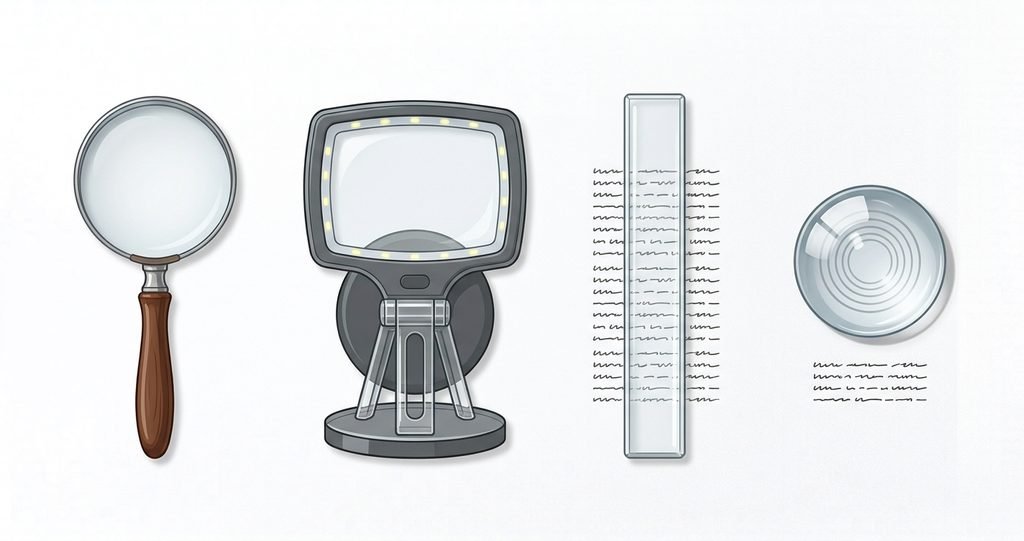
Optelec describes four forms for reading, and Wiltronics adds a few more:
| Type | What it is | Best for |
|---|---|---|
| Handheld | Lens on a handle you move over text | Quick checks at home or outdoors |
| Stand | Sits on the document so it stays steady | Long reading, or people who find holding a lens hard |
| Bar | Placed on the page to enlarge one line at a time | Reading a line of print or handwriting |
| Dome | A round design that glides over a page | Books, magazines and photos |
| Compact, often in a hard case; some have multiple lenses | Carrying in a bag | |
| Magnifying lamp | Lens on a flexible arm, moved over the work | Reading and detailed tasks, depending on lens size and lighting |
| Head-worn binocular | Worn on the head, alone or over glasses | Close precision work |
Wiltronics adds that freestanding magnifiers are hands-free reading aids that keep a set distance and focus, useful for people with unsteady hands.
Lens Materials and Light
The sources describe a few design choices that change how a magnifier performs:
- Glass biconvex lenses are the simplest and work for a not-too-large field of view (RP Photonics).
- Plastic lenses are often aspheric, which is practical to make in plastic.
- Aplanatic designs use two plano-convex lenses with the convex sides facing inward. They show low distortion and are popular as reading glasses.
- Fresnel lenses, such as thin sheet magnifiers, allow very large magnifiers but reduce image quality.
- Built-in lighting is common on some models. Light through the lens is brighter but can cause stray reflections unless the lens has good anti-reflection coatings.
Magnifying Glass Safety: The Fire Risk
Part of the answer to what is a magnifying glass used for is a safety rule. A magnifying glass can focus sunlight onto a small spot. RP Photonics warns that one left in a sunny location, such as a shop window, can start a fire, and it advises covering the glass when not in use.
UK fire services give similar warnings about magnifying mirrors and glass. Merseyside Fire & Rescue said on 19 January 2022 that two serious fires in six days were caused by sunlight reflected off mirrors, with one home left uninhabitable and no one injured. Its advice included:
- Keep magnifying mirrors out of direct sunlight.
- Avoid placing glass ornaments or paperweights on window sills.
- Never leave shaving or vanity mirrors on windowsills.
- Keep aerosols and other flammable items out of direct sunlight.
- Keep working smoke alarms on every level of the home and test them weekly.
Hereford & Worcester Fire and Rescue Service gives matching advice and notes an outdoor case in Malvern where sunlight through a glass bottle in a flower bed ignited a hedge that spread to a building.
Those pages are about mirrors and glass objects generally, not magnifying glasses specifically, but the physics is the same: focused sunlight can start a fire.
General Safety Tips
They are general habits, not findings from one source:
- Store your magnifier in a drawer or case, not on a windowsill.
- Never point a lens at sunlight to burn things, especially with children around.
- Don’t look at the sun through any magnifier. That can damage eyesight.
- Keep paper and fabric away from a lens used outdoors.
- Teach children to treat it as a tool, not a toy.
How to Choose a Magnifying Glass
If you now know what a magnifying glass is used for in your own life, match it to the job:
- Reading small print: try a bar, dome or stand magnifier.
- Hobby or repair work: consider a head-worn magnifier or a magnifying lamp for hands-free viewing.
- Close inspection: a pocket magnifier or loupe is easy to carry.
- Low vision: ask an eye-care professional or a specialist supplier, because the right strength depends on your remaining vision.
- Strength: a simple magnifier gives about 2× to 6×, and more power usually means a smaller field of view and less light.
- Lighting: pick a lit model if you read in dim rooms.
What to Check Before You Buy
Once you know what is a magnifying glass used for, check these:
- Lens size, since a larger lens shows more at once.
- Whether the frame is stable and comfortable to hold.
- Whether the lens is glass or plastic.
- The stated magnification, and whether it is for the lens alone or the whole kit.
- Return policy, if you can’t test it first.
A Short History Behind What Is a Magnifying Glass Used For
Encyclopedia.com says Egyptians used chips of crystal or obsidian to view small objects thousands of years ago, and that Roger Bacon (c. 1220–1292) is believed to have designed the first magnifier built for scientific purposes in the 13th century. It also says Emperor Nero watched actors on a distant stage through gemstones, though that is a reported claim I did not verify elsewhere.
Common Mistakes When Asking What Is a Magnifying Glass Used For?
- Holding the lens too far from the object, which gives a blurry or flipped image.
- Expecting a cheap lens to give strong magnification without losing clarity.
- Leaving it in a sunny window, which RP Photonics warns can start a fire.
What Is Verified and What Is Not
| Claim | Status |
|---|---|
| Answer to what is a magnifying glass used for: see the nine uses above | Stated across the sources |
| A simple magnifier gives about 2× to 6× | Stated by RP Photonics |
| Triplet loupes can reach about 30× | Stated by RP Photonics |
| Hand lenses typically have a focal length of 125 mm or more | Stated by RP Photonics |
| A magnifier left in sunlight can start a fire | Stated by RP Photonics; related warnings from two fire services |
| Handheld, stand, bar and dome types exist | Stated by Optelec |
| Magnifiers were forerunners of the microscope | Stated by Encyclopedia.com |
| Roger Bacon designed the first scientific magnifier | “Believed to,” per Encyclopedia.com |
| Nero watched actors through gemstones | Reported by Encyclopedia.com; not verified elsewhere |
| Magnifiers can replace an eye exam or prescription | Not claimed by any source; do not assume |
| Exact price or brand recommendations | Not covered; I gave none |
Frequently Asked Questions
What is a magnifying glass used for? It makes small details look larger for reading, inspecting, science work, hobbies and low-vision aid. It can also focus sunlight to start a fire.
What is a magnifying glass used for in science? Wiltronics says labs use it as the simplest form of a basic microscope and for studying small organisms.
What is a magnifying glass used for in reading? Reading small print, medicine labels and maps. Optelec describes bar, dome, stand and handheld types for this.
How strong is a magnifying glass? A simple one gives about 2× to 6×, according to RP Photonics. Triplet loupes reach about 30×.
What is the difference between a magnifying glass and a loupe? A loupe is used close to the eye. A hand lens is held farther away and has a focal length of 125 mm or more.
Can a magnifying glass start a fire? Yes. RP Photonics says one left in a sunny spot can, and fire services warn about sunlight magnified by mirrors and glass.
What is a magnifying glass used for by people with low vision? Everyday tasks such as reading labels, prices and maps. The right strength depends on remaining vision, so get personal advice.
Who invented the tool behind what is a magnifying glass used for? No single inventor is named in the sources I read. Encyclopedia.com says Roger Bacon is believed to have designed the first scientific magnifier in the 13th century.
Is a magnifying glass good for kids? It can be, with supervision. Teach them never to focus sunlight.
Bottom Line
So, what is a magnifying glass used for? It makes small things readable and visible, which is why it shows up in reading, low-vision support, labs, hobbies, repair work and children’s exploration. Now that you know what is a magnifying glass used for, pick the type that fits the job, remember that more power usually means a smaller view and less light, and keep it out of direct sunlight, because the same lens that helps you read can start a fire.
Related guides on this site: our brand name normalization rules and our review of the Mobile Edge eco-friendly briefcase show how we check product claims.