What Does ICL Mean in Text? “I Can’t Lie,” Explained
If someone just sent you “icl” and you had to stop and stare at it, you are not behind. It is a small abbreviation, it shows up without warning, and it looks like it could mean almost anything.
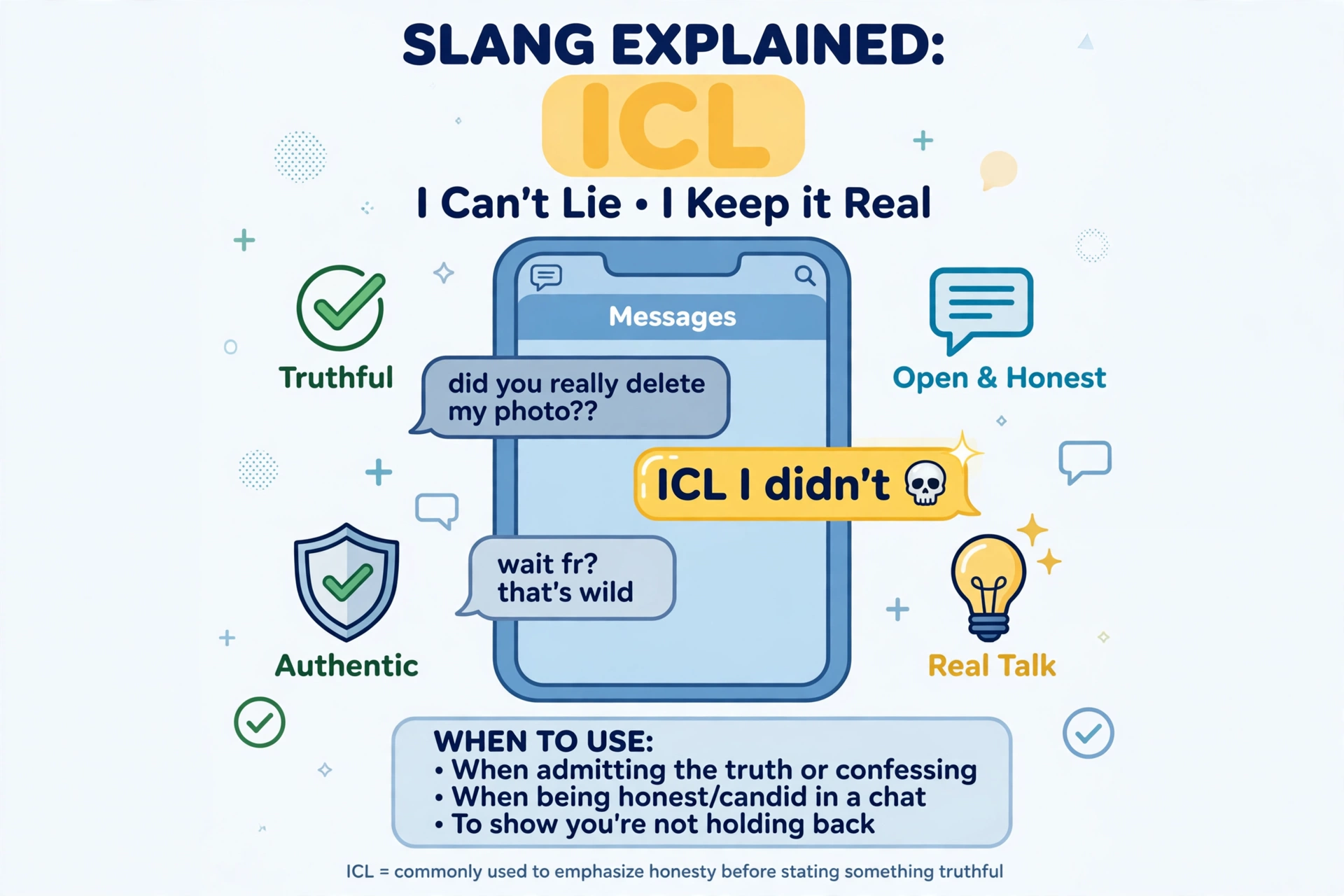
Here is the short answer up front: in texting and on social media, icl almost always means “I can’t lie.”
It is a quick honesty flag. When you see it, the sender is telling you that what follows — or what just came before it — is their real opinion or feeling, not a joke, not sarcasm, and not something they are just saying to be polite.
In this guide, you will learn exactly how icl is used, why its position in a message changes its tone, how to tell what it means from context, and how it differs from close cousins like ngl and tbh. You will also learn the other things ICL can stand for outside of texting, so you do not mix them up.
The Short Answer
ICL means “I can’t lie” in texting.
People usually type it in lowercase, as “icl,” and they use it the same way you might use “honestly” or “to be honest” in spoken conversation. It goes before or after an opinion, a reaction, or a small confession.
For example:
- “icl that movie was way better than I expected”
- “that test was hard icl”
- “icl I was nervous before the interview”
In each case, icl does not change the facts of the sentence. It changes how you should read it. It tells you the sender means it sincerely.
That is the whole core meaning. Everything else in this article is about using that meaning correctly — and about spotting the rare cases where the letters mean something else entirely.
What ICL Means in a Text
Think of icl as a tone marker. Text messages strip out facial expressions and voice tone, so a compliment can read as sarcasm and a criticism can read as an attack. Icl steps in to remove that doubt.
When someone writes “icl,” they are usually doing one of these things:
- Admitting something slightly vulnerable. “icl I miss summer already” is an honest feeling the sender might normally keep quiet.
- Giving an opinion they know others may not share. “icl I don’t like pineapple pizza” warns you that an unpopular take is coming.
- Backing up a compliment so it does not sound fake. “icl you handled that really well” reads as sincere praise, not flattery.
- Owning up to something. “icl I forgot completely, my bad” is a small, honest confession.
Notice what icl is not doing in any of these examples. It is not a promise, and it is not about refusing to lie for someone else. That is a common mix-up. In normal texting, icl does not mean “I won’t lie for you.” It means “I am being honest about this right now.”
Where You Will See ICL
You will most often see icl in casual, fast-moving places:
- One-to-one texts and group chats
- TikTok captions and comments
- Snapchat messages and replies
- Instagram DMs and comments
- Discord servers and other casual chat apps
It fits those places because it is short, informal, and low-effort — exactly the kind of shorthand that works when a conversation is moving quickly. You will rarely see it in a formal email, a job application, or a school essay, and that is by design. In those settings, “honestly” or “to be honest” does the same job without the slang.
On TikTok in particular, icl often appears in captions and comments as a quick way to signal that an opinion is real rather than posted just for attention. As Parade’s guide to ICL puts it, the abbreviation is commonly used to introduce an honest reaction on TikTok and other social platforms, in captions, comments, or replies.
How ICL’s Position Changes Its Tone
The meaning of icl stays the same wherever it sits, but the feel of the message shifts a little. This is the first thing to check when you are trying to read a message correctly.
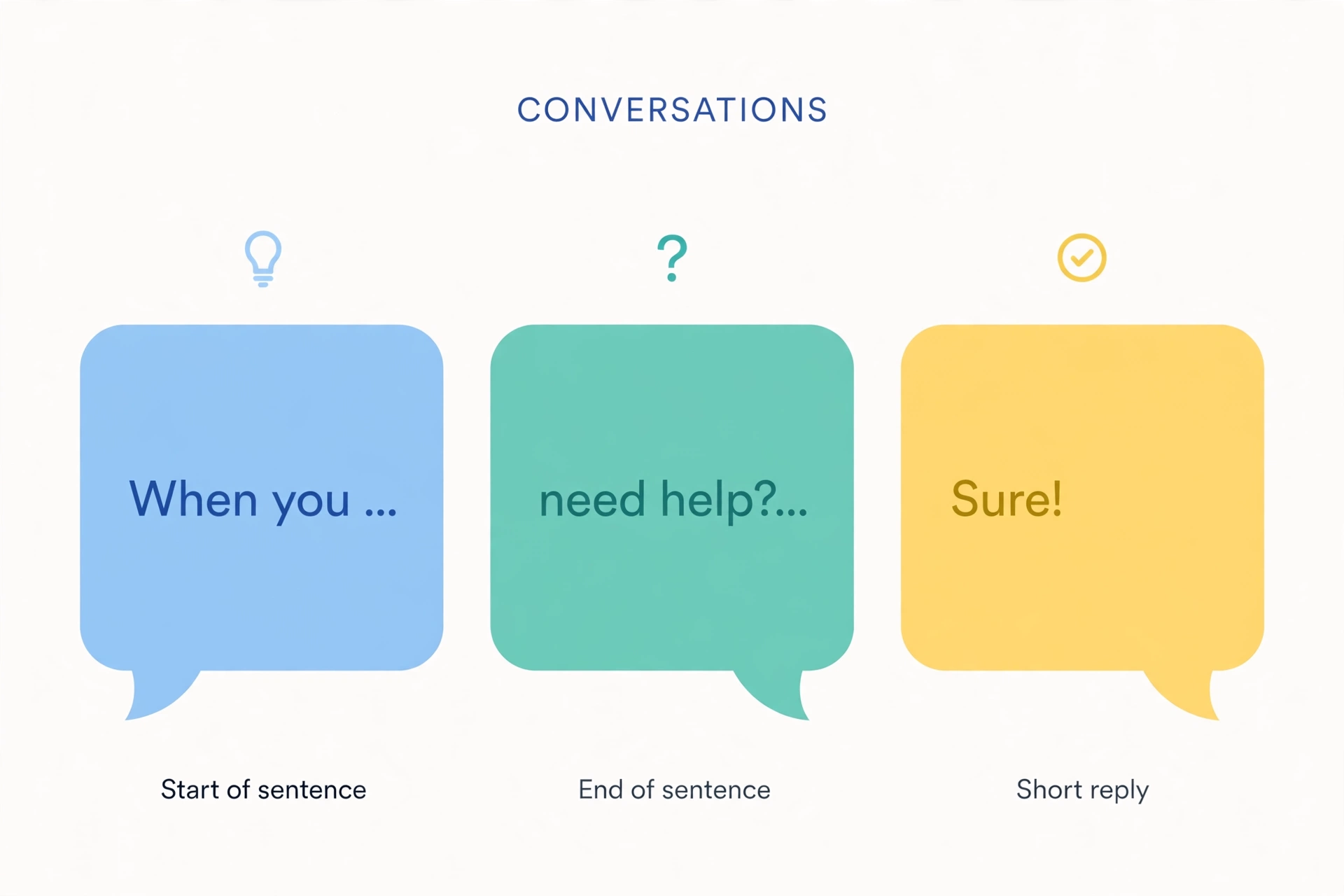
ICL at the start of a message
When icl opens a message, it works like a heads-up: something honest is coming.
- “icl I don’t think this restaurant is worth the hype”
- “icl that song is stuck in my head”
- “icl I’m nervous for tomorrow”
This version sounds a little more careful. The sender is preparing you before the opinion lands.
ICL at the end of a message
When icl closes a message, it adds weight after the fact, like a shrug that says “and I really mean that.”
- “that was a pretty good concert, icl”
- “this class is so long icl”
- “that test was hard icl”
This version sounds more relaxed and offhand. The opinion comes first, and the honesty marker lands as a final emphasis.
ICL on its own
Sometimes icl stands alone as a one-word reply. In that case, it usually means something close to “honestly, same” or “I can’t even deny it.”
For example, if a friend sends a message you completely agree with, replying with just “icl” can work as a short way of saying you honestly feel the same way. It only works when the message you are replying to already makes the meaning clear, though. On its own, out of nowhere, it will just confuse people.
Lowercase icl vs uppercase ICL
Capitalisation also nudges the tone. Lowercase “icl” reads softer and more casual, like a passing thought. Uppercase “ICL” reads more deliberate, like the sender is planting a flag on their opinion. The meaning does not change, but the emphasis does.
How to Tell What ICL Means From Context
In almost every casual chat, “I can’t lie” is the right reading. Still, it helps to have a quick checklist for the moments when a message is unclear. Work through these questions in order.
1. Is it in a casual chat, comment, or DM?
If yes, read it as “I can’t lie.” This covers texts, TikTok comments, Snapchat messages, group chats, and Instagram DMs. The surrounding words will almost always be an opinion, a feeling, or a reaction.
2. Does it sit next to a feeling or an opinion?
Look at what comes right before or right after it. If the rest of the sentence is something like “that was fun,” “I’m nervous,” “this is overrated,” or “you were right,” then icl is doing its usual honesty job.
Try replacing it with “honestly” in your head:
- “icl that was fun” becomes “honestly, that was fun” — that works.
- “that was fun icl” becomes “that was fun, honestly” — that works too.
If “honestly” fits smoothly in that slot, you have your answer.
3. Does the message sound sincere or dismissive?
This is the key test for the one confusing look-alike. If the sentence sounds sincere — praise, a confession, a real opinion — it is “I can’t lie.” If the sentence sounds dismissive, like the sender is brushing something off, they probably meant a different abbreviation entirely, such as IDC (“I don’t care”). Icl itself is not normally used to express indifference, even though a few online dictionary entries list “I care less” as a possible expansion. That phrase does not work well as standalone English, and it is not the meaning people normally intend in a chat.
4. Is the conversation about something other than chat?
If the message is about eye surgery, lenses, or vision, about cricket teams and seasons, or about a university or a company, then ICL may not be slang at all. See the section below on other meanings — but only go there if the context clearly points away from texting.
5. Are there other slang words stacked around it?
Sometimes icl appears in a longer string of slang, especially in TikTok-style comments. In those strings, icl still means “I can’t lie,” but the words next to it can change the overall tone. Some viral slang strings include crude or rude words, so if the rest of the string looks rough, do not assume the whole message is polite just because icl on its own is harmless. Read the full string, not just the three letters you recognise.
ICL vs NGL vs TBH vs FR
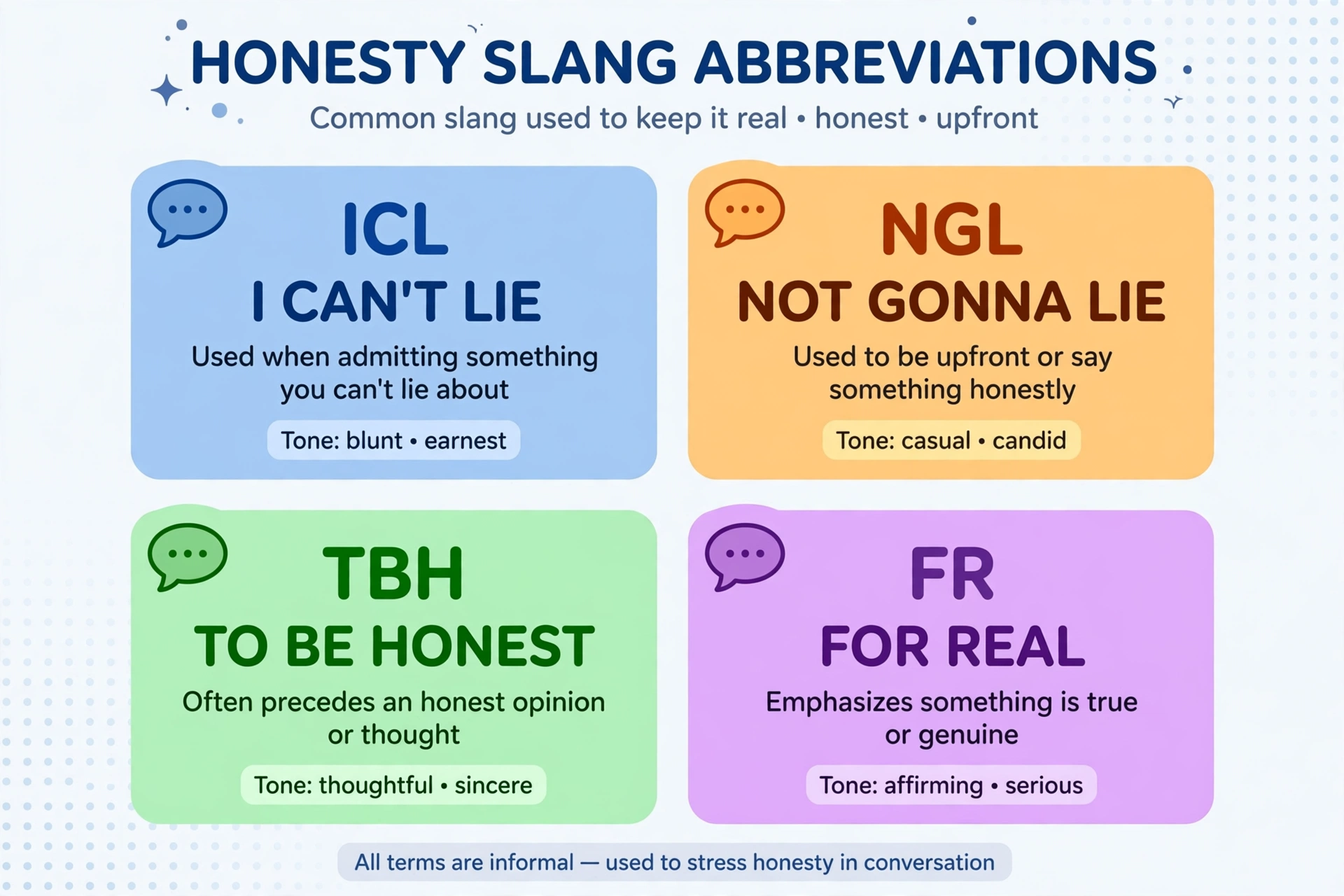
Icl has several close cousins, and mixing them up is easy. They all signal honesty, but they do not feel quite the same. SlangSense’s comparison of icl with ngl, tbh and fr makes the same point: icl and ngl are close twins that often come before an admission, while tbh can sound blunter and fr more often backs up a point.
Here is how they differ in practice:
- ICL — “I can’t lie.” Sincere, sometimes a little vulnerable. Best before a genuine feeling or confession. Example: “icl I miss you.”
- NGL — “Not gonna lie.” Almost the same job as icl, and often a little lighter or more playful. You can usually swap icl and ngl without anyone noticing. Example: “ngl that outfit is cute.”
- TBH — “To be honest.” A franker opinion, and it can sound harsher than icl. It fits mild criticism well, but it fits less well when you are trying to be gentle. Example: “tbh the ending was weak.”
- FR — “For real.” The odd one out. It often agrees with someone or emphasises a point, rather than introducing a confession. Example: “this class is so long fr.”
- IDC — “I don’t care.” The opposite job. This is the abbreviation for indifference, not honesty. Do not confuse it with icl. Example: “idc what they think.”
A simple rule of thumb: match the weight of the abbreviation to the weight of what follows. Icl carries a little emotional weight, so it can sound oddly heavy on something trivial. “Icl this coffee is warm” reads strangely, because there is nothing honest or vulnerable to admit about a warm coffee. Save icl for moments when sincerity actually adds something.
Other Things ICL Can Mean (Outside of Texting)
Outside of casual chat, the same three letters have completely different jobs. These are not texting meanings, and you should not present them as if someone in a group chat meant them. They only matter when the context clearly points away from texting.
- Implantable collamer lens. In eye care, ICL is a thin lens placed inside the eye to correct short-sightedness. You will see this meaning on clinic pages and in discussions of vision surgery, often alongside words like lens, myopia, or consultation.
- Indian Cricket League. In sports writing, ICL was a private Twenty20 cricket competition launched in 2007. It is a historical reference, not a live tournament, and you will only meet it near cricket teams, seasons, and history.
- Imperial College London. In education and job posts, ICL can refer to the London university. The surrounding words — courses, admissions, research — make this one obvious.
- International Computers Limited. In computing history, ICL was a British mainframe computer company. You will only meet this meaning in tech-history writing.
- “In cyber life.” This is an old, rare meaning recorded in an early online dictionary entry from 2009, as a partner to IRL (“in real life”). It is not current texting slang, and you should not read a modern message this way.
- “I cried laughing” and joke entries. A few online dictionary entries list these, but they are rare next to the many entries that say “I can’t lie.” Treat them as curiosities, not as meanings you should expect in a normal chat.
One error worth avoiding: some guides claim a sports meaning along the lines of an “International Champions League.” That competition name does not match the real sporting ICL, which is the Indian Cricket League. If you see that claim, treat it with caution.
When to Use ICL — and When Not To
ICL works well when:
- You are texting friends, family, or anyone you are relaxed with
- What follows is genuinely sincere — praise, a confession, or an honest opinion
- You are writing a caption or comment where your tone could easily be misread
- You want to soften a hot take without backing down from it
Skip ICL when:
- You are writing a work email, a job application, or anything academic
- You are talking to someone who does not know texting slang — clarity beats brevity
- The content is trivial and there is nothing sincere to flag
- The rest of your message already includes crude or rude slang that could change how the whole message is read
The one-second test before you send is simple: ask whether “to be honest” would fit in the same slot. If it would, icl works. If “to be honest” sounds too heavy there, icl will too — so use ngl, or nothing at all.
How to Reply When Someone Sends You ICL
The best reply depends on what the sender actually admitted, not on the abbreviation itself. Respond to the feeling or the opinion, not to the letters.
- “icl I’m nervous for tomorrow” → “That’s normal, you’ve got this. Want to practice tonight?”
- “icl this song is mid” → “Nah, it grows on you. Give it two more listens.”
- “icl I miss you” → “I miss you too. Let’s hang out this weekend.”
- “icl that movie was actually really good” → “Right? I wasn’t expecting to like it that much either.”
If you agree with a hot take, a simple “icl same” or “lol same” works in a casual chat. If you disagree, you can push back gently without making a big deal of the abbreviation. The sender used icl to be honest with you, so an honest, calm reply fits best.
Is ICL Rude or Safe to Use?
On its own, icl is not rude, and it is not profanity. It is informal internet shorthand, and it is widely understood as harmless in casual conversation.
The bigger risk is what sits next to it. Icl itself is clean, but a longer slang string around it can include crude words, and a blunt opinion after icl is still a blunt opinion. Icl does not soften the content of what you say — it only signals that you mean it. So if the opinion itself is harsh, icl will not make it gentle.
For parents, icl in a child’s text is usually harmless. It mostly means they are sharing a real opinion or feeling. If the message is hard to read because it is packed with other slang, a calm question about what they meant usually tells you more than the letters do.
A Short Note on Where ICL Came From
The exact origin of icl as slang is not pinned down, and you should be wary of any guide that claims otherwise. What can be said is this: the “I can’t lie” meaning was already in use online by the late 2010s — Parade notes that Wiktionary documents a December 2019 example on Twitter — and it became much more visible on TikTok and other social platforms in the 2020s. An earlier, unrelated online dictionary entry from 2009 used icl to mean “in cyber life,” which shows how the same letters can pick up a new meaning over time.
That history is a good reminder of how slang works. A meaning is not fixed forever. It is fixed by how people actually use the word, and right now, in texting, people overwhelmingly use icl to mean “I can’t lie.”
Frequently Asked Questions
What does icl mean in texting?
Icl means “I can’t lie.” It is used before or after an honest opinion, admission, or reaction, to signal that the sender is being sincere. For example, “icl that was better than I expected.”
What does icl mean on Snapchat?
The same as in regular texting: “I can’t lie.” Snapchat’s fast, friends-only tone suits short honesty markers, so icl usually opens a genuine reaction to a snap or a message.
What does icl mean on TikTok?
Again, “I can’t lie.” On TikTok it appears in captions and comments as a quick way to introduce an honest reaction, such as “icl this might be my favorite trend right now” or “icl, I wasn’t expecting that ending.”
Is icl the same as ngl?
They are very close, but they are not the same phrase. Icl stands for “I can’t lie” and ngl stands for “not gonna lie.” Both introduce an honest opinion or admission, and you can usually swap them without changing the meaning much. Ngl often feels a little lighter.
Does icl mean “I care less”?
Not in normal use, no. A few online dictionary entries list “I care less” or “I could care less,” but that phrase does not work well as standalone English, and it is not the meaning people intend in a chat. If someone wants to express indifference, they normally write IDC (“I don’t care”) instead. EasyPuns’ guide to icl makes the same myth-busting point: “I care less” on its own sounds unfinished, like half a comparison.
Is icl a bad word?
No. Icl is not profanity. It is informal, so it fits friends and group chats better than a formal email, but the abbreviation itself is not offensive. What matters is the opinion or language around it.
Can icl mean something else?
Yes, but only outside of texting. In eye care it can mean an implantable collamer lens, in sports history it can mean the Indian Cricket League, and in other formal contexts it can be a university or company name. In a casual message, though, “I can’t lie” is the intended meaning.
Bottom Line
When you see icl in a text, a comment, or a DM, read it as “I can’t lie” — a short, sincere flag that says the sender means what follows.
Check where it sits in the message to catch the tone: at the start, it warns you that honesty is coming; at the end, it adds weight after the fact; on its own, it usually means the sender honestly agrees. Compare it with ngl and tbh if you want to fine-tune your own replies, and only look for another meaning when the context clearly leaves texting behind — an eye clinic, a cricket history page, or a university post.
Used that way, icl is one of the simplest pieces of texting slang to get right. It does not hide meaning. It removes doubt about it.