What Does NVM Mean in Texting?
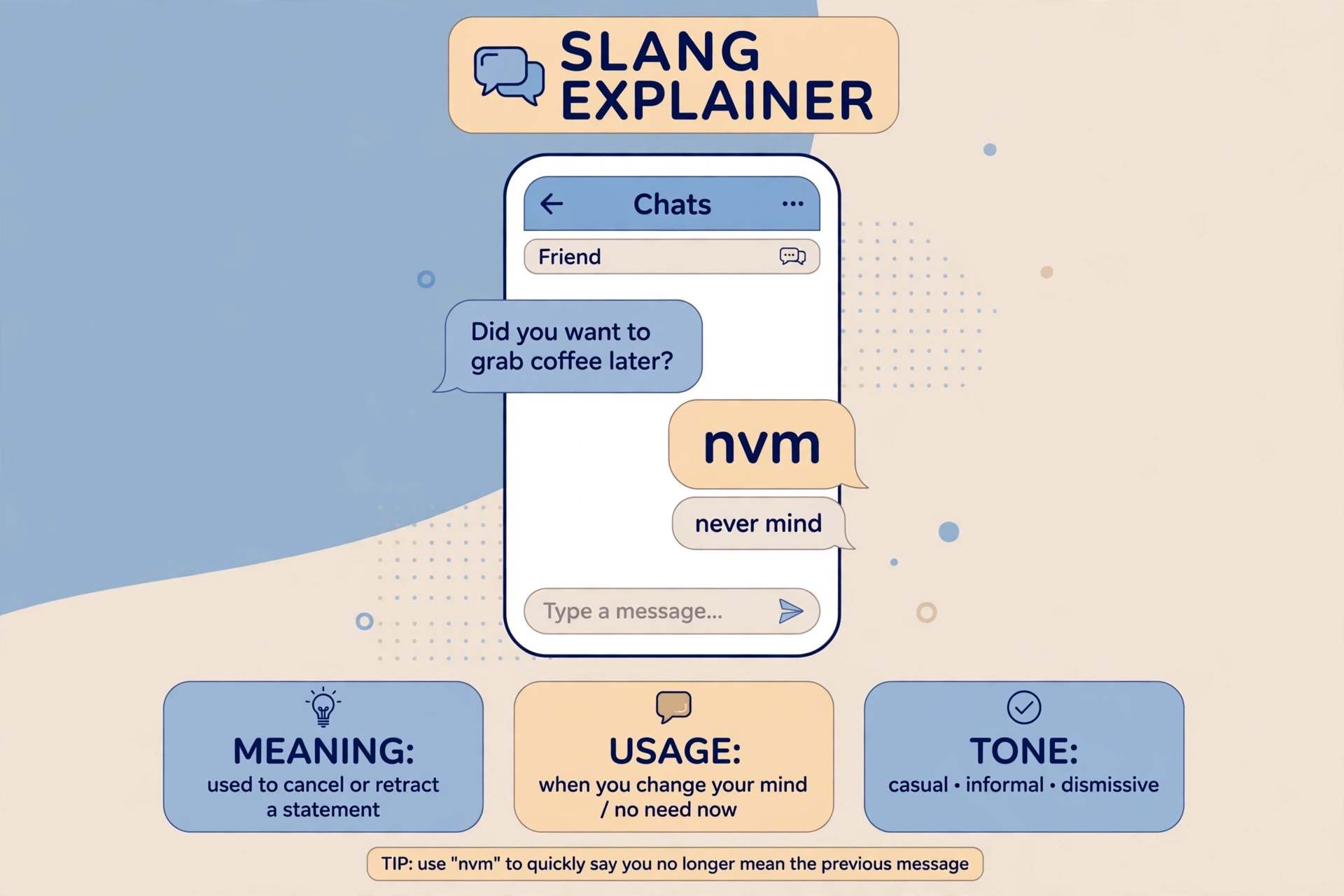
If someone just sent you “nvm” and you are not sure what they want from you, here is the short version: it almost always means never mind.
In plain terms, the sender is telling you to forget their last message. They may have found the answer themselves, changed their mind, or decided the topic is no longer worth pursuing. You do not usually need to do anything about it — and that, most of the time, is the whole point of the message.
People also search for this as “n v m meaning,” with spaces between the letters. That spaced form is a search spelling, not how anyone types it in a real chat. In a message, it is written as one block: nvm, usually in lowercase.
The Short Answer
NVM stands for “never mind.”
When you see it in a text, a DM, or a group chat, read it as: “Forget what I just said” or “Do not worry about that last message.”
It is informal shorthand. It works best with friends, family, and casual group chats. It is not the right choice for a formal email, a job application, or a message to someone you need to impress with careful wording.
A few quick examples show how ordinary it is:
- “Can you send me that link? Actually, nvm, I found it.”
- “What time is the meeting? Nvm, I just checked the calendar.”
- “I was going to explain the whole thing, but nvm, it is not important.”
In each case, the sender is cancelling their own earlier message. They are not asking you a new question. They are closing a small loop before you spend time on it.
What NVM Stands For, Word by Word
NVM is not a normal acronym made from the first letters of three separate words in the usual way. It is a shortened form of a two-word phrase:
- Never
- Mind — shortened to “VM” in the abbreviation, keeping the sound of the second word
That is why you will sometimes see it written as NVMD, with an extra D for the end of “mind.” Both forms mean the same thing. NVM is simply shorter, so it is the form you will see far more often.
The full phrase itself is much older than texting. Merriam-Webster defines “never mind” as telling someone not to be concerned about something, or saying that something previously mentioned can be disregarded. Cambridge Dictionary gives the same core idea: it is used to tell someone not to worry about something, because it is not important.
So when someone types “nvm,” they are borrowing a long-established English phrase and squeezing it into three letters for speed.
How the abbreviation came about
No single inventor or exact first message is documented for “nvm,” and this article does not pretend otherwise. What the sources agree on is the general picture: as early internet chatrooms and SMS texting took off in the 1990s and early 2000s, people shortened common phrases to save time and keystrokes.
“Never mind” was an obvious candidate. It is a phrase people say often, it is used to cancel or correct something quickly, and it shortens neatly. Once it was common in chatrooms and early messaging apps, it carried straight over into modern texting, social media comments, gaming chat, and DMs.
How People Actually Use NVM
NVM shows up in a handful of everyday situations. Once you recognise the pattern, it becomes easy to read.
1. You solved it yourself
This is the most common use. You ask for help, then find the answer before the other person replies.
- You: “Do you know where the charger is?”
- You, a minute later: “Nvm, it was in my bag.”
Here, nvm is doing a kind favour. It tells the other person they can stop looking.
2. You changed your mind
Plans shift, and nvm is a fast way to say so.
- “Can you pick me up at 6? Nvm, I will drive myself.”
- “Should we order pizza? Nvm, I already ate.”
3. You decided it is not worth explaining
Sometimes you start to say something, then realise the explanation is longer than the point is worth.
- “I was going to tell you the whole story, but nvm, it does not matter.”
This one is softer than it sounds. It usually means “let it go,” not “I am angry with you.” Tone and context decide which it is, as the next section explains.
4. You are correcting yourself
NVM can also work as a quick reset after a mistake or a confusing message.
- “Wait, the meeting is Tuesday… nvm, I mean Wednesday. Sorry about that.”
- “Oops, nvm, I sent that to the wrong chat.”
In this use, nvm clears the wrong version so the right one can land cleanly.
5. You are dropping a topic on purpose
Sometimes nvm ends a subject rather than a single message.
- “Forget it, nvm. Let us talk about something else.”
This is the use most likely to sound abrupt, especially if it lands in the middle of a disagreement. A bare “nvm” with no extra words can feel like a door closing. Adding a few kind words — “nvm, it is fine, honestly” — changes the feeling completely.
The Tone Problem: Why the Same Three Letters Can Feel So Different
NVM has one stable meaning, but it does not have one stable tone. The words around it, and your relationship with the sender, do most of the emotional work.
Here is how the same abbreviation can land in different ways:
| What you see | How it usually feels | What is probably happening |
|---|---|---|
| “Nvm, I found it! Thanks anyway” | Warm and relieved | They solved it and are grateful you were about to help |
| “Nvm, it is fine” | Neutral, slightly flat | They are letting it go, but you may want to check they really are fine |
| “Nvm. Forget it.” | Frustrated or hurt | They may feel unheard, or they are ending an argument |
| “Nvm, I will just do it myself” | Annoyed or disappointed | They expected help and feel let down |
| “Nvm lol, I misread that” | Light and joking | They are laughing at their own mistake |
The lesson is simple: do not read tone from the abbreviation alone. Read the sentence before it, the sentence after it, and what you know about the person. A friend who types “nvm!!” after finding their keys is not sending the same message as someone who types “nvm.” in the middle of a tense argument.
If you are the one sending it, remember that the other person cannot see your face. When the situation is even slightly sensitive, add a few words. “Nvm, all good” and “nvm, sorry, I figured it out” are both clearer and kinder than a lone “nvm.”
NVM, NVMD, and NM: The Variants, Explained
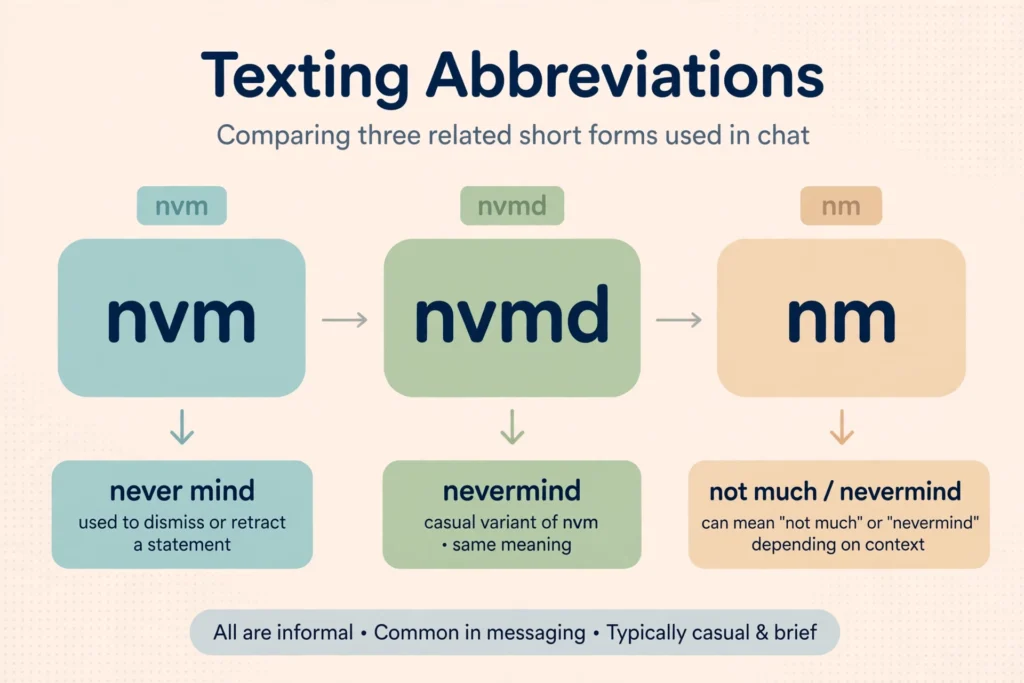
These three short forms get mixed up constantly. Here is how they differ.
NVM — never mind
This is the standard, clearest form. When you mean “forget what I just said,” use this one. It has one job, and it does it well.
NVMD — never mind
NVMD means exactly the same thing as NVM. The extra D stands for the final sound of “mind.” It is simply less common, because it is longer to type and adds nothing to the meaning. If you see it, read it as nvm. There is no hidden difference to decode.
NM — never mind, or not much
NM is the tricky one, because it has two genuinely different meanings, and only context tells you which one is meant:
- After a question or a mistake, NM can mean “never mind.” Example: “Can you help with this? Actually, nm, I got it.”
- As a reply to “What is up?” or “What are you doing?”, NM means “not much.” Example: “Hey, what is up?” — “Nm, just watching TV.”
That second meaning is the one that causes confusion. If someone answers “nm” to “what are you doing?”, they are not cancelling anything. They are just saying nothing much is happening.
Because of this double meaning, nvm is the safer choice when you mean “never mind.” It leaves no room for the “not much” reading.
How to Tell What “NVM” Means From Context
If you receive an “nvm” and you are unsure what the sender wants, work through these four checks. They take seconds, and they resolve almost every case.
1. Look at the message right before it
NVM almost always refers to the sender’s own previous message. Ask yourself: what did they just ask, say, or send?
- If they asked a question and then wrote “nvm,” they probably found the answer.
- If they made a statement and then wrote “nvm,” they are probably taking it back.
2. Check whether a problem was just solved
If the conversation shows the answer appearing — a link found, a time confirmed, a mistake spotted — then nvm is almost certainly a friendly cancellation. The sender is saving you work.
3. Check the tone of the conversation so far
In a relaxed chat, nvm is relaxed too. In a tense chat, it may be a withdrawal. If the chat was going fine and suddenly ends with a bare “nvm,” it is worth a gentle check-in rather than assuming the worst or ignoring it.
4. When in doubt, ask one short question
You do not need a long reply. One of these is enough:
- “All good?”
- “No problem — did you sort it?”
- “Okay, do you still want help with it?”
Most of the time, the answer will be a quick “yeah, all sorted, thanks.” And if the sender was upset, you have given them an easy opening to say so, without making the situation bigger.
Common Confusions About NVM
Does NVM mean “not very much”?
No. In texting, this is not a standard meaning of nvm, even though the letters might suggest it to you. “Not much” belongs to nm, not nvm. If someone writes “nvm” and you read it as “not very much,” you will misunderstand the message. Treat “not very much” as a guess to discard, not as an alternative definition.
Does NVM mean something technical?
Outside of texting, the same three capital letters can stand for “non-volatile memory,” a type of computer memory that keeps its data when the power is off. That is a real technical term, but it belongs in computing, not in a chat. If your friend texts you “nvm” after asking about homework, they are not talking about computer memory. Context makes this one easy: in a conversation, nvm means never mind.
Is “nevermind” one word or two?
The phrase is two words: never mind. Written as one word, “nevermind” is a different, much rarer form — traditionally a noun meaning attention or concern, as in “pay it no nevermind.” You do not need that form for texting. When you write it out in full, write two words: never mind.
Is NVM rude?
Not by itself. It is neutral shorthand, and most of the time it is used for a practical reason: to cancel a request quickly. It only turns rude when it is used to shut someone down mid-conversation, especially during an argument, with no explanation. The rudeness comes from how it is used, not from the letters themselves.
Should you use NVM at work?
Be careful. With a close colleague in a quick chat, a friendly “nvm, found it, thanks!” is usually fine. In a formal email, a message to a client, or anything that might be kept as a record, write the full version instead: “Never mind, I found it — thank you.” It takes a few more seconds and removes all doubt about your tone.
How to Reply When Someone Sends You “NVM”
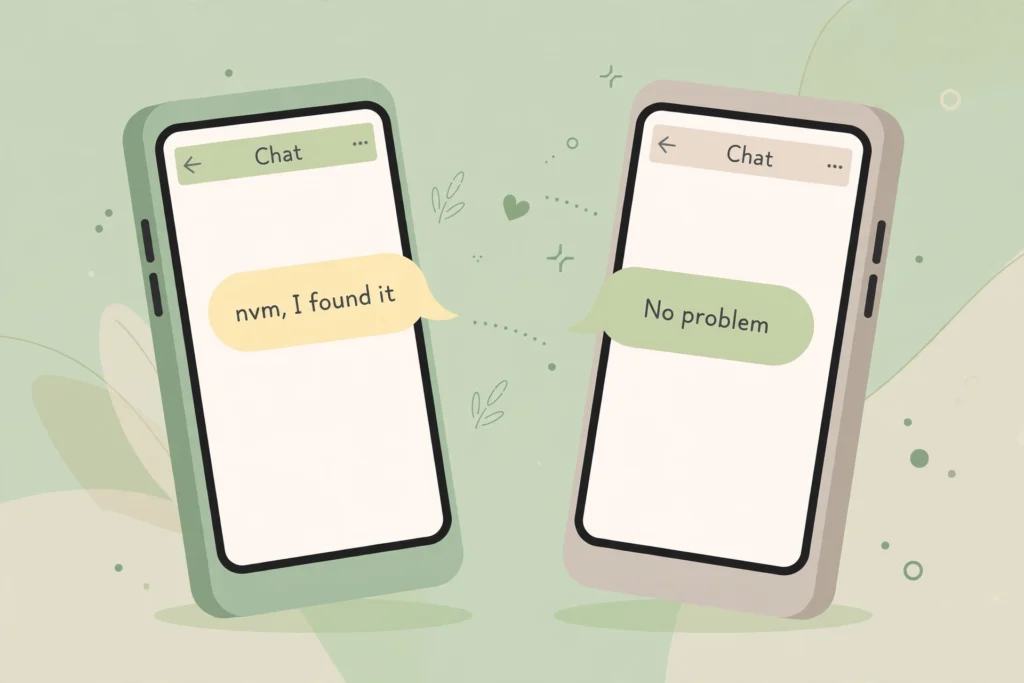
You rarely need a long reply. Match your answer to the situation:
- They solved it themselves: “No problem!” or “Glad you found it.”
- They changed a plan: “Okay, no worries.” Then move on to the new plan.
- They seem upset: “Are you sure? I am happy to help if you still want it.” This gives them a way back in without pressure.
- You are not sure what they mean: “All good?” One short check beats guessing.
What you should not do is keep answering the original question as if nvm was never sent. If someone wrote “nvm” after asking for a link, and you then send the link anyway with a long explanation, you have ignored the message they actually sent. Acknowledge the nvm first, then offer help only if it is still wanted.
Polite Alternatives to “NVM”
Sometimes a fuller phrase is kinder, clearer, or simply more appropriate. Keep these in your pocket for the moments when a bare “nvm” feels too blunt:
- “Never mind, I figured it out — thank you!”
- “Actually, do not worry about it.”
- “Forget what I just said, I have got it now.”
- “Sorry, I found the answer myself.”
- “It is okay, I will sort it out.”
- “Let us drop that — it is not important.”
Notice what these all have in common: they say the same thing as nvm, but they also tell the other person why, or thank them. That small addition is what turns a cancellation into a complete, polite message.
And when you are writing formally, skip the abbreviation entirely. “Please disregard my previous message” is the professional version of nvm, and it leaves no room for misreading.
Other Short Forms That Work the Same Way
NVM sits in a large family of chat shorthand where a few letters stand in for a whole phrase, and context does the rest of the work. Two examples from this site show the same pattern from different angles: TW usually means “trigger warning,” but it has other meanings depending on where you see it, and ITTM has one well-established meaning alongside several newer guesses that are far less reliable. In both cases, as with nvm, the safest move is to read the surrounding conversation before settling on a meaning.
The general rule applies to all of them: the shorter the message, the more the context matters. A single abbreviation never carries the full meaning on its own.
Frequently Asked Questions
What does nvm mean in texting?
NVM means “never mind.” It tells the other person to forget or disregard what was just said, usually because the sender found the answer, changed their mind, or decided the topic is not important anymore.
What is the difference between nvm and nm?
NVM always means “never mind” in texting. NM can mean “never mind,” but it can also mean “not much,” especially as a reply to “what is up?” Because of that double meaning, nvm is the clearer choice when you mean “never mind.”
What does nvmd mean?
NVMD means the same thing as nvm: “never mind.” The extra D represents the end of the word “mind.” It is just a less common spelling, with no difference in meaning.
Is nvm the same as never mind?
Yes. NVM is simply the shortened, informal written form of “never mind.” The meaning is identical; only the setting changes. Use “never mind” in full when you want to sound more formal or more careful.
How do you pronounce nvm?
Say it as the full phrase: “never mind.” People do not usually read out the letters “en-vee-em” in conversation. In speech, just say “never mind.”
Is it okay to use nvm with people you do not know well?
It is best kept for casual chats with people you already talk to informally. With strangers, in professional settings, or in any message where tone could be misread, write “never mind” in full, or use one of the polite alternatives above.
What should I reply if someone just sends “nvm”?
Usually, a short acknowledgement is enough: “No problem” or “Okay.” If the conversation felt tense, or you are unsure whether they are upset, add a gentle check: “All good?” That covers both the practical and the human side of the message.
Does nvm ever mean something else in texting?
In ordinary texting, no — “never mind” is the established meaning. The same letters mean “non-volatile memory” in computing, but that is a different field, not a different texting definition. If a message does not make sense with “never mind,” check whether you have misread the letters, or simply ask the sender what they meant.
Bottom Line
NVM means never mind: forget what I just said, do not worry about that last message, it is sorted or it no longer matters.
That is the whole definition, and it covers almost every text you will ever receive with those three letters. The variants are simple too: nvmd is the same thing with an extra letter, and nm is the one to watch, because it can also mean “not much.”
When you send it, a few extra words go a long way. “Nvm, found it, thanks!” is clearer and kinder than a bare “nvm,” and it costs you almost nothing. When you receive it, trust the context: look at the message before it, check whether a problem was just solved, and if you are still unsure, ask one short question.
Three letters, one meaning, and a much smoother chat once you know how to read them.