Blue on a Mood Ring: What Does It Mean?
You glance down at your hand and your mood ring is blue. Does that mean you are calm? Happy? Relaxed? In love?
The short answer is: on most traditional mood-ring charts, blue means you are calm, happy, and relaxed — but it is not a scientific reading of your mood. Your ring is really measuring the temperature of your finger, and blue usually shows up when your finger is warm.
That distinction matters, because it explains why the same ring can turn blue after a warm shower, on a hot day, or when you are simply sitting comfortably — even if nothing about your feelings has changed.
The Short Answer
Blue on a mood ring traditionally means calm, happy, and at ease.
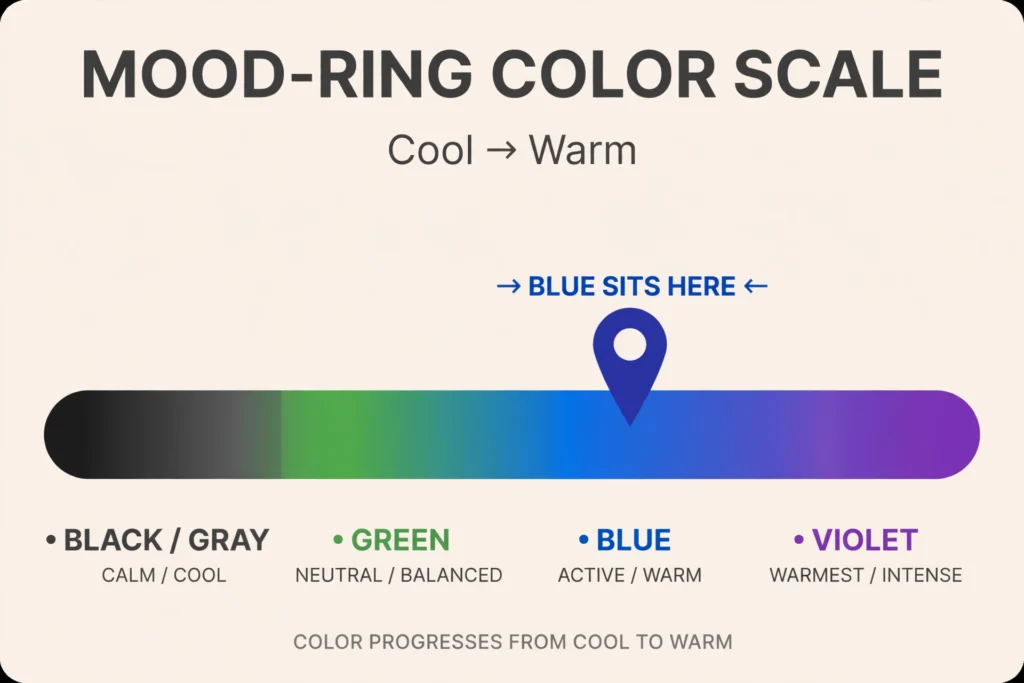
On the classic 1970s-style chart, blue sits on the warm side of the scale. Green is the usual neutral, middle point. As your finger gets warmer, the color moves from green toward blue-green, then blue, then dark blue or violet. As your finger gets cooler, it moves the other way, toward yellow, amber, brown, and finally black or gray.
So, in plain terms:
- Blue = warm finger, traditionally read as relaxed and happy.
- It does not mean the ring has read your mind or measured an emotion directly.
- The exact shade matters, and so does the chart that came with your ring, because brands do not all use the same chart.
If you want the one-sentence version to tell a friend: blue usually means calm and content on a traditional chart, but what it really proves is that your finger is warm enough for the ring to show blue.
How Mood Rings Actually Work
Before you trust any color meaning, it helps to know what is happening inside the stone.
It Is a Thermometer, Not a Mind Reader
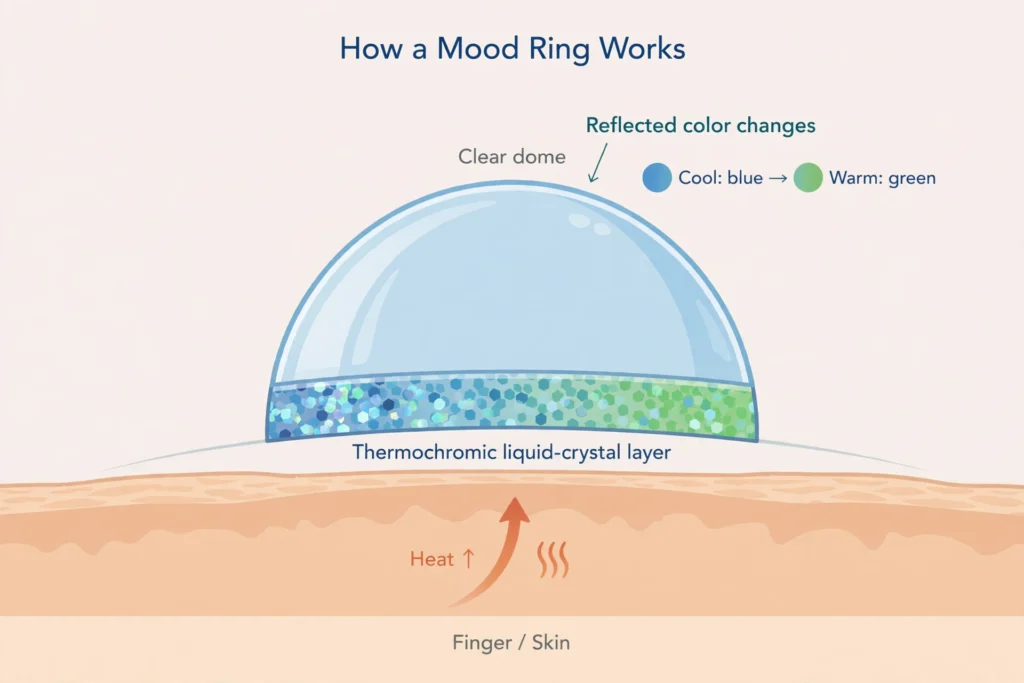
A mood ring does not contain a gemstone that senses feelings. Under its clear glass or quartz dome sits a thin layer of thermochromic liquid crystals. “Thermochromic” simply means the material changes color with heat.
When the temperature of your finger changes, those crystals twist and shift their arrangement. That changes which wavelengths of light they reflect back to your eyes, and you see a different color.
That is the real science in a mood ring, and it is genuine: the crystals really do respond to temperature. The leap from temperature to a specific emotion is where the science stops and the marketing starts.
Why Warmth Can Look Like a Mood
There is a loose, indirect link between feelings and finger temperature, and it works through blood flow.
When you are relaxed, blood tends to flow more freely to your hands and fingers, which warms the skin slightly. When you are stressed or cold, your body can direct blood toward your internal organs instead, leaving your fingers cooler.
That is why, on a traditional chart, warmer colors such as blue and violet are linked to relaxed or happy states, while cooler colors such as amber, brown, and black are linked to tension or nervousness.
But temperature is shaped by many things that have nothing to do with mood:
- The temperature of the room you are in
- Whether you have just been outside in cold or heat
- Exercise, a hot shower, or holding a warm drink
- How tightly the ring fits, since a loose ring reacts more to the air than to your skin
- Circulation, which varies from person to person
So blue tells you your finger is warm. It does not tell you why it is warm.
Why Two Rings Can Show Different Colors on the Same Hand
This is one of the most confusing parts of mood rings, and it is worth knowing before you compare rings with a friend.
There is no single, regulated mood-ring chart. Each manufacturer chooses its own liquid-crystal mixture and prints its own chart to go with it, a point other mood-ring guides also stress when they warn that a chart in the box is a marketing decision, not a scientific standard. One brand may set blue to appear at your normal resting skin temperature, while another brand shows green at that same temperature.
Modern rings can also behave differently from the original 1970s rings. Some use different pigments, some cycle through colors, and some only show two or three colors clearly. A colored dome over the crystals can also shift what you see — for example, a yellow-tinted dome over a blue pigment can make the stone look green.
The practical rule is simple: trust the chart that came with your own ring first, and treat every other chart — including this article — as a general guide to the traditional meanings, not a rule for your specific ring.
What Blue Traditionally Means on a Mood Ring
Across most traditional charts, blue is a positive, settled color. It is not the “average” color — that is usually green — and it is not the most intense color — that is usually violet or purple. Blue sits just past calm, in the warm, comfortable zone.
The original 1970s-style chart described blue as “emotions are charged, active, relaxed,” while a full color-by-color guide describes classic blue more simply as happiness, joy, and emotional equilibrium. Later charts tend to simplify that to calmer language: happy, calm, relaxed, at ease, and sociable.
Put together, the traditional reading of classic blue is:
- You are relaxed, not tense
- You are in a good, settled frame of mind
- You are comfortable and open, rather than guarded or on edge
- You may be feeling happy and sociable, but not overwhelmed or overexcited
That last point matters. Blue is usually read as steady happiness, not as a spike of excitement. The spike, on most charts, belongs to violet or purple.
Blue Shades and Variations: They Are Not All the Same
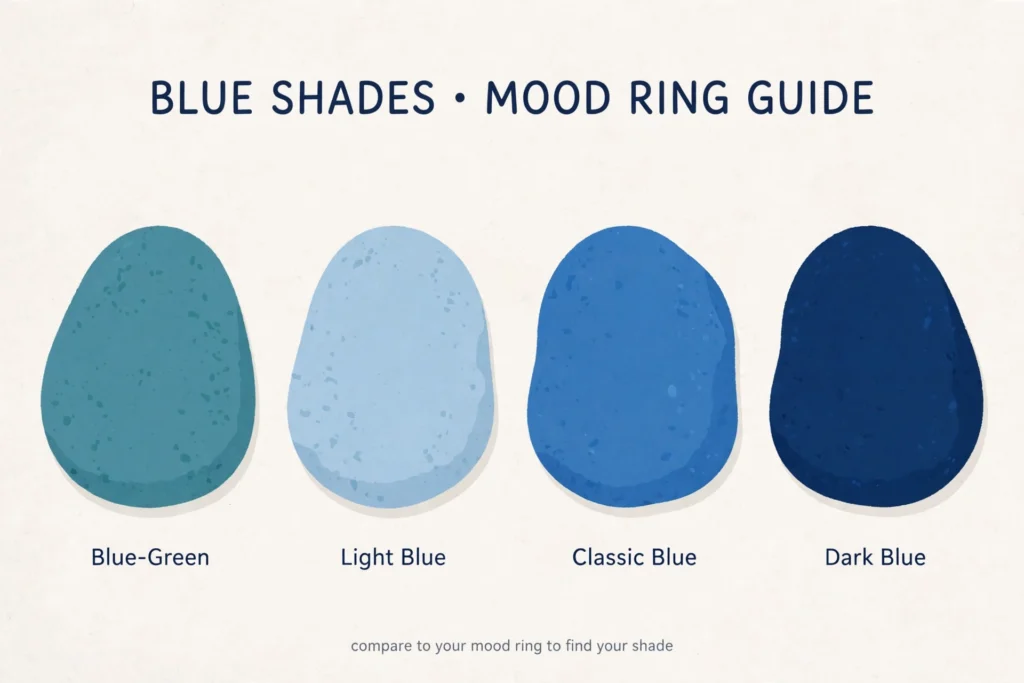
This is where most short guides stop, but it is exactly where blue gets interesting — because “blue” on a mood ring is rarely one exact shade. The shade you see gives you a more specific traditional reading, even though, again, these are popular interpretations, not scientific facts.
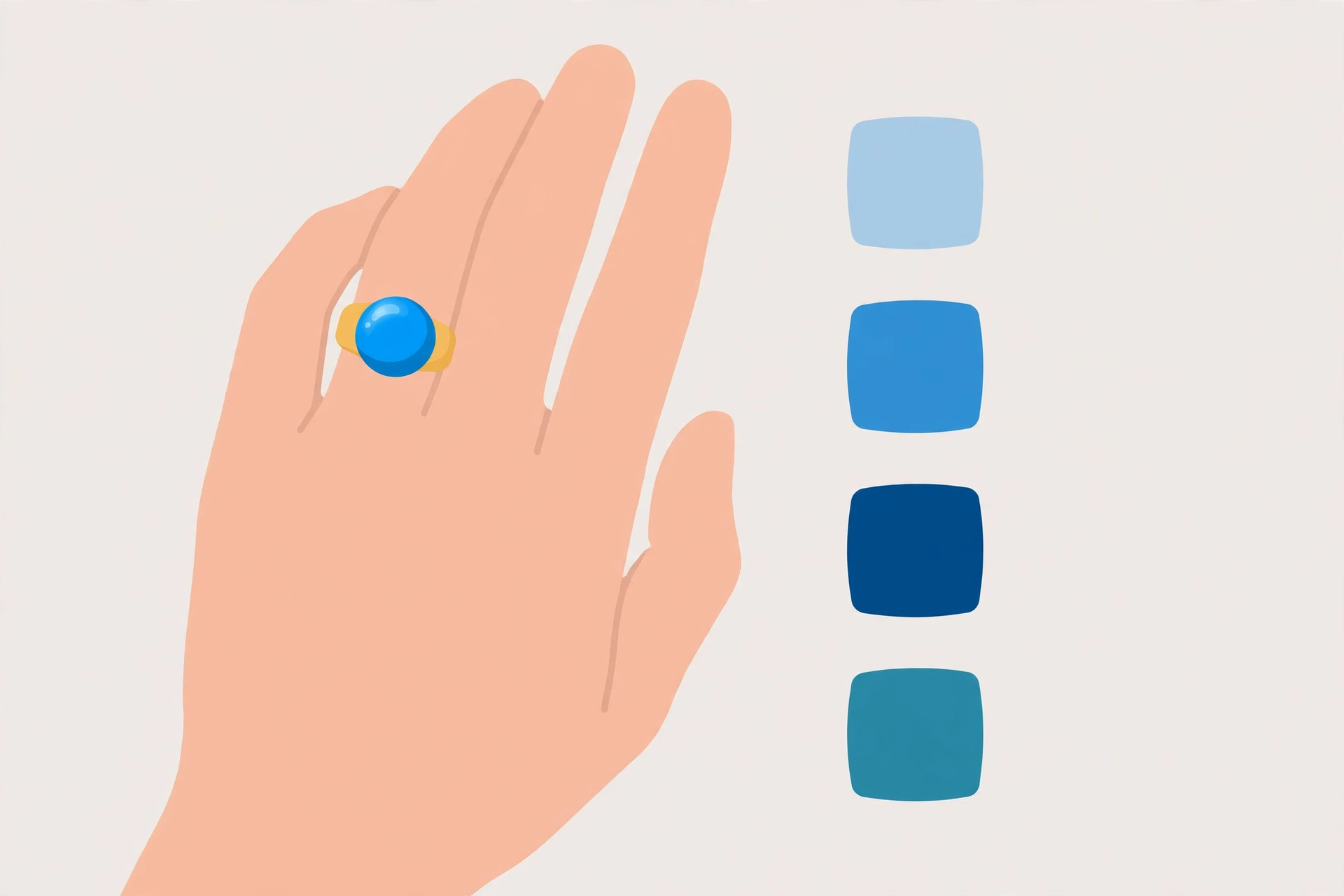
Blue-Green or Teal
Blue-green sits between green and blue on most charts, so it is the bridge shade.
Traditionally, it means relaxed but still alert — content, comfortable, and at ease, with a little more energy than plain calm. Some charts describe it as peaceful and optimistic, or as a sign you are settled but sociable.
If your ring often sits at blue-green, the traditional reading is that you are in a balanced, comfortable state, just a step warmer — and, by chart logic, a step more relaxed — than the green neutral point.
Light Blue or Sky Blue
Light blue is commonly linked to deep relaxation, calmness, and a peaceful, content frame of mind.
Some charts describe it as lighthearted and hopeful, or as feeling open and at ease with yourself and the people around you. In general color symbolism, light blue is also associated with serenity and calm, which lines up neatly with the mood-ring reading — but that is a cultural association, not proof that the ring is measuring serenity.
If your ring shows light blue, the traditional reading is soft and gentle: calm, comfortable, and optimistic, rather than intense or passionate.
Classic Blue
Classic, medium blue is the shade most people mean when they ask what blue on a mood ring means, and it carries the core blue meaning: happy, calm, relaxed, and at ease.
Charts often add words like sociable, upbeat, and emotionally balanced. In the original 1970s wording, blue also carried a sense of being emotionally charged and active — not sleepy or switched off, but engaged in a relaxed way.
Think of classic blue as the “all is well” shade: not neutral like green, not intense like violet, just comfortably good.
Dark Blue
Dark blue is where the readings start to split, and that split is worth flagging honestly.
On many charts, dark blue means deeply relaxed, affectionate, or absorbed in something — a warmer, more intense version of blue. Some charts link it to passion, excitement, or romantic feelings, placing it close to violet at the warm end of the scale.
Other charts treat dark blue more quietly, as focus, introspection, and quiet strength. The difference comes down to the brand’s chart, not to a scientific test.
What most charts agree on is the direction: dark blue means your finger is warmer than it is for classic blue, so the traditional reading is stronger or deeper than plain blue — whether that depth is read as affection, absorption, or passion depends on the chart you are using.
Blue-Purple or Indigo Tint
If your blue leans toward purple, you are at the boundary between blue and violet. Traditionally, violet is the warmest color on the classic scale and is linked to passion, excitement, and very happy or romantic feelings.
A blue-purple tint is therefore often read as a step beyond blue: still happy and relaxed, but with more emotional intensity. If your ring’s chart treats violet as its own separate color, follow that chart rather than guessing.
How to Interpret Blue on Your Own Ring
Use this simple check before you decide what your blue means.
Step 1: Check Your Ring’s Own Chart First
Look for the card or insert that came in the box, or the chart on the seller’s listing. If your brand’s chart says blue means something slightly different from the traditional meanings above, your brand’s chart wins for your ring.
If you have lost the chart, use the traditional meanings in this article as a starting point, but remember they are a general guide.
Step 2: Give the Ring Time to Settle
A ring straight out of a drawer, a jewelry box, or a cold room needs a minute or two against your skin before its color settles. A reading taken the second you put it on is mostly telling you the temperature of the room or the box, not your finger.
Wear it for a few minutes indoors, at a normal room temperature, with a snug — not tight — fit, and then look at the color.
Step 3: Ask What Else Could Explain the Color
Before you read blue as a mood, run through the obvious non-mood explanations:
- Have you just washed your hands in warm water, had a shower, or been exercising?
- Are you holding a warm drink, or sitting in a warm room?
- Has the ring been in sunlight or near a heater?
- Is the ring fitting snugly against your skin, or is it loose and reacting to the air?
If any of those apply, blue is most likely telling you about warmth, not about a change in how you feel.
Step 4: Look at the Pattern, Not a Single Glance
One blue reading means very little on its own. A pattern is more interesting — though still not scientific.
If your ring tends to turn blue when you are winding down in the evening, reading a book, or spending relaxed time with people you like, that pattern fits the traditional blue reading. If it turns blue every time you step into a warm room, the pattern is telling you about temperature, not mood.
Treat the ring as a prompt to pause and notice how you actually feel, rather than as a verdict on how you feel.
What Blue Does Not Mean
It is just as useful to know what blue does not prove.
- It does not prove you are happy. You can be perfectly happy with cold hands, and your ring will show a cooler color. You can feel low while your hands are warm, and it may still show blue.
- It does not diagnose stress, anxiety, or any health condition. A mood ring is novelty jewelry, not a medical device, and its color should never be used to judge your health or someone else’s.
- It does not read someone else’s feelings for you. You cannot tell what another person is feeling from their ring color, because you do not know their circulation, their room temperature, or their ring’s chart.
- It does not mean the ring is broken if it is not blue. Many rings sit at green for much of the day, because green is the neutral point for an average resting finger. A ring that never leaves black, on the other hand, may be cold — or its crystal layer may be damaged or worn out.
If an online seller claims a mood ring can read emotions accurately, diagnose stress, or reveal a hidden feeling, treat that claim with skepticism. Bold claims deserve a closer look before you buy, in the same way you would start by checking whether a website is a scam when any unfamiliar seller makes a promise that sounds too precise to be true.
Why Your Ring Might Stay Blue, or Never Turn Blue
If Your Ring Is Almost Always Blue
Some people simply run warm, and some rings are calibrated so that blue appears at or near normal skin temperature. If your ring is often blue and you feel fine, that is usually just your baseline.
A ring that is always blue in every situation — indoors, outdoors, warm room, cold room — may also be a lower-quality ring with a narrow color range, or a ring whose crystals have degraded so it no longer shifts properly. Compare it with how it behaved when it was new, if you can.
If Your Ring Never Turns Blue
Cold hands are the most common reason. If your hands are often cool, your ring may sit at green, yellow, or amber most of the day and only reach blue when you are genuinely warm.
A loose fit can also keep a ring from warming up properly, because it reacts to the air around it instead of your skin. Try a snugger fit, indoors, after a few minutes of wear, before you conclude the ring is faulty.
If Your Ring Stuck on One Color
A ring that no longer changes color at all, and stays black, brown, or gray, has often suffered damage to its crystal layer. Heat, water, harsh chemicals, and long exposure to sunlight can all degrade thermochromic material over time, and once that layer breaks down, it cannot be repaired or recharged.
To keep a mood ring working longer, keep it dry, avoid hot water, showers, and swimming pools while wearing it, keep it out of prolonged direct sunlight, and clean it only with a soft, dry cloth. Store it somewhere cool and dry when you are not wearing it.
Blue Compared With the Colors Around It
Seeing blue in context makes it easier to read, so here is where blue sits on the traditional scale:
- Black or gray: Coolest end. Traditionally read as tense, nervous, or stressed — or simply cold hands, or a damaged ring.
- Brown or amber: Cooler than average. Traditionally read as nervous, unsettled, or mixed feelings.
- Yellow: Slightly cool. Often linked to nervousness, excitement, or mental restlessness.
- Green: The neutral middle. Traditionally average, calm, and balanced — the baseline for a resting finger.
- Blue-green: Just past neutral. Relaxed, comfortable, and content.
- Blue: Warm and settled. Happy, calm, relaxed, and at ease.
- Dark blue: Warmer still. Deeply relaxed, affectionate, absorbed — or, on some charts, passionate.
- Violet or purple: Warmest end on the classic scale. Passionate, excited, or very happy.
Notice how blue is not an extreme. It is a warm, positive, but steady part of the scale. That steadiness is part of why so many people like seeing blue: on a traditional chart, it is the color of feeling good without feeling overwhelmed.
Frequently Asked Questions
What does blue mean on a mood ring?
On most traditional charts, blue means calm, happy, and relaxed. Your finger is warm, and the chart reads that warmth as a settled, positive state. It is a traditional interpretation, not a scientific measurement of emotion.
What does dark blue mean on a mood ring?
Dark blue traditionally means a deeper version of blue: deeply relaxed, affectionate, or absorbed in something. Some charts also link it to passion or romantic feelings, because dark blue sits near the warm end of the scale. Check your own ring’s chart, because brands differ on this shade.
What does light blue mean on a mood ring?
Light blue is usually linked to deep relaxation, calmness, and a peaceful, content frame of mind. Some charts describe it as lighthearted and hopeful. It is a softer, gentler reading than dark blue.
Is blue a good color on a mood ring?
On traditional charts, yes — blue is one of the most welcome colors, because it is linked to happiness, calm, and relaxation. Green is neutral, blue is positive, and black or gray at the cool end are the colors most charts link to tension. But “good” here only means good on the chart, not a medical or emotional verdict.
Why is my mood ring blue when I do not feel happy?
Because the ring measures finger temperature, not happiness. Warm hands from a hot room, warm water, exercise, or a snug ring in a warm environment can all turn a ring blue even when your mood has not changed. Cold hands can do the opposite, keeping a ring away from blue even on a good day.
Can a mood ring be blue because of the weather?
Yes. Room temperature, outdoor cold or heat, and sunlight all affect finger temperature, and therefore the ring’s color. A reading taken right after coming in from cold weather, or while standing in a warm room, is more about the environment than about your mood.
Do all mood rings mean the same thing by blue?
No. There is no universal, scientific standard for mood-ring colors. Each brand chooses its own crystal mixture and its own chart, so blue can appear at a slightly different temperature — and carry a slightly different label — from one ring to another. Always check the chart that came with your ring first.
Is blue the warmest color on a mood ring?
Not usually. On the classic scale, violet or purple sits at the warmest end, past dark blue. Some modern rings use different pigments and may not follow that order at all, which is another reason to follow your own ring’s chart.
What should I do if my mood ring never changes color?
First, check the simple explanations: cold hands, a loose fit, or not wearing it long enough for it to warm up. If it stays stuck on black, brown, or gray in every situation, even indoors after several minutes, the crystal layer may be damaged or worn out, often from water, heat, or sunlight. In that case it cannot be repaired.
Are mood-ring color meanings real or just for fun?
The temperature science is real — thermochromic liquid crystals genuinely change color with heat. The mood labels are traditional and popular, not scientific. No mood-ring chart has been shown to measure a specific emotion accurately. Enjoy blue as a fun, nostalgic signal, and as a prompt to notice how you feel, rather than as proof of how you feel.
Should I buy a mood ring that promises to read my exact mood?
No, not on that promise. A mood ring is novelty jewelry, and any seller claiming exact emotional readings is overstating what the product can do. Choose a ring for its look, its quality, and its price — not for a claim that it can read your mind.
The Bottom Line
Blue on a mood ring traditionally means you are calm, happy, and relaxed — a warm, settled, positive state, a step past the green neutral point and a step short of violet intensity.
The shade adds detail: blue-green leans toward relaxed contentment, light blue toward gentle calm and optimism, classic blue toward steady happiness and ease, and dark blue toward deeper relaxation, affection, or absorption — with the exact wording depending on your ring’s own chart.
What blue does not do is prove any of that scientifically. Your ring is a small, clever thermometer on your finger. It reacts to warmth, and warmth only loosely follows mood. Enjoy blue when you see it, use it as a reminder to pause and check in with how you actually feel, and do not let a single color override what you know about yourself.
That is the honest way to read a blue mood ring: a traditional, positive meaning, grounded in real temperature science, and best taken as a bit of fun rather than a fact about your feelings.