MMSBRE: What It Means, Why the Definitions Disagree, and How to Check It Before You Trust It
You searched for “mmsbre” and found a term that sounds technical, important, and oddly hard to pin down. That confusion is not your fault.
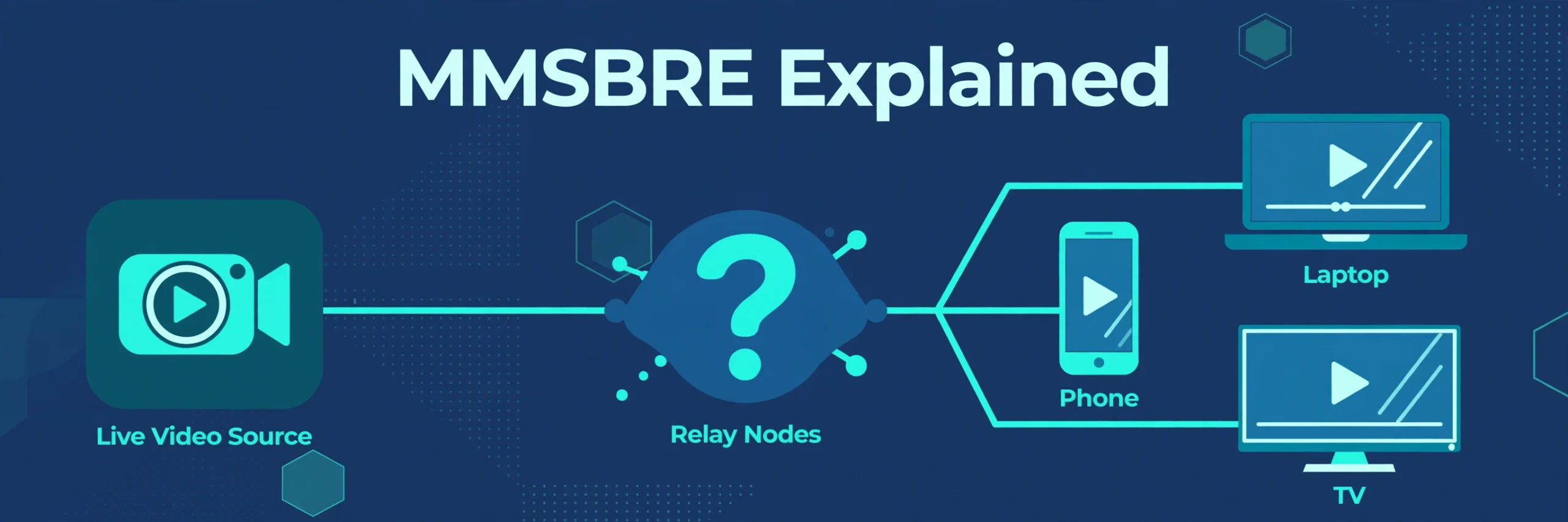
Here is the short version: MMSBRE has no single, officially verified definition. The explanation you will see most often is “Multi-Media Streaming and Broadcast Relay Environment,” used to describe a connected system that captures media, encodes it, relays it to several destinations, and monitors how it performs. But other pages give completely different expansions, and none of them point to an official standard, a registered product, or a major vendor’s documentation. So the honest answer is not one neat definition. It is a term with several competing explanations, and the meaning depends entirely on the context where you found it.
This article walks you through what each explanation actually claims, what the underlying technology really is, where the claims break down, and how you can check any MMSBRE claim in a few minutes before you act on it.
The Short Answer
- Most repeated meaning: Multi-Media Streaming and Broadcast Relay Environment — a conceptual, umbrella-style label for a multi-destination streaming setup, not a single product.
- Official status: Not verified as a formal standard, a protocol, or a product from a recognised standards body or major technology vendor.
- What it is not, as far as the evidence shows: It is not something you can download as “MMSBRE software,” not a proven business platform with verified pricing or results, and not a term defined by the CMS Medicaid rate guide (more on that claim below).
- What you should do: Read the surrounding context first. If the page talks about video, relay, and delivery, it is using the streaming reading. If it talks about workflows, dashboards, and efficiency, it is using the business reading. If it gives you neither — no product, no documentation, no company — treat it as an unexplained keyword, not a fact.
- Bottom line up front: The ideas underneath the streaming reading are real and widely used. The MMSBRE label itself is not established in the same way, and you should not trust any page that presents it as settled, official, or proven.
What Does MMSBRE Stand For?
This is where most articles about MMSBRE start to disagree, and that disagreement is itself the most important thing to understand.
The most repeated expansion
Across several recent explainers, the most frequently repeated expansion is:
Multi-Media Streaming and Broadcast Relay Environment
Broken down word by word, that phrase means:
- Multi-Media: Video, audio, captions, graphics, and metadata, not just a single video file.
- Streaming: Media delivered continuously over a network, so playback can start before the whole file has downloaded.
- Broadcast Relay: Taking one source feed and forwarding it, sometimes adapted for each destination, to websites, apps, social platforms, or internal systems.
- Environment: The whole connected setup — tools, servers, protocols, security controls, and monitoring — rather than one app or one server.
Writers who use this expansion are usually describing an architecture, not a thing you buy. In that reading, MMSBRE is a way of grouping together capture, encoding, relay, delivery, and monitoring as one coordinated system.
The other expansions you will find
Other pages use the same six letters for very different ideas. These are all reported expansions found in live search results, and they conflict with each other:
- Modular Multi-Sided Business Resource Ecosystem — a platform-economics reading, where a system coordinates users, service providers, and infrastructure layers.
- Management, Marketing, Systems, Branding, Resources, and Efficiency — a business-health checklist, where each letter stands for one area a company should review.
- Multi-Modal Small Business Resource Exchange — a small-business support reading, describing grants, mentorship, and networking in one ecosystem.
- Multi-Modal Sequential Bayesian Regression Estimator — an AI and data-analysis reading, where the term is presented as a statistical estimator rather than a streaming system.
- Medicaid Managed Care Rate Development and Broadcast Relay Environment — a healthcare-administration reading that links the term to Medicaid rate certification.
You cannot reconcile all of these into one definition. They describe different fields, different problems, and different kinds of systems. If a page gives you one of them without explaining why, and without a primary source, you are reading that author’s interpretation, not a settled fact.
Why so many definitions exist
Emerging or low-authority keywords behave like this. A short, unusual string is easy to repeat, easy to search, and easy to build a new article around. Once a few articles use it, search suggestions surface it to more people, more people search it, and more articles appear to answer the search. Curiosity drives the loop, and each new article can attach a slightly different meaning.
One explainer even treats MMSBRE mainly as a tagging and content-discovery concept: a compact label that communities use to group related posts, experiments, and resources, which then gains visibility through algorithmic discovery. That reading does not contradict the streaming reading exactly, but it explains the search trend differently. In the tagging reading, MMSBRE is interesting because people keep searching for it, not because a new technology was launched.
None of this means every article using the term is dishonest. It means you need to separate three layers:
- The underlying technologies, which are real.
- The MMSBRE label, which is not standardised.
- The specific claims a page makes about results, savings, or products, which need their own evidence.
MMSBRE as a Streaming and Broadcast Relay Environment
This is the most developed explanation, and it is also the most useful one to understand, because the system it describes is something you may actually build, buy, or use — even if you never use the MMSBRE name for it.
How the pipeline works
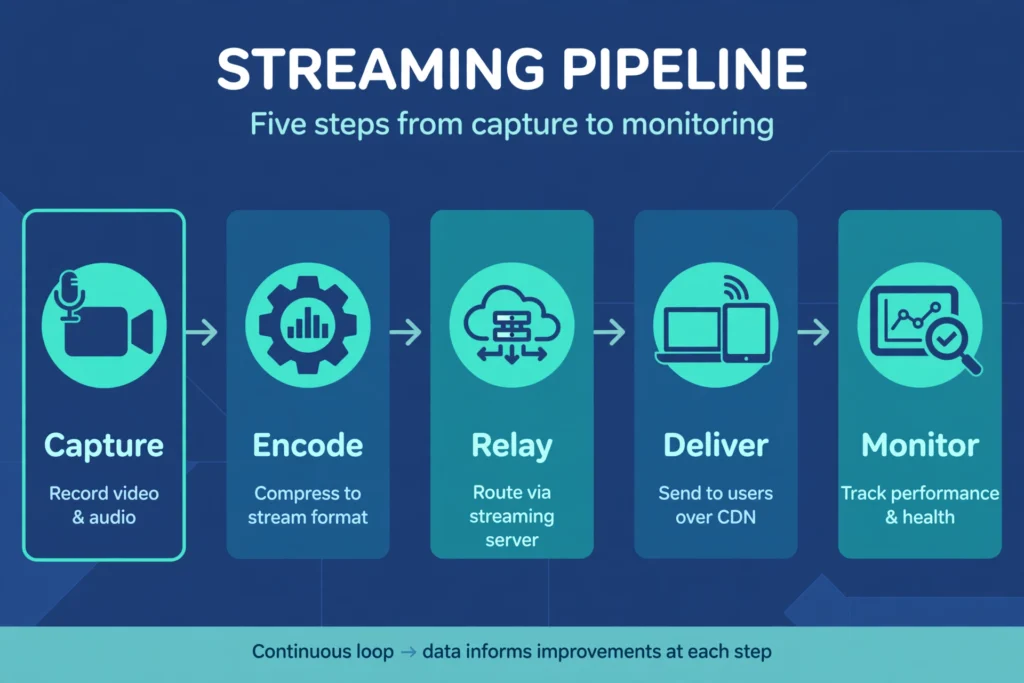
In the streaming reading, MMSBRE describes a pipeline with five stages. You can follow a single live feed through each one:
1. Capture and ingestion
Everything starts with a source: a camera, a microphone, a screen share, a studio feed, or a pre-recorded file. The ingestion layer receives that source, checks that it is valid, authenticates the broadcaster where needed, and creates a stable input for everything downstream.
This stage matters more than it looks. A poor or unstable source cannot be fully repaired later. If the input drops, stutters, or arrives out of sync, every destination downstream inherits the problem.
2. Encoding and packaging
Raw media is large and inflexible. The encoding layer compresses it and usually creates several versions at different resolutions and bitrates — for example, a high-quality version for fast broadband, a mid-quality version for standard connections, and a low-quality fallback for slow mobile networks. A compatible player can then switch between those versions as network conditions change, which is what adaptive bitrate streaming means in practice.
The packaged stream is then split into short segments and listed in a playlist or manifest file. Two widely used delivery formats for this are HLS and MPEG-DASH. HLS, for example, is specified in IETF RFC 8216, which describes how a player reloads media playlist files during a live stream. You do not need to read the RFC to understand MMSBRE, but it is a useful anchor: the delivery formats underneath the streaming reading are documented, public, and real, even though the MMSBRE label itself is not.
3. Broadcast relay
The relay layer is the heart of the streaming reading. Instead of uploading the same stream separately to every platform, a relay receives it once and distributes it to several approved destinations: a company website, a mobile app, a customer portal, a social platform, an internal archive, or a backup destination.
This saves duplicated work, but it also creates a single point of dependency. If the relay fails, several destinations can fail at the same time. A serious setup therefore needs retries, backup routes, destination-specific health checks, and clear failure notifications, not just a “send everywhere” button.
4. Delivery
Delivery is where viewers actually meet the stream. A content delivery network (CDN) usually caches segments at edge locations close to viewers, so the origin server is not handling every request directly. The player handles adaptive quality switching, captions, and short network recovery.
Delivery also includes the parts viewers never see: signed media URLs for private content, encryption where needed, access tokens that expire, and geographic or organisational restrictions. Putting a login screen in front of a page is not enough on its own if the underlying media URL is still publicly accessible.
5. Monitoring and observability
A stream can be technically “online” while viewers are still having a bad experience. Useful monitoring therefore looks at the viewer’s experience, not just the server’s status. That includes startup time, buffering frequency, playback errors, encoding failures, authentication failures, CDN performance, and destination availability.
Logs explain individual events. Metrics reveal trends. Alerts tell a team when action is needed. Together, they answer the only question that really matters during a live event: is this working from the viewer’s perspective?
Where this kind of system is actually used
Under the streaming reading, the concepts behind MMSBRE show up in familiar places:
- Live events, sports, concerts, and webinars sent to multiple platforms at the same time.
- Online education and corporate training, where adaptive quality helps viewers on uneven connections.
- News and media organisations distributing one source feed across several channels.
- Creators and brands combining live video with chat, product information, and replay.
These are applications of the underlying pipeline, not proof that a product called MMSBRE powers them. Be wary of any article that names a well-known platform and claims it “uses MMSBRE” without a source from that platform. That is a claim about a specific company, and it needs that company’s documentation, not another explainer article repeating it.
When you do not need this kind of architecture
Not every project needs a multi-destination relay environment, and overbuilding is a real risk.
A hosted webinar or streaming platform is usually enough when your audience is relatively small, you only need one destination, standard branding is acceptable, built-in analytics give you enough information, and you do not need complex integrations.
A more custom, MMSBRE-style architecture becomes worth considering when content must reach several destinations, access rules are complex, streaming connects to payments or commerce, you need custom dashboards or detailed analytics, existing business systems must be integrated, or reliability requirements justify backup paths.
The best system is not the one with the most services. It is the simplest architecture that meets your real requirements, with a fallback plan for the moment something goes wrong live.
MMSBRE as a Business and Workflow Concept
The second major reading has almost nothing to do with video. In this reading, MMSBRE is a shorthand for connecting separate business tools so data and tasks move with less manual effort.
What the business reading claims
Under this interpretation, the focus shifts from media delivery to operations:
- Mapping end-to-end workflows instead of fixing one tool at a time.
- Reducing repeated data entry and unnecessary approvals.
- Choosing scalable digital systems rather than adding another disconnected app.
- Using meaningful metrics instead of collecting every possible data point.
- Keeping the customer experience in mind when internal processes change.
Some versions turn this into a checklist. The “Management, Marketing, Systems, Branding, Resources, and Efficiency” version, for example, asks a leadership team to review each area and find bottlenecks. As a thinking tool, that is reasonable. As a proven framework with verified results, it is not established by the pages that describe it.
Streaming reading vs business reading
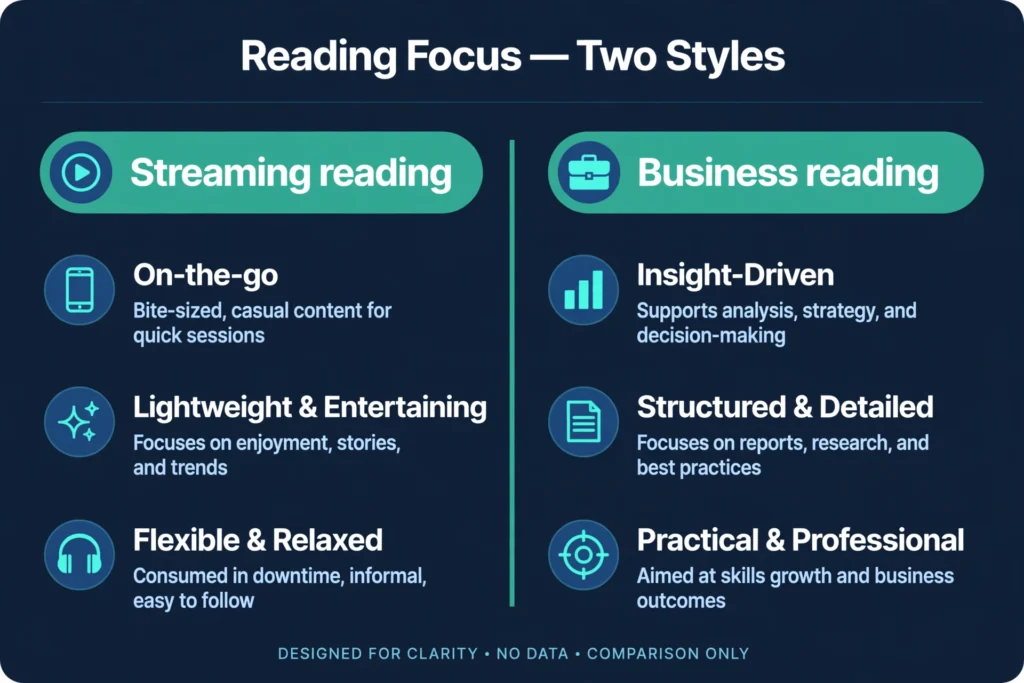
It helps to see the two readings side by side, because they share vocabulary — modularity, connectivity, efficiency — while meaning different things:
| Aspect | Streaming / broadcast reading | Business / workflow reading |
|---|---|---|
| Main goal | Reliable multi-platform media delivery | Connected operations and resource efficiency |
| Core elements | Capture, encode, relay, CDN, monitoring | Automation, APIs, data flow, process design |
| Typical content | Live or on-demand video and audio | Business data, tasks, and documents |
| Status of the label | Emerging, not standardised | Emerging, not standardised |
If you are reading a page and cannot tell which column it belongs in, that is a warning sign. A clear article will commit to one reading, or explicitly say it is covering both. A vague article will drift between them and let you assume they are the same system.
The savings and performance claims you should not take at face value
Some MMSBRE articles attach impressive numbers to the concept: projected annual savings, labour reallocation figures, bandwidth savings, or claims about how many streams a system can handle. Treat those numbers as unverified unless the article shows its working.
A projected saving from an unnamed “regional broadcast operations group,” with no company name, no methodology, and no independent source, is an anecdote, not evidence. The same applies to claims that a system becomes cost-efficient only above a specific traffic threshold, or that it will reshape an industry by a specific year. Those may be reasonable guesses, but they are guesses, and they should be labelled as such.
This matters because the business reading is the one most likely to be used to sell you something: a dashboard, a consultancy engagement, a course, or a “system” with no verifiable track record. If the pitch relies on the MMSBRE name rather than on a demonstrable product, a named customer, or a documented result, the name is doing work the evidence is not.
Is MMSBRE a Website, a Company, or a Product?
This is a separate question from the acronym, and it has its own confusing answer.
The mmsbre.com business site
Search listings describe mmsbre.com as a business offering innovative solutions and technology services aimed at improving operational efficiency and growth. That tagline is the main thing consistently reported about the site.
What is not verified from the material reviewed for this article is who owns or operates the site, what specific services it sells, what it charges, whether it accepts guest posts or partnerships, or what results its clients have achieved. Those are the details you would need before trusting it as a vendor, and they were not established by a primary source in this research. Do not fill those gaps with assumptions from other MMSBRE articles, because those articles are describing the acronym, not necessarily this site.
An older, unrelated use of the same domain
The same domain string also appears in a much older context: newsletters from 2012 for a Santa Barbara real-estate business, which told readers to type mmsbre.com into a mobile browser to reach a mobile listings site. That is almost certainly a different, earlier use of a short domain — a mobile shortcut for a real-estate brand — rather than evidence about the current streaming or business concept.
It is a useful reminder. A domain name can be reused, repurposed, or parked over time. Finding an old mention of “mmsbre.com” does not prove a connection to today’s MMSBRE articles, and finding today’s articles does not explain the 2012 newsletters.
The Medicaid claim, checked
One article links MMSBRE to Medicaid by saying it stands for “Medicaid Managed Care Rate Development and Broadcast Relay Environment” and citing the official CMS 2025–2026 Medicaid Managed Care Rate Development Guide.
The guide itself is real. The Centers for Medicare & Medicaid Services did issue a 2025–2026 Medicaid Managed Care Rate Development Guide for rating periods starting between July 1, 2025, and June 30, 2026, and the guide is available from Medicaid.gov. What was not verified in this research is any connection between that guide and the term MMSBRE. The guide is about Medicaid capitation rate development and certification, and nothing found in the research shows it defining, using, or endorsing MMSBRE as a system.
So treat the Medicaid expansion as unverified and the CMS link as unsupported unless a primary document actually containing the term is produced. A real document cited next to an unrelated claim does not make the claim true. This is exactly the kind of check the next section is designed to help you run.
How to Check Any MMSBRE Claim Before You Trust It
You do not need to become a streaming engineer or a standards expert to evaluate MMSBRE. You need a short, repeatable check that separates a real system from a repeated keyword.
Step 1: Find the context
Read the page around the term before you accept its definition.
- Does it talk about cameras, encoding, relay, CDNs, and viewers? That is the streaming reading.
- Does it talk about CRM tools, dashboards, approvals, and efficiency? That is the business reading.
- Does it talk about neither, and just repeat the keyword? Then the page may be written for search visibility rather than to explain something real.
If the page switches between readings without warning, note that. It is a sign the author is combining sources rather than describing one system.
Step 2: Look for a primary source
Ask one question: who originally defined this, and where?
A trustworthy technical term usually has at least one of these:
- A standards-body specification or RFC.
- Official documentation from a vendor that ships the product.
- A named company with a product page, version history, and support channel.
- A research paper or technical report with authors and a publication venue.
MMSBRE, in the research for this article, had none of these. Its definitions came from secondary explainer articles citing each other, not from a primary document. That does not automatically make the term meaningless, but it does mean you should not quote it in a technical document, a business case, or a purchase decision as if it were standard terminology.
Step 3: Check whether a site, product, or download is real
If MMSBRE appears as a website name, a platform, or a download, run the same checks you would for any unfamiliar site. Look for a real company name and address, a contact method that works, clear terms and pricing, and independent mentions outside its own pages. If you are unsure how to judge an unfamiliar site, the same careful approach used for checking whether a website is a scam applies here too: verify the operator, look for inconsistencies, and do not trust a professional-looking page on its own.
In particular, do not download anything labelled “MMSBRE software” without verifying the publisher, checking for independent security information, and confirming that the download is what it claims to be. No verified MMSBRE product was identified in this research, so an unexpected download prompt is a reason to stop, not to proceed.
Step 4: Separate the concept from the claim
Even when the underlying idea is sound, the specific claim may not be. Keep these apart:
- Concept: “A relay that sends one stream to several destinations can save duplicated work.” This is reasonable and widely practised.
- Claim: “This MMSBRE system will save your team a specific amount per year.” This needs a named case, a methodology, and a timeframe.
- Claim: “Major platforms use MMSBRE.” This needs a source from those platforms.
- Claim: “MMSBRE is an official standard.” This needs a standards-body listing.
If a page moves smoothly from a reasonable concept to a specific claim without adding evidence, it is asking you to transfer trust from the first to the second. Do not let it.
Step 5: Decide what you actually need
Most readers searching for MMSBRE do not need the term at all. They need one of these:
- If you are building a stream: You need to choose an ingestion method, an encoding setup, a delivery format such as HLS or MPEG-DASH, a CDN, and a monitoring plan. Those choices have documentation. The MMSBRE label adds nothing to them.
- If you are fixing a workflow: You need to map the manual transfer that wastes the most time, check whether the tools involved already integrate, and fix that one transfer before redesigning everything. A checklist acronym is optional.
- If you are evaluating a vendor: You need the vendor’s name, product, pricing, customers, and support. If the vendor’s main credential is the MMSBRE name, keep looking.
- If you are writing about MMSBRE: Say that the term is emerging and contested, give the most repeated expansion, mention the alternatives, and do not present any one of them as official. That honesty is more useful to your readers than a confident, invented certainty.

Common Mistakes People Make With MMSBRE
- Treating an explainer article as a primary source. One blog repeating another blog is not verification, even if five blogs say the same thing.
- Mixing the domain with the acronym. A site called mmsbre.com and an acronym spelled MMSBRE may be related, or they may simply share a short string. Check separately.
- Assuming a real guide proves an unrelated claim. The CMS Medicaid rate guide is real, but that does not make the Medicaid expansion of MMSBRE verified.
- Downloading first and checking later. An unfamiliar keyword plus a download button is a combination that deserves extra caution, not less.
- Quoting savings or scale figures without a source. A number without a methodology is decoration, not data.
- Using the term in a professional document as if it were standard. If your reader looks it up and finds five conflicting definitions, your document loses credibility along with the term.
MMSBRE and the Bigger Pattern: Why Unverified Terms Keep Trending
MMSBRE is not unique. It belongs to a pattern you will see again: a compact, unusual keyword appears in search suggestions, explainers rush to define it, each explainer adds its own spin, and the search trend itself becomes the story. Similar verification-style explainers on this site have covered the same dynamic from the other side — how to judge an unfamiliar online entity before you trust it or work with it, as in the Aelftech review, where the useful question was never just “what is this called” but “what can actually be verified about it.”
The lesson carries over directly. A term’s search volume tells you people are curious. It does not tell you the term is standard, safe, or valuable. Curiosity is a reason to investigate, not a reason to believe.
That is also why this article does not end with a single, confident definition. Giving you one would be easier to read and harder to trust. The more useful outcome is that you leave knowing which parts are solid — the streaming pipeline, the delivery formats, the monitoring discipline — and which parts are not — the MMSBRE label, its competing expansions, and any specific product, savings, or endorsement claim attached to it.
FAQ
What does MMSBRE mean?
The most repeated explanation is “Multi-Media Streaming and Broadcast Relay Environment,” used as a conceptual label for a system that captures, encodes, relays, delivers, and monitors multimedia across several destinations. It is not a single verified definition, and other sources give different expansions.
Is MMSBRE a real technology?
The technologies underneath the streaming reading — capture, encoding, adaptive bitrate delivery, CDN distribution, relay, and monitoring — are real and widely used. MMSBRE itself, as a formal standard or product, was not verified in this research. Treat it as an emerging, context-dependent label rather than an established technology name.
Is MMSBRE a product I can buy or download?
No verified MMSBRE product was identified in this research. Do not download anything labelled “MMSBRE software” without verifying the publisher and finding independent confirmation of what it is. A site using the name mmsbre.com is a separate thing to check on its own merits, and its ownership, services, and pricing were not verified here.
Why do different sites define MMSBRE differently?
Because there is no single authoritative definition for them to cite. Different writers have applied the same letters to streaming architecture, business ecosystems, small-business resources, statistical estimation, and healthcare administration. Without a primary source, each article becomes its own interpretation.
Does the CMS Medicaid guide define MMSBRE?
No connection was verified between the CMS 2025–2026 Medicaid Managed Care Rate Development Guide and the term MMSBRE. The guide itself is real and deals with Medicaid capitation rate development, but citing it does not establish the Medicaid expansion of MMSBRE. That claim should be treated as unverified unless a primary document containing the term is shown.
Is MMSBRE the same as HLS, MPEG-DASH, or a CDN?
No. HLS and MPEG-DASH are delivery formats, and a CDN is a distribution network. In the streaming reading, MMSBRE is presented as the whole environment that might use those formats and networks, along with capture, encoding, relay, security, and monitoring. The formats are documented; the umbrella label is not standardised in the same way.
Is MMSBRE safe?
There is no verified evidence that MMSBRE, as a term, is itself a threat. The practical risks are different: misunderstanding the term, trusting an unverified product or savings claim, or downloading software from an unverified publisher. Those risks are managed by checking the source, not by fearing the keyword.
Should I use the term MMSBRE in my own work?
Only with a caveat. If you use it, say which reading you mean, note that it is not a standardised term, and avoid presenting it as an official framework, a product, or an endorsement. If your audience needs precision — for example, in a technical specification or a business case — use the specific technologies and tools instead of the umbrella label.
What should I do if a vendor pitches me an “MMSBRE system”?
Ask for the product name, the vendor’s legal name, documentation, pricing, named customers or case studies, and support terms. If the pitch cannot supply those and instead leans on the MMSBRE name and generic efficiency claims, treat that as a gap in evidence, not a reason to proceed.
Will MMSBRE settle into one meaning?
That is unverified, and it depends on whether developers, companies, and standards bodies start using it consistently with documentation behind it. Until then, expect the meaning to stay context-dependent, and check each new use on its own terms rather than assuming it matches the last article you read.
Bottom Line
MMSBRE is best understood as a warning label as much as a definition. The most repeated meaning — Multi-Media Streaming and Broadcast Relay Environment — gives you a useful mental model for how modern multi-destination streaming works: capture once, encode well, relay carefully, deliver close to the viewer, and monitor the experience, not just the server.
But that model is not the same as a verified standard, a product, or a proven business system, and the competing expansions for the same six letters prove the point. A business checklist, a small-business exchange, a statistical estimator, and a Medicaid-linked phrase cannot all be the same thing, and none of them arrived with the kind of primary documentation you should expect before you trust, buy, or quote a technical term.
So if you remember one thing, make it this: use the ideas, check the claims, and do not let a confident-sounding acronym do the work that evidence is supposed to do.