HM Meaning in Text: What “Hm” Really Means When Someone Sends It
You send a real message — a question, an idea, maybe something personal — and all you get back is “hm.”
No emoji. No follow-up. Just two letters.
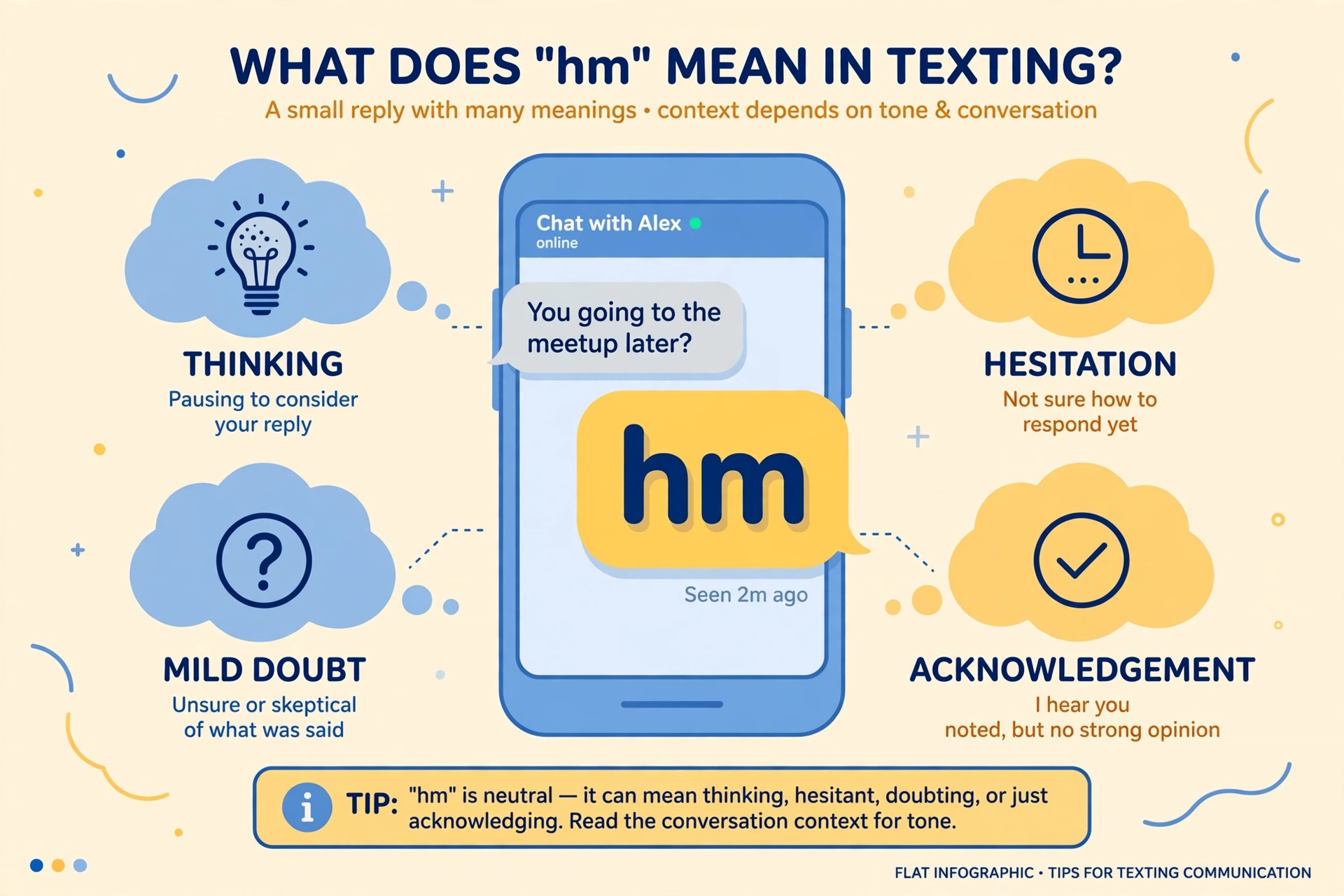
So what does hm mean in text? In most cases, it means the person is thinking, hesitating, or not quite sure yet. It is the written version of the little humming sound people make out loud when they pause to think.
That is the short version. The tricky part is that “hm” on its own does not tell you which kind of thinking is going on. Is it genuine thought, mild doubt, or quiet disinterest? The answer is almost always in the context around it, not in the two letters themselves.
The Short Answer
When someone texts you “hm,” they are usually doing one of these things:
- Pausing to think before they answer
- Showing hesitation or mild doubt about what you just said
- Acknowledging your message without fully agreeing or disagreeing
- Buying a little time while they decide what to say next
What “hm” almost never means on its own is a clear yes or a clear no. It is a pause, not a verdict. If you need a real answer, you will usually have to wait for their next message — or ask for one.
“Hm” Is a Sound, Not an Abbreviation
Here is the first thing most people get wrong about “hm”: it does not stand for a phrase.
Unlike LOL (laughing out loud) or BRB (be right back), “hm” is not initials for anything. It is a spelled-out sound — the closed-mouth hum people make when they are thinking. Linguists call this kind of word an interjection: a small reaction that stands on its own rather than forming a full sentence, similar to “oh,” “uh,” or “wow.”
Dictionaries back this up. Merriam-Webster’s entry for hmm lists “hm” as a variant of “hmm” and defines it as a sound made by someone who is thinking about what to say or do. Dictionary.com defines hmm the same way: a sound made when considering or puzzling over something.
That is also why “hm” feels so vague. A sound does not carry a fixed meaning the way a word like “yes” does. It borrows its meaning from the situation around it.
A quick note on where “hm” comes from
“Hm” is not internet slang that someone invented for texting. The thinking hum existed in speech long before phones did, and writers used it in dialogue and comics to show a character pausing or thinking. Texting simply gave that spoken sound a written form, because chats move fast and people needed a quick way to type a pause.
The Online Etymology Dictionary notes that “hmm” is attested from 1868 as a sound made during contemplation or showing mild disapproval, and that it is probably a variation of “hum,” attested in similar senses from the 1590s. That is the documented history — nothing more specific than that is claimed here.
The Main Meanings of “Hm” in Texting
1. Thinking or processing
This is the most common meaning. The person read your message and is still turning it over in their mind.
- “Hm, let me think about it.”
- “Hm, that’s actually a good point.”
- “Hm, I hadn’t thought of it that way.”
In these cases, “hm” is just the first beat of a longer reply. The rest of the sentence tells you the thinking is genuine.
2. Hesitation or mild doubt
Sometimes “hm” signals that the person is not fully convinced. It is a soft way of saying “I’m not sure about that” without starting an argument.
- “Hm, are you sure that’s true?”
- “Hm… I don’t know about that.”
- “We should leave at 6 in the morning.” / “Hm.”
Notice how the last example says a lot with very little. The person has not said no, but they clearly are not enthusiastic either.
3. Quiet acknowledgement
“Hm” can also work as a simple “noted” — a way of showing you heard someone without adding much of your own.
- “Hm, okay, that makes sense.”
- “Hm, interesting.”
This is the neutral middle ground. It is not warm, but it is not cold either. It just says: I read that, and I am still with you.
4. Mild surprise or curiosity
A short “hm” can mark something unexpected catching the person’s attention.
- “Hm, I didn’t expect that.”
- “Hm, you might be onto something.”
Here the tone is closer to curiosity than doubt. The person is reacting to new information and wants to hear more.
5. Low interest or a dry reply
This is the reading people worry about most, and it does happen — but it is not the default meaning. “Hm” starts to feel dismissive when it shows up as a pattern: one-word replies, long delays, and no follow-up effort.
One bare “hm” after a long message does not prove someone is uninterested. Repeated bare “hm” replies across a whole conversation are a different story. Look at the pattern, not the single message.
Hm vs. Hmm vs. Hmmm vs. Mhm
These look-alikes are related, but they do not all carry the same weight. A useful rule of thumb: more letters usually mean a longer, more visible pause.
| Reply | What it usually signals | Tone |
|---|---|---|
| Hm | A brief pause or quick reaction | Neutral, sometimes clipped |
| Hmm | Longer, more visible thinking | More thoughtful, less curt |
| Hmmm | Drawn-out thinking, suspicion, or playful teasing | Engaged, sometimes suspicious |
| Mhm (mm-hmm) | Agreement or “I’m listening” | Positive, confirming |
The important distinction is the last row. “Mhm” is a different sound — the closed-mouth version of “uh-huh” — and it generally means yes or “go on.” So “hm” and “mhm” are not interchangeable. If someone replies “mhm,” they are agreeing or encouraging you to continue. If they reply “hm,” they are still thinking.
How Punctuation Changes What “Hm” Means
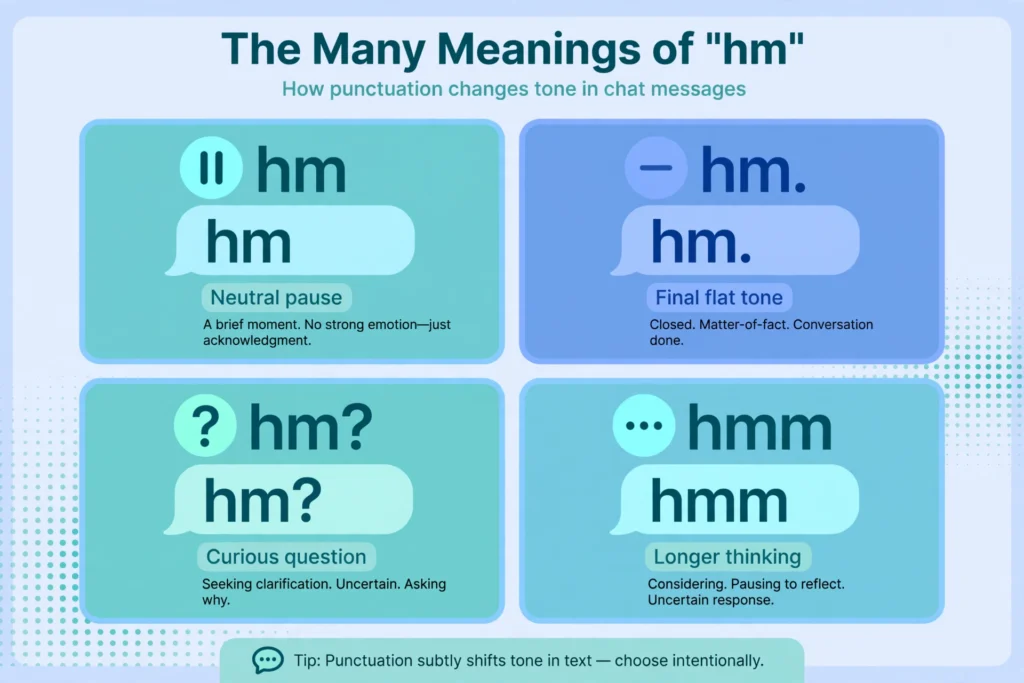
With such a short reply, punctuation does a surprising amount of work. Here is how the same two letters shift:
- “hm” (no punctuation) — usually feels casual and neutral, like a quick pause mid-chat.
- “Hm.” (with a period) — often reads more final or flat. It can feel closed-off, as if the person has finished thinking and is not inviting more discussion.
- “Hm?” (with a question mark) — usually signals genuine confusion or a request for clarification, closer to “what do you mean?” or “are you serious?”
- “Hm…” (with an ellipsis) — usually reads as trailing off: the person is unsure, weighing something, or leaving the thought unfinished.
None of these readings is guaranteed. Punctuation is a clue, not a code. But if you are trying to judge a bare “hm,” the punctuation attached to it is one of the best clues you have.
How to Tell What “Hm” Means From Context
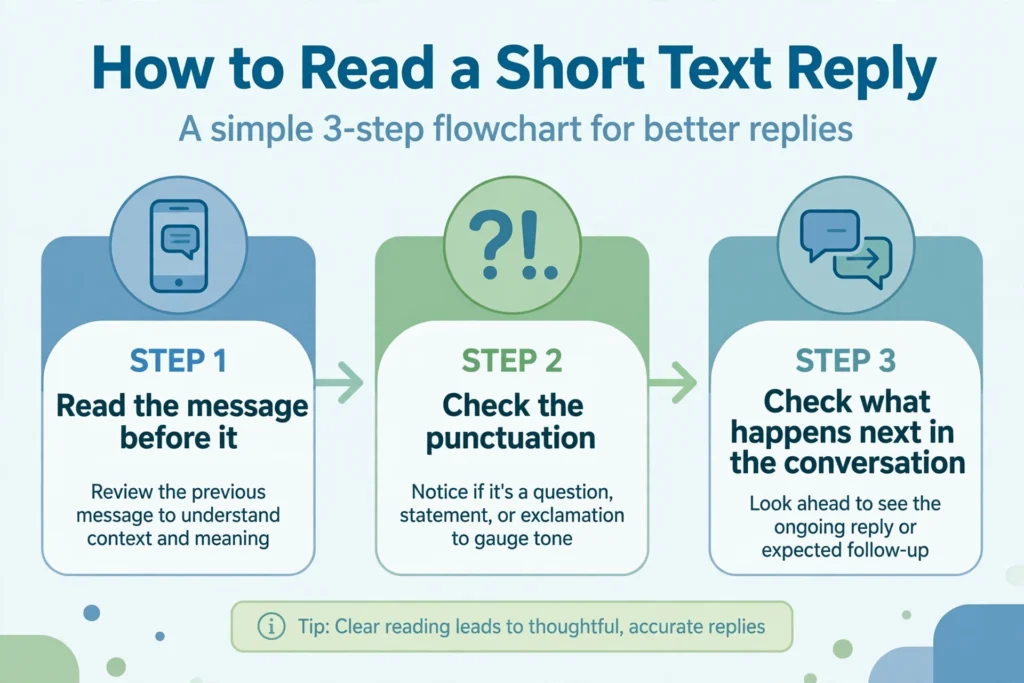
Since “hm” has no fixed meaning, you need a small checklist. Run through these four questions before you decide what someone meant.
Step 1: What did you just say?
The message before the “hm” matters more than the “hm” itself.
- If you asked a question that needs thought (“Should we move the trip to Friday?”), a “hm” most likely means they are thinking.
- If you made a surprising claim (“I just got offered the job”), a “hm” most likely means surprise or curiosity.
- If you made a suggestion they might not like (“Let’s wake up at 5 am”), a “hm” most likely means hesitation.
Step 2: Check the punctuation
Use the guide above. A “hm?” is asking you something. A “Hm.” is closing something down. A bare “hm” is usually just a pause.
Step 3: Watch what happens next
This is the most reliable test of all.
- If they follow up with a real reply within a few minutes, the “hm” was just thinking time. Forget about it.
- If they keep the conversation going normally afterward, the “hm” was neutral.
- If the “hm” is followed by silence, or by a string of one-word replies, low interest becomes a more reasonable reading.
Step 4: Consider your relationship and the normal pattern
A friend who always texts in short bursts probably means nothing special by “hm.” A person who usually writes long, warm replies and suddenly answers with a single “hm” is sending a different signal. Judge the message against how that person normally texts you, not against a universal rule.
A few examples, decoded
- You: “Want to try that new place on Saturday?” / Them: “Hm, let me check my schedule first.” — Genuine thinking. They need to check something before committing.
- You: “I think we should just drive instead of flying.” / Them: “Hm… I’m not sure that’s cheaper.” — Mild doubt. They disagree gently and are about to explain why.
- You: “Did you hear they cancelled the show?” / Them: “Hm, really?” — Surprise and curiosity. They want details.
- You: (a long, personal message) / Them: “Hm.” — Flat and closed. This one is worth a follow-up question, because it gives you nothing to work with.
Other, Rarer Meanings of “HM” to Know About
Most of the time, “hm” is the thinking sound described above. But the same two letters show up in a few other places, and knowing about them stops confusion.
HM as “His/Her Majesty”
In formal British writing, “HM” is an abbreviation for His or Her Majesty — as in “HM King Charles III” or “HM Revenue & Customs.” This is a formal title abbreviation, not texting slang, and it has nothing to do with chat messages. If you see “HM” in capitals in a formal or official context, this is the meaning. In a casual text from a friend, it is not.
“Hm” as a shortened “hit me [up]”
In some casual and gaming chats, “hm” is used as a shortened form of “HMU” (hit me up), meaning “message me” — for example, “hm when you get home.” This is a niche usage, much less common than the thinking sound, and it usually only makes sense when the sentence around it is clearly asking for contact.
“Hm” as a shortcut for “him”
Some slang guides report “hm” being typed as a fast, phonetic shortcut for “him” — for example, “I saw hm yesterday.” Treat this one with caution. It is rare, it is easy to confuse with the thinking sound, and it is not a standard abbreviation. If a sentence only makes sense with “him” in it, that reading is possible. If it does not, do not assume it.
What “hm” does not mean
- It does not mean yes, and it does not mean no.
- It is not a standard abbreviation with a hidden full form.
- It is not, on its own, proof that someone is angry, bored, or ignoring you.
How to Reply When Someone Sends You “Hm”
Getting a bare “hm” can feel awkward, but your reply does not have to be. Match your response to the situation:
- If the chat feels light: keep it moving with something like “Hm? What’s on your mind?” or “Take your time — what do you think?”
- If the “hm” feels unclear: ask directly. “Is everything okay?” or “What do you mean by that?” gets you a real answer faster than guessing.
- If you are joking around with a friend: mirroring it back (“Hm, indeed”) or teasing them lightly (“That’s all I get?”) usually keeps things fun.
- If the conversation is serious: say so plainly. “I want to understand what you mean — can you say a bit more?” works better than reading a single word over and over.
The general rule is simple: do not assume the worst meaning first. A quick clarifying question almost always beats silent overthinking.
When You Should Not Reply With Just “Hm”
“Hm” works fine in casual, low-stakes chats. It works badly in a few situations:
- In work messages or emails. A standalone “hm” gives your colleague no information and can read as abrupt or unprofessional. A short sentence (“Let me think about that and get back to you”) does the same job far better.
- In serious or emotional conversations. If someone has just told you something important, a bare “hm” can feel dismissive even when you do not mean it that way. Add a sentence that shows you actually heard them.
- As your whole reply, repeatedly. One “hm” is a pause. Five in a row is a pattern, and the other person will reasonably read it as disinterest.
If you catch yourself typing “hm” alone, a good habit is to add even a few words: “Hm, let me think,” “Hm, interesting,” or “Hm, I’m not sure yet.” It takes two seconds, and it removes almost all the guesswork for the other person.
Frequently Asked Questions
What does hm mean in text?
In texting, “hm” is the written form of the thinking sound “hmm.” It usually signals thinking, hesitation, mild doubt, or quiet acknowledgement, and its exact shade of meaning depends on context and punctuation.
Is hm an abbreviation?
No. Unlike LOL or BRB, “hm” does not stand for a phrase. It is an interjection — a spelled-out sound people make when they pause to think, similar to “oh” or “uh.”
Does hm mean yes or no?
Neither. “Hm” reflects thought or uncertainty rather than a clear answer. If you need a yes or no, wait for the follow-up message or ask directly.
Is hm the same as hmm?
They are closely related, but not identical. “Hmm” usually signals a slightly longer or more considered thought than a quick “hm,” and it tends to read as warmer and less clipped.
What is the difference between hm and mhm?
“Mhm” (mm-hmm) generally means agreement or “I’m listening” — it is closer to “uh-huh.” “Hm” means thinking or hesitation. Mixing them up is one of the most common misreadings of short replies.
Is hm rude?
Not on its own. It can come across as cold or distant depending on punctuation and context — especially a flat “Hm.” sent alone — but it often just means the person is thinking and has not finished their reply yet.
What does hm mean from a girl or a guy?
The same thing it means from anyone else: thinking, hesitation, or a neutral reaction. There is no separate male or female meaning for “hm.” Judge it by the context and the person, not by who sent it.
Should I worry if someone replies with just hm?
Not necessarily. Check the context, the punctuation, and what happens next in the conversation before assuming anything negative. If it keeps happening and it bothers you, asking directly is more useful than guessing.
What does HM mean in capital letters?
In casual texting, capital “HM” usually means the same as lowercase “hm” — people just type it that way. In formal or official writing, “HM” can stand for His or Her Majesty, but that meaning does not apply to everyday chats.
Bottom Line
“Hm” is one of the smallest replies you can send, and one of the easiest to overthink. At its core, it is just a thinking sound written down: a pause that says “I’m processing this” without committing to an answer.
When you receive one, do not read it in isolation. Look at what you said just before it, check the punctuation, and — most importantly — watch what the person says next. That is where the real meaning lives.
And when you send one, remember how it feels on the other side. A few extra words — “Hm, let me think” instead of just “hm” — cost you nothing and save the other person a whole round of guessing.