
Mincigrap: What It Is, What Is Inside, and What Is Actually Known
If you searched for “mincigrap”, you probably saw it described as a French slimming supplement for weight loss and cellulite. The short version: Mincigrap is a dietary supplement from the French company Laboratoires Arkopharma, sold as Arkogélules Mincigrap in boxes of 45 capsules. It contains only one active ingredient — grape marc powder, made from pressed black grapes. Retailers make big claims about what it does, but no human clinical trial of Mincigrap itself was found, and the product’s own trademark in France has expired.
That gap between the claims and the evidence is what this guide is about: what Mincigrap is, what is inside it, who makes it, what sellers say it does, what the evidence actually shows, and how to check any product before you buy it.
The Short Answer
Mincigrap is a French dietary supplement from Laboratoires Arkopharma, sold under the names Arkogélules Mincigrap and Arkocaps Minigrap in boxes of 45 capsules. Its only active ingredient is grape marc powder — the powder made from the solid remains of pressed black grapes with red pulp, including the skins, seeds, and stalks. According to the retailer’s product description, that powder is rich in flavonoids and anthocyanins, tannins, and mucilages.
Sellers claim it helps you lose weight, firm your skin, and reduce cellulite. Those are the sellers’ claims, not proven facts. No human clinical trial of Mincigrap itself was found, and no safety information, side effects, or interactions for the product were found in the sources read. The trademark MINCIGRAP in France, owned by Laboratoires Arkomedika SA, was registered in 1985 and is now expired. If you are thinking about taking any slimming supplement, talk to your doctor or pharmacist first — especially if you are pregnant or breastfeeding, take medication, or live with a medical condition.
What Is Mincigrap?
Mincigrap is a dietary supplement, not a medicine. It comes from the French company Laboratoires Arkopharma and is sold as Arkogélules Mincigrap — or, in some shops, Arkocaps Minigrap — in boxes of 45 capsules.
Mincigrap follows Arkopharma’s plant-based pattern: a single plant ingredient, pressed into a capsule, sold as a food supplement rather than a drug. That distinction matters. A dietary supplement is not held to the same proof standards as a medicine, and it is not meant to diagnose, treat, or cure a disease — even when the shop selling it uses language that sounds medical.
Mincigrap is also a product with a history. Its French trademark was presented in 1985, so this is not a brand-new supplement. It has been sold in French pharmacies and in online shops in other countries, including Lebanon. But no official Arkopharma product page for Mincigrap was found, which suggests the company may no longer actively promote it.
Mincigrap vs Minigrap: The Two Spellings
One of the first things that confuses people searching for this product is the spelling: you will see it written both “Mincigrap” and “Minigrap”. Both spellings appear in retailer listings for what looks like the same Arkopharma product line — the same 45-capsule box, the same grape marc ingredient, the same company.
The French pharmacy listing uses “Arkogélules Mincigrap”, while a Lebanon online shop lists “Arkopharma Arkocaps Minigrap 45 Capsules”. The trademark registered in France is spelled “MINCIGRAP”. The difference is a single letter — the “c” in the middle — and it is most likely a spelling variation that crept into different shops’ listings over the years, rather than two different products.
If you are searching for this product, check both spellings. A shop that lists “Minigrap” and one that lists “Mincigrap” are probably selling the same Arkopharma capsules — but always compare the label details (company name, capsule count, ingredient) before you assume two listings are identical.
What Is Inside Mincigrap?
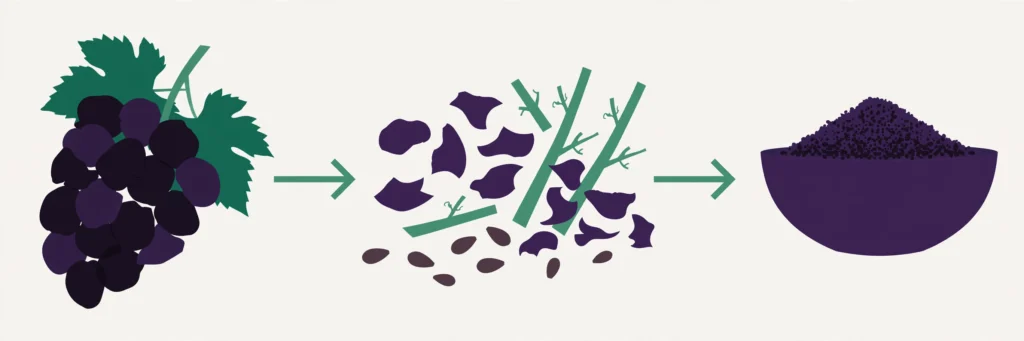
According to the retailer’s product description, Mincigrap “contains exclusively grape marc powder”. That is the whole active formula: one ingredient, in a vegetable capsule.
So what is grape marc? When grapes are pressed to make juice or wine, the solid remains left behind are called marc — or pomace: the skins, seeds, and stalks that stay in the press after the juice has been squeezed out. For Mincigrap, that marc comes from black grapes with red pulp, dried and ground into a powder.
The retailer describes the powder as “particularly rich” in three groups of compounds:
- Flavonoids and anthocyanins, which the retailer says “have very important antioxidant properties that preserve cells”. Anthocyanins are the pigments that give black grapes their deep purple-red colour, and flavonoids are a large family of plant compounds found in many fruits, vegetables, and teas.
- Tannins, which the retailer says “stimulate the vascular system to limit cellulite”. Tannins are the astringent compounds you can taste in strong tea or red wine.
- Mucilages, which the retailer says are “substances that control the assimilation of sugars and fats”. Mucilages are gel-like plant fibres that swell with water.
The capsules themselves are in a vegetable envelope made of hydroxypropylmethylcellulose, which the retailer describes as “highly tolerated by the greatest number”. In plain words, the capsule shell is plant-based rather than gelatin-based.
Notice what is not in the formula: no added stimulants, no caffeine, no green tea extract, and no second active ingredient. If the product you are looking at contains other ingredients, it is not the same Mincigrap described here — check the label.
The Trademark and the Company Behind It
The trademark recordtells us something useful about Mincigrap’s history. According to the trademark database, the trademark MINCIGRAP in France is owned by Laboratoires ARKOMEDIKA SA, registered in Class 5 (pharmaceuticals — pharmaceutical, veterinary and sanitary preparations, and dietetic substances adapted for medical use). The record number is 1307374, a mixed trademark (text and image), presented on 23 April 1985.
The important part is its current status: the trademark is registered — and expired in France. An expired trademark does not mean the product never existed or was fake; it means the legal protection for the name has lapsed, which usually happens when a company stops renewing it. For a buyer, it is one more sign that Mincigrap is an older product that may no longer be actively maintained by its maker.
Laboratoires Arkopharma itself is a real, long-established French company in the plant-based supplement field, and “Arkogélules” is its own brand line for plant-powder capsules. So the product’s origin is not mysterious. What is uncertain is its current status — whether Arkopharma still makes and sells it, and where you can buy a genuine box today.
What Sellers Claim Mincigrap Does
Retailers describe Mincigrap as a slimming and skin-firming supplement. Here are the claims from one retailer’s product page, in its own words:
- It will “facilitate your weight loss and firm your skin”.
- Its “beneficial effects are visible from the first weeks”.
- It “facilitates the elimination and loss of cellulite”.
- It helps “limit the orange skin and smooth the skin”.
- It can “promote elimination by taking care of transit”.
- It helps “reduce the assimilation of fats and sugars”.
- “Combined with physical activity and caloric control, these capsules allow you to lose weight quickly and refine your body”.
Read those claims carefully and you will notice a pattern: they promise fast, visible results from a single-ingredient capsule. And the last claim quietly adds the condition that does most of the work — “combined with physical activity and caloric control”. The retailer itself says the capsules work alongside exercise and eating less, which are the two things that cause weight loss on their own.
All of these claims belong to the retailer. None of them is backed by a human clinical trial of Mincigrap that was found in this research. That does not automatically mean the product does nothing, but it does mean you should treat the claims as marketing, not as proven facts.
What the Evidence Actually Shows
No human clinical trial of Mincigrap itself was found. There is no published study in which a group of people took Mincigrap capsules and a control group took a placebo, with weight, body fat, or cellulite measured over weeks or months. Without that kind of study, nobody can say with evidence that Mincigrap causes weight loss or reduces cellulite in people.
What does exist is research on grape polyphenols in general — the family of compounds that includes the flavonoids and anthocyanins in grape marc. A patent document cites studies showing that grape polyphenols affect digestive enzymes in test tubes and in rats. Those studies are real, but they are a long way from proving that a capsule of grape marc powder helps a person lose weight. A study of grape polyphenols in general is not a study of the Mincigrap product.
There is also no safety information for Mincigrap in the sources read for this article — no list of side effects, no contraindications, and no known interactions with medicines. That is not the same as saying the product is safe. A concentrated supplement is not the same as eating grapes, and anyone who is pregnant or breastfeeding, takes medication, or lives with a medical condition should talk to a doctor or pharmacist before taking any slimming supplement.
Mincigrap in the Patent Study
The most detailed document that mentions Mincigrap is a United States patent application — US20080171707A1, also published as US20110142971. It is not a patent for Mincigrap: it is about an onion extract for controlling weight gain, and Mincigrap appears in it only as a comparator product, tested alongside the inventors’ own onion extract.
The patent describes Mincigrap as a product that “represents a concentrated source of polyphenols derived from grape-cakes which impact on the digestive enzymes have been demonstrated in vitro (Griffiths 1986, Tebib et al. 1994, Carmona 1996) and in vivo in rats (Horigome et al. 1988, Vallet et al. 1994)”. In plain words, grape polyphenols were shown to affect digestive enzymes in laboratory tests and in rats — evidence about grape polyphenols generally, not a trial of Mincigrap in people.
The patent’s animal study used a dose of Mincigrap of 50 mg per kilogram of body weight in hamsters — a non-obese rodent model fed a lipid-rich, atherogenic diet. Its human-equivalent dose table lists Mincigrap as 6 x 390 mg capsules, or 2,340 mg per day (20–40 mg per kilogram of body weight), compared with the weight-loss drug Xenical at 3 x 240 mg, or 720 mg per day.
Those numbers are doses used in a patent study, not a recommended dose for you — this article does not recommend any dose. Never take a dose from a patent document as medical advice. If a product’s label gives a dose, that is the manufacturer’s instruction, and if you have any health condition or take any medication, check with a doctor or pharmacist before following it.

How to Check a Mincigrap Product Before Buying
Because Mincigrap is an older product with an expired trademark and no official product page found, be extra careful if you come across it for sale:
- Check the company name on the label. The genuine product is from Laboratoires Arkopharma. If the label names a different company, it is not the same product.
- Check the ingredient list. The product described here contains exclusively grape marc powder in a vegetable capsule. If the label lists other active ingredients, you are looking at something else.
- Check the capsule count and both spellings. The standard box is 45 capsules, and the same product appears under both “Mincigrap” and “Minigrap” — a very different count is a reason to ask questions.
- Check the seller. Buy from a pharmacy or a retailer you can verify, not from a random listing with no contact details. If you are unsure whether a seller or a website is trustworthy, a guide like the Tech2Explore explainer on how to check whether a website is safe can help you spot the warning signs before you pay.
- Check the price and the stock status. A French pharmacy listing seen at the time of checking showed the product at €5.40, out of stock. A listing far cheaper than that, or one that pressures you to buy quickly, deserves a second look.
- Check the claims. If a seller promises fast weight loss or “visible results in the first weeks”, remember that no human trial of Mincigrap was found to support those promises.
- Talk to a doctor or pharmacist first. This is the most important step, especially if you are pregnant or breastfeeding, take medication, or have a medical condition.
Names That Look Like Mincigrap but Are Not
Mincigrap is an unusual word, and a search for it can pull up things that have nothing to do with the supplement. Three of them are worth knowing so you do not mix them up:
- Mini-graph processing is a topic in computer science — the subject of a 2008 PhD dissertation by Anne Weinberger Bracy at the University of Pennsylvania, about instruction fusion in superscalar processors. It has nothing to do with grapes or supplements.
- Minigrapta is a genus of moths in the tribe Apameini, described in 2012, with the type species Xanthograpta basinigra. It is a name in insect taxonomy, not a product.
- MINC1 is a small-molecule inhibitor of MgcRacGAP, studied in cell division and cancer research. It is not Mincigrap, and it is not a supplement.
If you see one of these names in your search results, you have simply hit a lookalike. None of them is the Arkopharma product.
What Is NOT Verified
- No human clinical trial of Mincigrap itself was found. The retailer’s weight-loss and cellulite claims have no published human trial behind them in the sources read.
- No official Arkopharma product page for Mincigrap was found, so its current availability, price, and manufacturer status could not be verified from official sources.
- No safety information, side effects, contraindications, or interactions for Mincigrap were found in the sources read. The absence of safety information is not proof of safety.
- The in vitro and rat studies cited in the patent concern grape polyphenols generally, not a trial of the Mincigrap product in people. They do not prove that Mincigrap helps people lose weight.
- The only availability seen at the time of checking was a French pharmacy listing at €5.40 that was out of stock, and a Lebanon online shop listing for “Arkocaps Minigrap 45 Capsules” — listings seen at one point in time, not a guarantee of stock or price now.
Frequently Asked Questions
What is Mincigrap?
Mincigrap is a French dietary supplement from Laboratoires Arkopharma, sold as Arkogélules Mincigrap (also spelled Minigrap) in boxes of 45 capsules. It contains only grape marc powder.
What is Mincigrap made of?
It is made exclusively from grape marc powder — the dried, ground remains of pressed black grapes with red pulp, including skins, seeds, and stalks. The retailer says the powder is rich in flavonoids and anthocyanins, tannins, and mucilages, and the capsules use a vegetable shell of hydroxypropylmethylcellulose.
Does Mincigrap help with weight loss?
There is no human clinical trial of Mincigrap itself to support that claim. Sellers say it helps with weight loss, especially combined with physical activity and calorie control, but that has not been proven in a published human study. Exercise and eating less are what cause weight loss, with or without a supplement.
Does Mincigrap reduce cellulite?
Sellers claim it limits cellulite and smooths the skin, but no human trial of Mincigrap was found to support that either. The retailer says the tannins in grape marc “stimulate the vascular system to limit cellulite” — that is the retailer’s claim, not a proven effect.
Is Mincigrap still sold?
It is hard to say for sure. A French pharmacy listing seen at the time of checking showed it out of stock at €5.40, and a Lebanon online shop listed it. No official Arkopharma product page was found, and the French trademark has expired. If you find it for sale, check the label and the seller carefully.
What is the difference between Mincigrap and Minigrap?
There is no known difference. Both spellings appear in retailer listings for what looks like the same Arkopharma product — the same 45-capsule box and the same grape marc ingredient. The trademark is spelled MINCIGRAP. Check both spellings when you search.
Is Mincigrap safe?
No safety information, side effects, contraindications, or interactions for Mincigrap were found in the sources read. That does not mean it is safe — it means the safety information was not found. Talk to your doctor or pharmacist before taking any slimming supplement, especially if you are pregnant or breastfeeding, take medication, or live with a medical condition.
Bottom Line
Mincigrap is a real product with a real history: a French Arkopharma supplement made only from grape marc powder, sold in 45-capsule boxes under two spellings, Mincigrap and Minigrap. Its French trademark dates back to 1985 and has since expired, and no official product page was found — it may no longer be actively sold or promoted.
What Mincigrap is not is a proven weight-loss or anti-cellulite treatment. Sellers make strong claims, but no human clinical trial of the product itself was found, and the only studies behind its ingredient are laboratory and rat studies on grape polyphenols in general. If you come across Mincigrap for sale, check the label, the seller, and both spellings, and talk to a doctor or pharmacist before taking it. The safest way to lose weight is still the unglamorous one the retailer itself mentions: physical activity and calorie control.