Serumcu: The Turkish Word for a Serum Person, Explained
If you have seen the word “serumcu” online, you may have wondered what it means. Is it a skincare product? A job title? A brand? The short answer is that serumcu is a Turkish word for a person who works with serums — not a product, and not a medical qualification. The word shows up in more than one world, from skincare counters to IV drip clinics, and the meaning changes with the setting.
A serumcu is someone who works with serums: a skincare specialist, a formulator, a lab technician, a brand representative, a retail consultant, or an influencer who explains and sells serums. In medicine, the word can also point to the people who prepare and give intravenous (IV) drips. What it is not is a bottle you can buy, a degree you can earn, or an official medical title.
The Short Answer
Serumcu is a Turkish word that means “serum person” — a person who works with or deals in serums. It is built from the word “serum” plus the Turkish suffix “-cu”, which marks a profession, like the English “-er” in “baker” or “driver”. There is no formal degree called “serumcu”, and it is not an official medical term. In skincare, a serumcu might be a specialist, a formulator, or a salesperson; in medicine, someone who works with IV serums. It is not a product name, and not a finance job either, though a few confused pages online suggest otherwise.
What Does Serumcu Mean?
The simplest way to understand the word is to break it in two. “Serum” is the substance — the concentrated liquid used in skincare or medicine. The suffix “-cu” turns it into a person: the one who works with it. So a serumcu is, literally, a serum person.
The same pattern shows up all over Turkish. A “çaycı” is a tea vendor or maker — someone whose work is tea. A serumcu is someone whose work is serums. The word tells you what the person does, not what qualifications they hold.
That distinction matters. A dermatologist is a licensed medical doctor who specializes in skin health, while a serumcu may or may not be a medical professional at all. People in this field usually have backgrounds in chemistry, dermatology, pharmacology, aesthetics, or cosmetology — but the word itself guarantees none of that, so check who you are dealing with before you take their advice.
Where the Word Comes From
The word “serum” comes from Latin “serum”, meaning whey or watery fluid. In its oldest sense, it described the clear, watery part of a liquid — the part left behind when the thicker part separates out. That is still a good picture of what a serum is today: a light, watery liquid carrying a concentrated dose of active ingredients.
The Turkish suffix “-cu” is what turns the substance into a job. It works like the English “-er” in “baker” or “driver”, or “-ist” in “chemist”. Add it to a noun and you get the person who works with that thing. So “serum” plus “-cu” gives you “serumcu”: the person who works with serums.
The word is not an old, established profession name. It is a newer, informal word that has grown up alongside the skincare boom and the rise of IV wellness clinics. The word is useful, but it is not a credential.
Serumcu in Skincare: The Enthusiast and the Specialist
In the skincare world, a serumcu today could be several different kinds of people: a skincare specialist who advises customers, a formulator who develops new serums in a lab, a lab technician who tests them, a brand representative, a retail consultant, or an influencer who explains and sells serums online.
These are very different roles, with very different levels of expertise. A formulator with a chemistry background knows how ingredients interact. A retail consultant may know the product range well but have no scientific training. An influencer may be paid to promote a serum and may not have used it for long. The word “serumcu” covers all of them, so it tells you almost nothing about how much the person actually knows.
When you meet the word online, ask what the person actually does. Do they formulate products, or sell them? Do they have training in chemistry, dermatology, or cosmetology? A real specialist will answer plainly. Someone who leans on the word itself, without any detail behind it, is worth a second look.
What Is a Serum?
Before you can judge a serumcu, it helps to know what a serum is: a lightweight skincare product designed to deliver high levels of active ingredients into the skin. Unlike creams or lotions, serums are described as having smaller molecules that allow deeper penetration and faster absorption — that is how the products are marketed and described by skincare sources, and it is why they feel so different from a heavy moisturizer. They target specific concerns such as acne, dullness, pigmentation, dryness, or aging.
Serums come in many kinds, each built around a different set of active ingredients:
- Hydrating serums use ingredients like hyaluronic acid to draw moisture into the skin.
- Brightening serums use vitamin C or niacinamide to even out skin tone and add glow.
- Anti-aging serums use peptides, retinol, or antioxidants to target fine lines and texture.
- Exfoliating serums use AHAs or BHAs to remove dead skin cells and smooth the surface.
- Hair serums are a separate category, aimed at frizz control and heat protection.
- Medical serums include intravenous nutritional serums, vaccine serums, and blood-derived serums.
- Nutritional serums are liquid supplements that deliver concentrated nutrients.
The skincare serums are the ones you will meet most often.
How to Use Serums in a Daily Routine
Serums are concentrated, so a little goes a long way — and the way you apply them matters as much as which one you choose. Start with clean, slightly damp skin: damp skin absorbs a serum better than dry skin, so apply it right after cleansing, while your face is still a little moist. Use only a few drops — a pea-sized amount is usually plenty for the face and neck. Gently pat the serum into your skin instead of rubbing it in harshly, and allow it to fully absorb before you put on the next product.
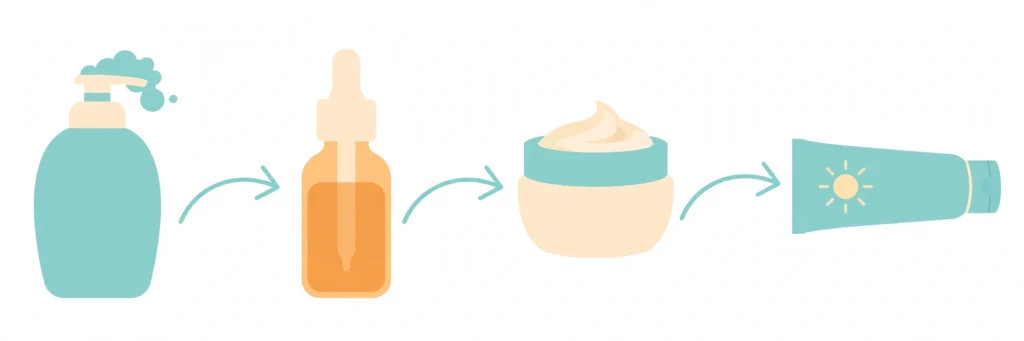
The order of your routine matters too: cleanser, then toner (if you use one), then serum, then moisturizer, then sunscreen in the morning — sunscreen always goes last. The serum goes on early because it is the most concentrated step, and the moisturizer seals it in.
Morning and night call for different serums: vitamin C in the morning for brightening and fighting environmental damage; retinol at night for fine lines and texture, or hyaluronic acid to restore moisture while you sleep. Let your skin type guide your choice: oily skin often benefits from niacinamide or salicylic acid, dry skin from hyaluronic acid and hydrating formulas, and sensitive skin from gentle, fragrance-free serums introduced one at a time.
Serumcu in Medicine: IV Therapy
The word “serumcu” also shows up in medicine, and here the meaning is quite different. In a medical environment, a serumcu may overlap with nurses or laboratory technicians. The “serum” in this setting means intravenous drips used for rehydration, detoxification, immune boosting, or nutrient replenishment. Clinics offering IV therapy employ professionals who prepare and administer sterile solutions.
Medical serums cover a wide range: electrolyte solutions, vitamin B and C infusions, chelation serums, antibiotic and antiviral serums, and glutathione and NAD+ therapies. These are real medical treatments, not beauty products, and the safety threshold is much higher: rigorous hygiene protocols, knowledge of anatomy, and monitoring patient responses are required, because a drip goes directly into the bloodstream.
Preparing and giving an IV drip is a clinical skill. It belongs to trained, licensed professionals working in licensed clinics, with sterile equipment and emergency care available if something goes wrong. Anyone offering IV drips outside that setting is not doing the same thing, however similar it looks.
The Gray Zone: Unlicensed IV Providers
There is a gray zone around IV therapy, and the word “serumcu” sits right in the middle of it — at least according to one Turkish site, milialar.org, the only source for the details in this section. That site says “serumcu” is not commonly used in everyday Turkish but emerges in informal or humorous contexts, as a cultural nickname in urban areas like Istanbul, Ankara, and Izmir, where mobile health services and wellness treatments are gaining popularity. Because that page could not be read in full — it served unrelated content when opened — everything here comes from that site’s account at snippet level, and none of it has been independently verified.
According to that same account, IV therapy has found a niche among people seeking quick fixes for fatigue, hangovers, vitamin deficiencies, or stress relief, and these serumcus often operate in a gray zone of legality and health regulations — many are said to be former nurses, med students, or health workers with access to medical supplies. In Turkish slang and humor, the site says, the serumcu has become a social symbol, “the last resort after a wild night”. The same account notes that the Turkish Ministry of Health has clear regulations: clinics must be licensed and practitioners must be certified.
Whether or not every detail of that account is accurate, the safety point is real. IV treatments must be given by licensed professionals in licensed clinics. An unlicensed mobile IV provider carries real risks: infection from non-sterile equipment, the wrong dose, an allergic reaction with no emergency care nearby, and no medical record of what was given. A drip is not a smoothie. If someone offers you an IV drip at home, in a hotel room, or from a van, walk away — it is not a convenience worth accepting.
Serumcu Is Not a Product — and Not a Finance Job
Two confusions about the word keep showing up online, and both are worth clearing up.
The first is treating serumcu as a product. Some skincare blogs use the word as if it were a serum itself — “your skin’s personal trainer”, or “tiny bottles pack a big punch”. That is a misuse of the word. Serumcu means a person, not a bottle. If a page sells you “a serumcu”, it is selling you a serum and dressing it up with a trendy word.
The second confusion is stranger. One site found in search results describes serumcu as a figure in financial markets, connected to custodianship, securities settlement, and central securities depositories. That is simply wrong. The word has no such meaning in Turkish or in finance. A serumcu has nothing to do with stocks, bonds, or bank accounts.
Common Mistakes and Myths About Serums
Serums are powerful precisely because they are concentrated, and that is also why they are easy to misuse. Layering too many serums at once is the first mistake: it is tempting to use a brightening serum, an anti-aging serum, and an exfoliating serum all in the same routine, but that can irritate the skin, especially when the active ingredients overlap or clash. More products do not mean faster results.
Mixing incompatible ingredients is the second. Retinol combined with strong exfoliants is a common example. Each one is useful on its own, but together they can strip the skin barrier and cause redness, peeling, and sensitivity. If you use strong actives, introduce them one at a time and on different days until you know how your skin reacts.
Applying serum on dry or unclean skin is the third. A serum applied to dry skin absorbs less well, and a serum applied to unwashed skin pushes dirt and oil deeper instead of delivering its active ingredients. Clean, slightly damp skin is the right starting point.
The myths are just as common. “More serum means faster results” is the biggest one — overusing active serums can irritate or damage the skin barrier without speeding anything up. “Natural always means safe” is another — even natural ingredients like essential oils or plant acids can be harsh or cause allergies. And “all serums suit all skin types” is untrue: each formulation must match specific skin needs.
How to Check a Serum or a Serumcu Before Trusting Them
Whether you are buying a serum or following a serumcu’s advice, a few checks will save you money and trouble. Read the ingredient list, not just the front of the bottle: the active ingredients and their position in the list tell you more than any marketing claim. A “vitamin C serum” with vitamin C near the bottom of the list is mostly something else. Look for transparent labeling with exact ingredients, and be wary of products that hide behind vague words like “proprietary blend” without naming anything.
Check the person behind the advice. If someone calls themselves a serumcu, ask what they actually do and what training they have — a formulator, a dermatologist, and a salesperson are not the same thing, and their advice should not carry the same weight.
Check the seller before you buy, especially from an unfamiliar shop or social media account. If a deal looks too good to be true, or a seller cannot be traced to a real business, step back. The Tech2Explore guide on checking whether a site is legitimate — Scamalytics explained — walks through the same checks: look up the seller, check for real contact details, and be suspicious of pressure to buy quickly.
For IV therapy, the checks are stricter and non-negotiable. The clinic must be licensed, the practitioner must be certified, and the treatment must happen in a proper clinical setting with sterile equipment. If any of those are missing, do not go ahead — no discount or convenience is worth the risk.
What Is NOT Verified
A lot has been written about serumcu, and not all of it is reliable. There is no verified evidence that “serumcu” is an established trend or movement with a founder, a community, or usage data behind it. There is also no verified evidence for the gray-zone details about mobile IV providers in Turkish cities beyond the single site’s account described above; that account could not be read in full, so treat it as one site’s story, not a confirmed fact.
Several specific claims were left out because they could not be verified. One blog claimed a skincare brand saw a 32% increase in repeat purchases within six months of launching a vitamin C and E ferulic serum — an unverified anecdote with no source behind it. Another claimed serums contain “20 or more active ingredient concentrations, far more than normal moisturizers with 5 to 10”, and attributed a fast-absorption claim to Harvard Medical School dermatologists — the numbers were unverified and the attribution could not be confirmed, so neither is repeated here as fact.
Finally, the claim that serums work “at the cellular level” or “penetrate deeper skin layers” is how the products are marketed and described by skincare sources. It is not presented here as established science. What is established is simpler: serums are concentrated, lightweight products, and they work best when matched to your skin type and used correctly.
FAQ
What does serumcu mean?
Serumcu is a Turkish word meaning a person who works with serums — literally “serum person”. It combines “serum” with the Turkish suffix “-cu”, which marks a profession, like the English “-er” in “baker”.
Is serumcu a real job?
It is a real word for a real kind of work, but not a formal job title or qualification. A serumcu could be a skincare specialist, a formulator, a lab technician, a brand representative, a retail consultant, or an influencer. There is no degree called “serumcu” and it is not an official medical term.
Is serumcu a product or a person?
A person. Serumcu refers to someone who works with serums. Some blogs use it as if it were a product name, but that is a misuse of the word. The product is a serum; the person who works with it is a serumcu.
What does a serumcu do?
It depends on the setting. In skincare, a serumcu might formulate serums, test them, sell them, or advise customers on which one to use. In medicine, a serumcu may prepare and administer IV drips in a clinic. Always ask what the person actually does.
Can anyone become a serumcu?
Anyone can use the word, since it is informal and unregulated. Real expertise is a different matter: professionals in this field usually have backgrounds in chemistry, dermatology, pharmacology, aesthetics, or cosmetology.
Is IV serum therapy safe?
IV therapy must be given by licensed professionals in licensed clinics, with sterile equipment and monitoring. Unlicensed mobile IV providers carry real risks, including infection, wrong doses, and no emergency care if something goes wrong. Never accept an IV drip from an unlicensed provider.
What is the difference between a serumcu and a dermatologist?
A dermatologist is a licensed medical doctor who specializes in skin health. A serumcu may or may not be a medical professional. The two words describe completely different levels of qualification, and they should not be confused.
Bottom Line
Serumcu is a Turkish word for a person who works with serums — a skincare specialist, a formulator, a salesperson, an influencer, or, in medicine, someone who works with IV drips. It is a useful word, but it is not a product, not a degree, and not a medical qualification. A serum is a concentrated, lightweight skincare product, and it works best when you choose it for your skin type, use only a few drops on clean, slightly damp skin, and do not layer too many strong actives at once. If you are considering IV therapy, the rules are stricter: licensed clinic, certified practitioner, sterile equipment — no exceptions. And whenever the word serumcu shows up online, ask who is using it and why. The word itself tells you almost nothing; the person behind it tells you everything.