Infiltrasjon Meaning: 4 Proven Uses and Costly Mistakes
Infiltrasjon is the Norwegian word for infiltration, and which meaning you need depends on the document in front of you. In a stormwater guide it means water soaking into the ground. In an encyclopedia entry on security policy it means covert placement of agents. In medicine it points to something spreading into tissue.
This guide sorts the four meanings, shows what Norwegian official and academic sources say about each, flags the costly mistakes and tells you what could not be verified.
A note on method: I read an entry in Store norske leksikon, a 2024 Norsk Vann report, a Tønsberg municipality guide on surface infiltration and an article on the lung-imaging term “infiltrate.” I did not find an English explainer for the Norwegian word. A page on septic soil tests would not load, so I did not use it. I translated the Norwegian passages myself, and I am not an engineer or a doctor.
The Short Answer
It is the Norwegian spelling of the same Latin-rooted word as the English “infiltration.” Its main uses are water entering soil, the covert placement of agents inside another group, and, in medicine, material spreading into tissue. Norwegian water guidance also has a separate term, styrt infiltrasjon, meaning managed aquifer recharge. Read the surrounding text to choose the right meaning.
4 Meanings of the Word
| Meaning | Where you see it | Source I read |
|---|---|---|
| Water soaking into the ground | Stormwater and drainage guidance | Tønsberg municipality guide (VA/Miljø-blad 92, 2009) |
| Managed (controlled) infiltration of surface water | Water supply and groundwater recharge | Norsk Vann report 286/2024 |
| Covert placement of agents | Politics, security and business rivalry | Store norske leksikon |
| Spread into tissue, shown on lung scans as an “infiltrate” | Medicine and radiology | The Common Vein (Jan 2026), citing the Fleischner Society |
Infiltrasjon in Water and Soil
This is the meaning you meet most often in Norwegian planning documents. Two related ideas matter: letting rainwater soak in at the surface, and deliberately sending surface water underground.
Surface Infiltrasjon: Letting Stormwater Soak In

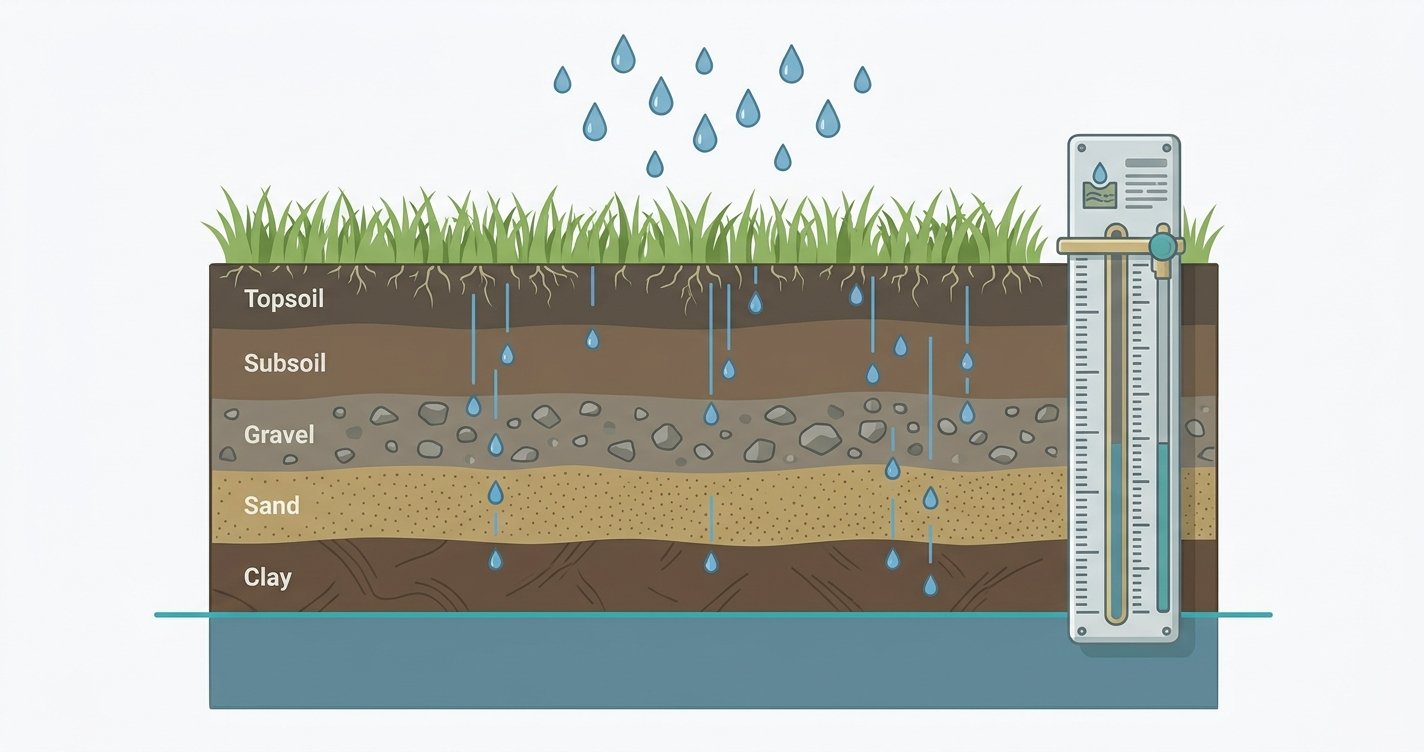
The Tønsberg guide says surface infiltration lets stormwater soak into the ground instead of running off in pipes. That can reduce the need for storm sewers and lower flood risk, since paved areas produce faster, larger runoff. It also helps keep groundwater levels up, and the soil can partly clean the water.
What the guide says about conditions:
- Good soils: coarse gravel and sand.
- Poor soils: clay and silt, which let water through slowly.
- Groundwater distance: at least 0.75 m between the infiltration level and groundwater, and preferably over 1 m, based on foreign guidelines.
- Frozen ground: infiltration is largely blocked, so designs should not count on it during frost.
- Clogging: fine sediment and compaction reduce capacity over time.
The guide is from 2009 and leans on some US figures, so treat its numbers as examples, not current design values.
Managed Recharge of Groundwater
Norsk Vann’s 2024 report defines styrt infiltrasjon as technical measures that increase the infiltration of surface water. It says the method was formerly called “artificial infiltration,” and that the term changed because of negative associations. Water is led from a surface source into the ground, seeps through sand and gravel and mixes with groundwater.
The report lists uses such as water treatment, more extraction capacity, storing water underground, stormwater and flood management and protecting aquifers. In its most common form, basin infiltration, gravity moves the water through the basin material.
Politics and Espionage
Store norske leksikon defines infiltrasjon in international politics as a covert attempt to place one’s agents inside another actor. The entry, by political scientist Ole T. Berg and updated on November 25, 2024, says the aim is either to weaken or win over the other side from within or to strengthen oneself through espionage or theft.
It names military conflicts, political disputes and economic rivalry between companies as examples. Related terms it lists include espionage, sabotage, spy and agent.
Medicine: The “Infiltrate” Problem
In medical English, “infiltrate” describes material that seems to have invaded tissue. On chest imaging, The Common Vein reports that the Fleischner Society’s glossary discourages the term because it is nonspecific and mixes an image finding with a suspected disease. It recommends “opacity” and then a more specific description, such as consolidation or ground-glass opacity.
I did not find a Norwegian medical dictionary entry, so I can’t say how Norwegian clinicians use infiltrasjon. This is general information, not medical advice. For a scan result, ask the doctor who ordered it.
5 Costly Infiltrasjon Mistakes to Avoid
These apply when you read or plan around it in drainage or stormwater work:
- Skipping the soil test. Clay and silt can make a plan fail, and the guide says to check soil maps and measure.
- Ignoring groundwater depth. Too little distance between the infiltration level and groundwater is a problem.
- Forgetting frost. Frozen ground blocks infiltration, so plan for meltwater and winter.
- Neglecting maintenance. The guide warns that unemptied sand traps and settling basins cause clogging.
- Assuming one country’s rules apply everywhere. Norwegian guidance, US figures and local codes can differ, so check with your local authority or an engineer.
What Is Verified and What Is Not
| Claim | Status |
|---|---|
| Surface infiltration lets stormwater soak into soil, with gravel and sand best | Stated by the Tønsberg guide (2009) |
| Groundwater should be at least 0.75 m below the infiltration level | Stated there, based on foreign guidelines |
| Styrt infiltrasjon is managed aquifer recharge | Defined in Norsk Vann report 286/2024 |
| In politics it means covert placement of agents | Defined by Store norske leksikon |
| “Infiltrate” is a discouraged term in lung imaging | Reported by The Common Vein, citing the Fleischner Society |
| How Norwegian doctors use the word | Not found |
| Current Norwegian design standards | Not checked |
| An English-language guide to the word exists | None found |
How to Translate a Norwegian Technical Word Safely
- Check the field first. The same word can mean water, spying or medicine.
- Look for compound words. Norwegian joins words, so overflateinfiltrasjon means surface infiltration.
- Use an official or academic source. Encyclopedias, municipal guides and industry reports beat a machine translation.
- Check the date. A 2009 guide may not match current rules.
- Read the definitions section. Reports such as Norsk Vann’s say what each term covers.
- Apply the same method elsewhere. We use it in our guides to onnilaina, messonde and wollmatten.
Frequently Asked Questions
What does infiltrasjon mean? It is Norwegian for infiltration. It can mean water entering soil, covert placement of agents or spread into tissue, depending on context.
Is it the same as infiltration? Yes, it is the Norwegian spelling, and the meanings overlap with the English word.
What is styrt infiltrasjon? Norsk Vann defines it as technical measures that increase infiltration of surface water, also called managed aquifer recharge.
What soil is best for infiltrasjon? The Tønsberg guide names coarse gravel and sand as good and clay and silt as poor.
Does it work in winter? Frozen ground largely blocks it, according to the Tønsberg guide.
What does infiltrasjon mean in politics? A covert attempt to place agents inside another actor, per Store norske leksikon.
What is an infiltrate on a lung scan? A discouraged term for an opacity presumed to reflect tissue invasion, per The Common Vein, citing the Fleischner Society.
Can I use these guides for my own project? They are general information. Check local rules and ask a qualified engineer or doctor.
Bottom Line
infiltrasjon has four main meanings, and the right one depends on the field: water entering soil, managed groundwater recharge, covert placement of agents or spread into tissue. The best sources I found are Norwegian official and academic documents, and the main mistakes come from skipping soil tests, ignoring frost and groundwater depth and assuming rules match across countries. Use the field and the date of a document to pick the meaning, and confirm details with a local professional.