Best Jazz Albums for Beginners: The Ultimate Gateway Records to Master
Entering the vast, improvisational world of jazz can feel remarkably overwhelming for newcomers facing decades of intricate sub-genres, complex chord progressions, and abstract compositions. Without a proper roadmap, listeners often stumble into avant-garde or free jazz too early, find it dense or inaccessible, and mistakenly write off an entire century of musical genius.
A successful journey into this timeless genre requires starting with records that balance sophisticated musicianship with immediate, captivating melodies. By intentionally curating your listening habits around foundational masterpieces, you unlock an appreciation for rhythm, harmony, and unscripted expression that transforms casual listening into a lifelong passion.
What Makes a Great Introductory Jazz Record?
Melodic Accessibility Versus Complex Improvisation
Navigating the world of recorded music requires understanding how essential jazz albums strike a delicate balance between structural familiarity and creative freedom. Unlike rigid pop song structures, jazz relies heavily on improvisation, where artists spontaneously invent melodies over a repeating chord progression. However, the best jazz music albums for newcomers retain strong, hummable hooks and steady, reassuring beats. This underlying accessibility acts as a bridge, allowing the uninitiated ear to appreciate complex instrumentation without feeling lost in a wall of abstract sound.
Navigating Key Eras: From Swing to Modal Jazz
Tracing the historical evolution of the genre helps beginners understand why certain periods stand out as the ultimate entry points. While early 1930s big band swing laid the groundwork for ensemble energy, and fast-paced 1940s bebop introduced dizzying instrumental virtuosity, it was the 1950s and 1960s cool jazz and modal eras that truly mastered atmospheric listening. These later periods stripped away frantic clutter in favor of spacious, relaxed, and deeply emotional arrangements. According to historical preservation records from the Library of Congress National Recording Registry, foundational albums from this golden mid-century window captured a cultural shift toward artistic introspection that continues to define modern recorded sound.
Essential Selections: The Ultimate Starter Records
Miles Davis – Kind of Blue
Breaking down the best-selling jazz record in history reveals why this 1959 masterpiece remains the undisputed gateway for newcomers. Kind of Blue shifted the genre away from rigid chord scales into modal jazz, allowing musicians to improvise freely over relaxed, expansive scales rather than complex chord changes. The album’s laid-back tempo, melancholic trumpet melodies, and legendary ensemble featuring John Coltrane and Bill Evans create an inviting atmosphere. Tracks like “So What” act as the ultimate entry point because they feel effortless, proving that emotional depth does not require blistering speed or chaotic noise.
Dave Brubeck Quartet – Time Out
Exploring unconventional time signatures in a way that remains instantly catchy is the defining genius of this classic release. Time Out challenged traditional 4/4 jazz rhythms by experimenting with asymmetrical meters, such as the famous 5/4 time signature on “Take Five” and 9/8 on “Rondo a Turk”. Despite the complex mathematical rhythm structures, Dave Brubeck’s melodic piano vamps and Paul Desmond’s soaring, silky saxophone lines make the music remarkably accessible. It teaches beginner listeners that complex technicality can coexist with infectious, toe-tapping grooves.
John Coltrane – Ballads
Shifting away from John Coltrane’s notoriously dense, high-speed “sheets of sound” era, this 1962 release highlights his profound ability to interpret romantic, slow-tempo standards. Ballads showcases a softer, deeply vulnerable side of the saxophonist, where every note is weighed for maximum emotional resonance rather than technical display. Accompanied by his classic quartet, Coltrane breathes new life into timeless American songbook classics like “In a Sentimental Mood.” This record serves as a comforting, gentle anchor for listeners who prefer lush, late-night atmosphere over frantic improvisation.
Building Your Personal Listening Collection
Choosing Between Vinyl, CDs, and Streaming
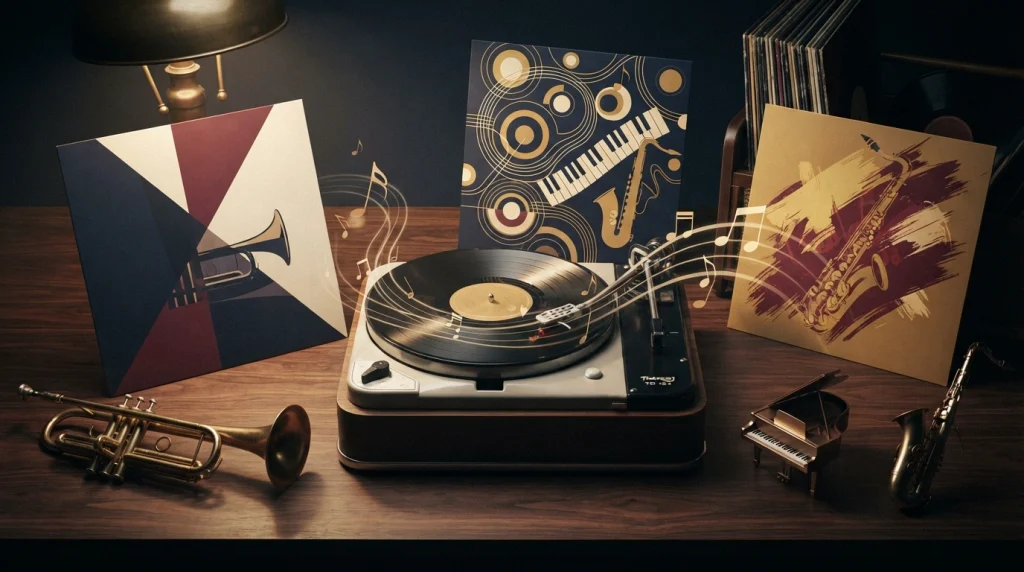
Curating your physical or digital library involves deciding how the medium impacts your engagement with the music. While high-resolution streaming services offer instant access to thousands of classic jazz titles for casual listening, physical formats like vinyl records and CDs introduce a deliberate ritual that enhances deep concentration. The tactile experience of handling gatefold sleeves, reading liner notes, and watching a record spin on a turntable encourages undistracted listening, allowing you to absorb the subtle dynamic shifts of acoustic instruments.
Tips for Active Listening and Appreciating Improvisation
Transitioning from passive background music to a deeper appreciation of jazz requires training your ear to follow individual musical conversations within an ensemble. Instead of listening to the track as a single uniform wall of sound, consciously isolate specific elements during different rotations: focus on the walking bassline that anchors the harmony, track the ride cymbal and polyrhythms of the drummer, or follow how the piano comps chords behind a soaring saxophone solo. Recognizing how musicians trade off solos and respond to each other in real-time transforms every listening session into an engaging, unpredictable dialogue.
Frequently Asked Questions About Starting With Jazz
What Is the Absolute Best Jazz Album to Start With?
Miles Davis’s Kind of Blue is universally considered the best starting point due to its soothing modal framework, relaxed tempo, and instantly inviting melodic atmosphere.
Is Jazz Hard to Understand for Beginners?
Not if you begin with accessible sub-genres like cool jazz, modal jazz, or classic vocal standards rather than diving straight into complex avant-garde or free jazz styles.
Why Is 1959 Considered a Golden Year for Jazz?
The year 1959 marked a revolutionary turning point that produced monumental masterpieces—including Kind of Blue, Dave Brubeck’s Time Out, and Charles Mingus’s Mingus Ah Um—which redefined modern music.
Should I Buy Vinyl Records to Start Listening to Jazz?
Vinyl offers an immersive, tactile listening experience with warm analog sound that complements acoustic instrumentation, though high-resolution streaming is an excellent way to sample albums first.
The Lifelong Journey of Jazz Appreciation
Jazz is never a static museum piece meant merely to be studied from a distance; rather, it is a living, breathing, and endlessly evolving dialogue between artists and listeners. Once your ear naturally adapts to the rhythmic cadence, subtle phrasing, and expressive freedom of these introductory masterpieces, a limitless universe of sonic exploration opens up before you. Embracing this lifelong journey transforms casual listening into an active, rewarding pursuit, ensuring that every time you drop the needle or press play, you uncover fresh layers of depth and emotional resonance in America’s greatest musical art form.