Frehf Meaning: The Framework, the Conflicting Definitions, and the Truth
If you searched for “frehf” and expected one clear answer, you probably found the opposite. Some websites describe it as a framework for human-centered technology. Others call it a philosophy for ethical progress. Still others use the same letters for a telecom technology, a renewable-energy architecture, or a wellness approach. None of these sites agrees with the others, and none can point to a single official definition. That confusion is the honest starting point: frehf has no single official meaning, no dictionary entry, no verified founder, and no official organization behind it.
The Short Answer
Frehf is most commonly described as the Future Ready Enhanced Human Framework — a framework and a mindset for making technology serve people instead of frustrating them. In that reading, frehf is not an app, not a software product you can buy, and not a workflow template. It is a way of thinking about tools and systems: keep things simple, design for humans rather than machines, stay clear about what you are doing, and stay flexible when things change. But the same word is also used for at least four other things, including a philosophy called Freedom, Resilience, Ethics, Harmony, Flourishing, a telecom framework, a renewable-energy architecture, and a holistic wellness approach. There is no official body that decides which one is correct, so the word means different things in different places. If you use it, say which version you mean.
What Is Frehf? The Most Common Meaning
The most common expansion appears on several independent websites, including prizmatem.co.uk, coruzant.com and theruntime.com. All of them expand the letters the same way: FREHF stands for Future Ready Enhanced Human Framework. That shared expansion is the closest thing to a standard definition the term has, and it is the version this article uses as its main meaning.
In that version, frehf is built around one idea: technology should help people, not frustrate them, and enhance human ability instead of replacing human judgment. A powerful but confusing tool fails the frehf test; a simpler tool people can actually use passes it. The “future ready” part means systems should adapt as technology changes. It is not an app you can download, a template you can install, or a product you can buy, and it does not depend on any particular software. You can apply frehf thinking to the tools you already use, from a spreadsheet to a robot working next to a person on a warehouse floor. Prizmatem says frehf gained attention around 2025 and 2026 and was not invented by one person or company — a claim, not a verified fact.
The Core Principles
Frehf has no official rulebook, so different sources list different principles. Both versions below are the claims of the sites that publish them, not an official standard.
Prizmatem’s Four Principles
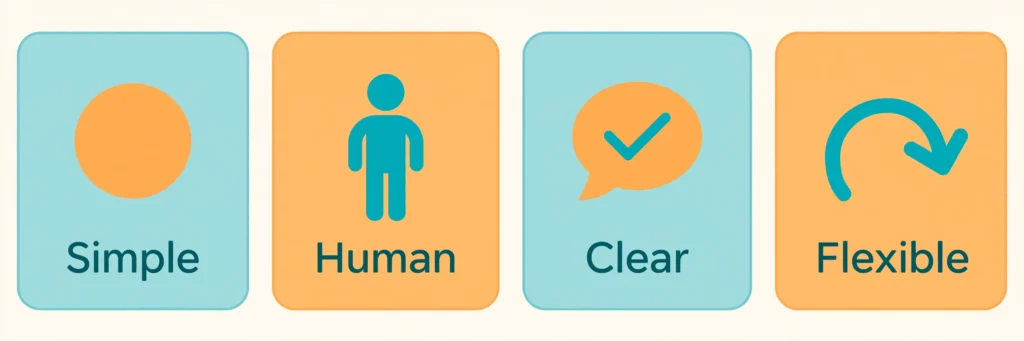
Prizmatem describes frehf through four principles. First, keep it simple: if a process has steps that add nothing, remove them. Second, design for humans, not machines: a system should match how people actually think and work, instead of forcing people to think like the system. Third, move fast, but stay clear: speed matters, but not if it creates confusion about what was done or who decided it. Fourth, stay flexible: tools, teams, and needs change, so a good setup should bend without breaking. You can test almost any tool against these four ideas in a few minutes: is it simple, is it built for the person using it, is it clear, and can it change?
Coruzant’s Three Principles
Coruzant describes frehf through three principles that focus more on teams and workplaces. The first is intentional communication: clarity over frequency, signal over noise. A team that sends fewer, clearer messages communicates better than a team that sends constant updates nobody reads. The second is emotional intelligence at scale: embedding empathy into how work is organized, so that always-on tools and constant notifications do not burn people out. The third is human-centered digital environments: respecting people’s attention and reducing friction in the tools they use every day. Coruzant also names three supporting components: data alignment, decision ownership, and feedback loops.
How Frehf Works: A Step-by-Step Breakdown
Prizmatem describes frehf as a five-step process you can run for almost any task. First, identify the task: write down in one sentence what you are actually trying to do, before you open any app or buy anything. Second, break it down into its smallest useful steps, so you can see which parts matter and which parts are just habit. Third, remove the obstacles: the steps that slow people down, confuse them, or force them to work around the system. Fourth, deliver clear instructions: every step should be obvious enough that a beginner could follow it without guessing. Fifth, optimize and apply: once the simple version works, use it, watch where it still causes friction, and improve it a little at a time. The point is that simplicity comes before speed: a fast but confusing process costs more time in mistakes than a slow one everyone understands. Prizmatem compares frehf to Getting Things Done and Agile and calls it broader — its claim, not an official ranking. If you already use either, the frehf steps work as a check on top of them.
Who Can Benefit From Frehf?
Frehf is aimed at ordinary users first, not at experts. According to prizmatem, the people who gain the most are beginners and non-technical users; content creators juggling several tools; small business owners who cannot afford a complicated system; students and online learners organizing study and deadlines; and remote teams who need clear communication. None of these groups needs more features. They need fewer obstacles between them and the work itself.
Frehf in Action: Real-World Applications
Coruzant offers three illustrative examples — examples from that article, not verified frehf deployments, since no company is on public record as adopting “frehf” as an official program. The first is a logistics warehouse where people work alongside collaborative robots, known as cobots: robots handle heavy lifting and repetitive movement, while people handle judgment and exceptions. The second is assistive robotics in elderly care, helping with reminders, movement, or monitoring, where a confusing interface for a vulnerable person can be frightening or unsafe. The third is precision farming, where drones and sensors help farmers decide where to water or spray, while the farmer makes the final call. Coruzant also cites two statistics: a 2024 Grammarly report that it says puts the cost of inefficient communication at $1.2 trillion per year, and a claim that drone spraying can reduce pesticide use by up to 40%. Both come from coruzant’s article and its sources, not from frehf itself, so treat them as attributed claims, not proof that frehf works.
The Other Definitions of Frehf
The other definitions of frehf do not fit neatly with the one above. If you only read the Future Ready Enhanced Human Framework version, you would think the word has a settled meaning. It does not: at least four other definitions circulate online, using the same letters for very different ideas.
The Philosophy Version: Freedom, Resilience, Ethics, Harmony, Flourishing
Billyokeyo offers a completely different expansion: F.R.E.H.F. stands for Freedom, Resilience, Ethics, Harmony, Flourishing. In billyokeyo’s version, frehf is a movement and a philosophy for ethical progress and emotional sustainability, not a technology framework at all. It claims the term circulated in niche forums from around 2022 and gained visibility in mid-2024 with an open-source manifesto titled “Designing for Flourishing: The Frehf Protocol,” with no single person credited with coining it, and it names two apps, “Calmr” and “Cirql,” as “Frehf-compliant.” All of this is billyokeyo’s claim, and none of it is verified by an independent source. There is no public record of the manifesto, no confirmed author, and no official list of compliant products. Notice the direct conflict: this expansion cannot be true at the same time as the Future Ready Enhanced Human Framework expansion, because the letters spell out different words.
The Telecom, Energy, and Wellness Versions
Itsreleased.co.uk gives yet another expansion: FreHF stands for Frequency-Based High-Fidelity processing, a telecom and data-transmission technology framework, and it claims performance improvements of up to 30% on networks. That number is itsreleased’s claim, not a verified measurement, and the article gives no test data or named source that would let you check it. Fizara.com expands FREHF as the Future Renewable Energy Hybrid Framework, a renewable-energy architecture built on six core pillars, including hybrid energy sources, intelligent storage, and artificial intelligence. Scope24.net describes frehf as a holistic wellness approach covering mind, body, and spirit, with mindfulness, meditation, and physical movement, and it claims roots in ancient practices and Eastern philosophies. These three versions share only the letters with the technology-framework version, which is a good reminder that the same string of letters can be an acronym for unrelated things in different fields. If you are researching renewable energy and you land on a frehf article about human-centered design, you have simply found the wrong frehf.
Why So Many Definitions Exist
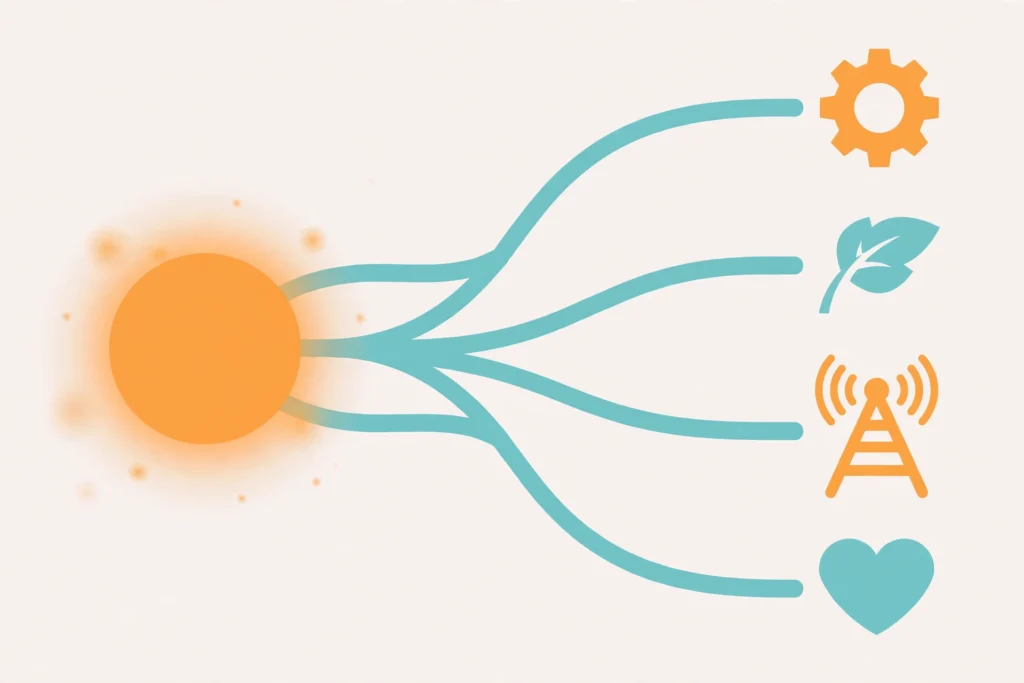
First, frehf is not a real word in any standard dictionary, so there is no authority that fixes its meaning. Anyone can use it, and anyone can define it. Second, it looks like an acronym, and acronyms get reused constantly across fields. Third, the word sounds technical and modern, which makes it attractive for content: a new term that sounds like a framework draws clicks, and once a few articles use it, more articles copy the definition, sometimes changing it slightly each time. When you meet an unfamiliar framework claim like this, check it the same way you would check an unfamiliar website. Tech2Explore’s guide to checking whether a website is legitimate explains the habit: look for the source behind the claim, check whether the numbers have a named origin, and be suspicious when every article repeats the same phrases without adding evidence.
Common Mistakes to Avoid
If you decide to try frehf thinking, prizmatem warns about four mistakes that undo the benefit. The first is skipping the basics: people jump to advanced features before they have a simple version that works, and then they blame the tool when it fails. Start simple, and add complexity only when the simple version is genuinely not enough. The second is rushing into advanced features: every feature you enable is another thing to learn, remember, and maintain, so turn features on when you need them, not when you discover them. The third is expecting results without participation. Frehf is not something you install and forget; it asks you to keep choosing the simpler option and clearing away friction, and if nobody does that work, the system drifts back to complexity on its own. The fourth is forcing it on overly complex systems. Some systems are complicated because the job itself is complicated, and frehf helps you remove the unnecessary complexity, not pretend the necessary complexity does not exist.
How to Get Started With Frehf Today
Getting started does not require buying, joining, or downloading anything. Prizmatem suggests starting with one area, not everything at once: pick the tool or process that frustrates you most, and run the five steps on it. As you do that, ask four questions: what am I actually trying to do, what steps are unnecessary, is there a simpler way, and would a beginner understand this? Then choose tools that match frehf values — simple to learn, clear about what they do, flexible enough to change with you — and build a small personal workflow around them. A workflow that fits on one page and that you actually follow is worth more than a perfect system you never use. You do not need to call what you are doing “frehf” for it to work.
What Is NOT Verified
This section matters most, because frehf is a term where confidence is easy and evidence is thin. There is no single official definition, and no official organization, standard, or certification that decides which expansion is correct. There is no verified founder and no verified inventing company. There is no public record of the “Designing for Flourishing: The Frehf Protocol” manifesto that billyokeyo describes, and no confirmed author for it. There is no official list of “Frehf-certified” or “Frehf-compliant” products, so any product that claims that label is using the word on its own authority. There are no verified case studies or deployments of frehf as an official program; the warehouse, elderly-care, and farming examples are illustrative examples from coruzant, not documented deployments. The statistics in articles about frehf — the $1.2 trillion communication figure, the 40% pesticide reduction, the 30% network improvement — are attributed claims from those articles, not frehf’s own measured results. And the expansions themselves conflict, so they cannot all be “the” meaning of the word. The central idea is still a good one, and you can use it without believing the unverified claims around it — but do not repeat those claims as facts, buy a product because it calls itself frehf-compliant, or tell someone frehf is an established standard. It is not.
FAQ
What does frehf stand for?
It depends on which version you mean. The most common expansion is Future Ready Enhanced Human Framework. Billyokeyo expands it as Freedom, Resilience, Ethics, Harmony, Flourishing; itsreleased as Frequency-Based High-Fidelity processing; and fizara as Future Renewable Energy Hybrid Framework. No official body decides which is correct, so always say which version you mean.
Is frehf a software, a method, or a mindset?
In its most common meaning, it is a framework and a mindset, not a software product. It is a way of thinking about how you choose, set up, and use technology, and a method for simplifying processes in five steps. You cannot buy it or download it, and it does not depend on any particular software.
Is frehf free to use?
Yes: there is nothing to buy and no organization to pay, and you can apply the principles to your own tools without permission. That is also why there is no official support, no certification, and no one to complain to if it does not work for you.
Is frehf a real framework or just a buzzword?
It is somewhere between the two. The idea behind it — simple, human-centered, clear, flexible technology — is real and useful, and it overlaps with human-centered design. But the word itself has no official standard, no verified founder, and no single definition. Treat the idea as useful and the word as unsettled.
What is the difference between frehf and other productivity frameworks?
According to prizmatem, frehf is broader than Getting Things Done and Agile, because it applies to tools and systems in general rather than only to personal tasks or software teams. Frehf adds a test that applies to both: is the system simple, built for the human using it, clear, and flexible? That comparison is prizmatem’s claim, and you can use frehf alongside either framework rather than replacing them.
Can frehf scale for enterprise use?
There is no verified evidence of frehf being used at enterprise scale as an official program. The principles behind it — clear communication, decision ownership, feedback loops, and human-centered design — are used in large organizations under other names. But if a vendor tells you their product is “enterprise-ready frehf,” ask what that means in practice, because there is no standard to measure it against.
Is there an official Frehf organization?
No. There is no verified official Frehf organization, standard body, or certification authority. If you find a website that claims to be the official home of frehf, check whether it names its founders, shows its sources, and explains how it got that authority. In the sources reviewed for this article, no such organization exists.
Bottom Line
Frehf is a useful idea wrapped in an unsettled word. The most common meaning — the Future Ready Enhanced Human Framework — asks you to judge technology by a simple test: does it help people, or does it frustrate them? Keep it simple, design for humans, stay clear, and stay flexible. But the word itself has no single official meaning, no founder, no organization, and no standard, and it is also used for a philosophy, a telecom technology, an energy architecture, and a wellness approach. So use the idea, and be careful with the word: say which version you mean, and never pay for a product or a certification just because it carries the frehf name.