Magazinepanda.com Explained: What It Really Is, Why Reviews Disagree, and Is It Safe?
If you searched for magazinepanda.com, you probably found a wall of articles that all sound oddly alike. Most of them call it a digital magazine. A few go further and praise it as a trusted source, a business platform, or a place for writers to build a portfolio.
So which version is true? The honest answer is narrower than most of those guides admit. Magazinepanda.com is best understood as a general-interest online magazine: a website that publishes articles across many topics for casual readers. Beyond that simple description, a surprising amount is unverified, conflicting, or simply repeated from one third-party guide to the next.
This article separates what independent reviews agree on, what they disagree about, and what no public source has actually confirmed. That way you can decide for yourself how much to trust any single article you read there.
The Short Answer
Here is the short version, before the detail:
- What magazinepanda.com is: a general-interest digital magazine and content platform. Independent reviews consistently describe it as a multi-topic site publishing informational articles on technology, business, health, lifestyle, education, and related subjects.
- What it is not, on the available evidence: a shop, a paid subscription service, a financial service, or an app you download. No public source reviewed for this article shows a working storefront, a pricing page for a product, or an app tied to the name.
- What it costs to read: articles appear to be available without a paid subscription, according to several third-party reviews. That is a description of how the site is presented, not a promise — you should confirm the current access terms on the live site itself.
- Is it safe to browse? Third-party reviews report that the domain uses HTTPS, which encrypts the connection between your browser and the site. HTTPS is a basic technical measure, not a guarantee that every article is accurate or that every link on the site is trustworthy.
- What is still unverified: who owns and runs the site, who writes and edits its articles, how large its audience really is, and whether it currently accepts outside contributions. No dependable ownership information was confirmed in the public sources reviewed.
- The biggest trap: similarly named domains. Addresses such as magazine-panda.com, magazinepandas.com, and magazinepanda.org are separate addresses, and they should not be assumed to have the same owner, policies, or editorial standards as magazinepanda.com. Always check the exact spelling in your address bar.
If you only want to read a general article there, you can do that with normal caution. If you want to rely on it for a health, money, or legal decision — or pay someone for a guest post on it — you need to check much more carefully first.
What Magazinepanda.com Actually Is
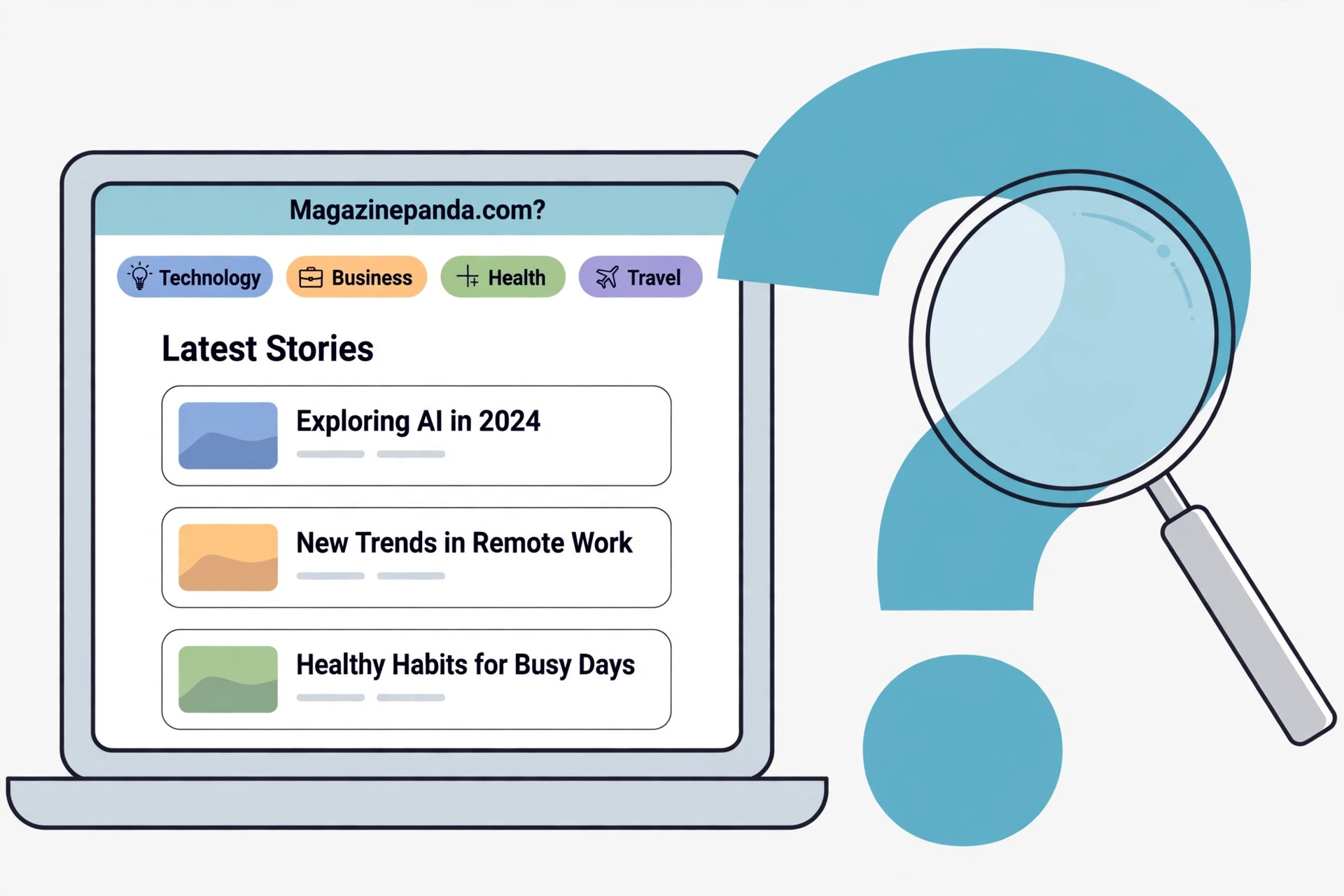
Strip away the promotional language, and the picture is simple. Magazinepanda.com is described across independent reviews as a broad, multi-topic publishing site rather than a specialist publication.
A specialist site builds authority by going deep on one subject. Magazinepanda.com takes the opposite approach. It covers many subjects at a surface-to-middle depth, in plain language, for readers who want a quick overview rather than a technical paper.
That model has an obvious appeal. You can move from a technology explainer to a business idea to a lifestyle tip without opening five different websites. It also has an obvious limit, which runs through this whole article: a site that covers everything cannot be equally expert at everything.
Third-party reviews describe the site as WordPress-based, which is the same everyday publishing setup used by countless blogs and small magazines. That detail matters only in one practical sense: it fits the picture of a standard content site, not a custom-built platform, marketplace, or software product.
What Topics Does It Cover?
The reported topic list is long, and it varies slightly from one review to the next. That variation is itself worth noticing, because it means no single list should be treated as the site’s official, current category index.
The categories most often mentioned include:
- Technology and digital trends
- Business and entrepreneurship
- Finance and personal money topics
- Digital marketing
- Education and career guidance
- Health and wellness
- Travel
- Automotive topics
- Law
- Lifestyle and personal development
- Entertainment and popular culture
- General knowledge and everyday problem-solving
One detailed guide lists the site’s own categories as Automotive, Education, Finance, General, Health, Law, Technology, Travel, and Digital Marketing. Other reviews add business, lifestyle, entertainment, productivity, and gaming to the picture.
What should you take from that? The breadth is the point. If you land on magazinepanda.com expecting deep, specialist coverage of one field, you are likely to be disappointed. If you want a readable introduction to a topic you know little about, that is closer to what the site is built for.
Be careful with one common exaggeration, though. Some third-party pages describe the site as a source of “data-driven” or “strategic” insights. That wording sounds impressive, but the reviews that use it do not show the research methods, authors, or sources behind the claim. A claim that content is data-driven does not, on its own, prove that it is well researched. Judge each article by the evidence it actually shows you, not by the label on the site.
What You Will Find When You Read It
Based on the descriptions in independent reviews, most articles on magazinepanda.com aim to explain things simply. Expect plain-language guides, explainers, trend pieces, and practical tips written for a general reader rather than a professional in the field.
That style works well for getting oriented. If you have never heard of a topic, a short, clearly written overview can help you learn the basic terms and the questions worth asking next.
It works less well when you need depth or certainty. A general overview can explain a concept. It usually cannot settle a complicated technical question, a medical decision, a legal obligation, or an investment choice. The reviews agree on this point: treat the site as a starting point for learning, not as the final word.
You should also pay attention to dates. Technology instructions go out of date fast. Prices, product specifications, laws, travel rules, and entertainment schedules change too. An article that was accurate when it was written can quietly become misleading if it is never updated. Always look for a publication or update date before you act on time-sensitive details.
Is Magazinepanda.com Legitimate?
This question needs two separate answers, because people use the word “legitimate” to mean two different things.
First, does the site appear to be a real content-publishing website, rather than a fake shop or a financial scam? On that question, the public evidence points to yes. Independent reviews describe it as a standard content platform supported by display advertising, not as an online store or a money service. No widely reported scam findings about the domain turned up in the sources reviewed for this article.
Second, is it an authoritative source you can rely on? That is a different question, and the answer is: not automatically. A website can be real, operational, and safe to browse while still publishing articles that vary a lot in accuracy and depth.
That distinction is the most important idea in this article. “It exists and loads normally” is not the same as “everything it publishes is checked by experts.” Keep those two judgements separate, and you will avoid the most common mistake readers make with general-interest sites.
Is Magazinepanda.com Safe?
Safety, like legitimacy, breaks into smaller questions.
Is the connection encrypted? Third-party checks report that the domain supports HTTPS, and one detailed guide also notes that it uses Cloudflare infrastructure. HTTPS encrypts the connection between your browser and the site. Cloudflare is a common service that can help with content delivery and security filtering. Neither fact identifies the site’s owner, and neither proves that the site’s articles are accurate or that its advertisements and outbound links are all trustworthy.
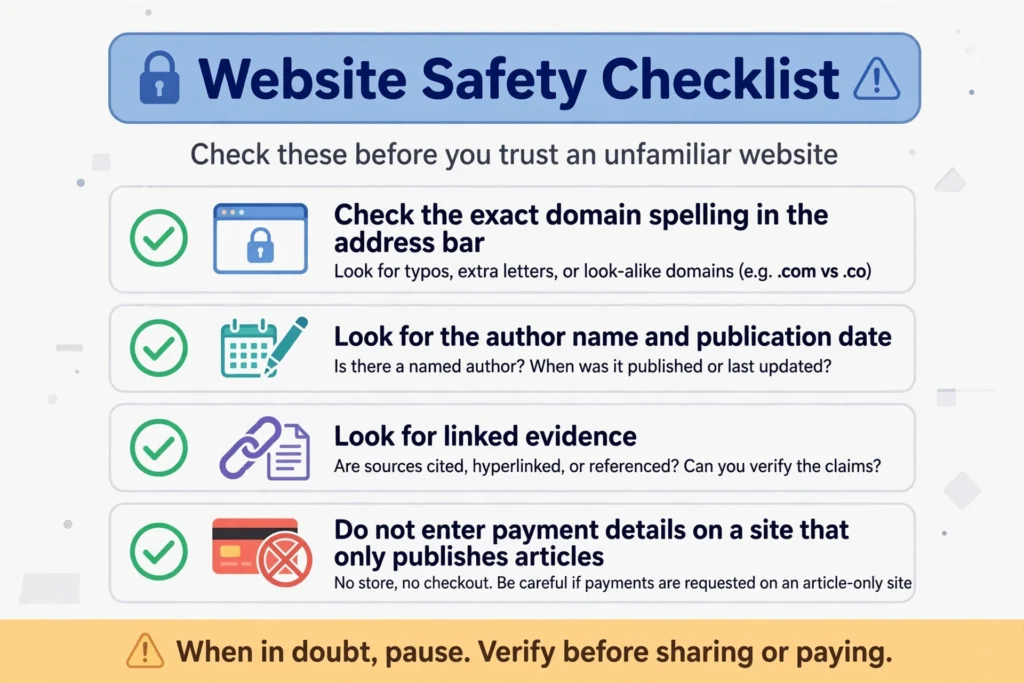
Is it safe to read? For casual reading, nothing in the sources reviewed suggests that simply opening an article is inherently dangerous. But normal web caution still applies. Be wary of download buttons, browser-notification requests, and links that lead to unfamiliar third-party services. Do not enter sensitive personal or payment information unless the site clearly explains why it needs it and how it will handle it — and a site that only publishes articles should not need your payment details at all.
Is its content safe to act on? That depends entirely on the topic. A lifestyle tip and a medical claim are not the same kind of risk. Health, finance, law, cybersecurity, and product-safety content deserve extra scrutiny wherever you read them, and magazinepanda.com is no exception.
For health topics in particular, a good habit is to check what MedlinePlus, the US National Library of Medicine’s public health resource, says about how to evaluate health information online. Its core questions — who runs the site, what is its purpose, where does the information come from, and is it up to date — work just as well for a general magazine as they do for a health site.
Why Reviews of Magazinepanda.com Disagree
If you read five guides about magazinepanda.com, you will notice something strange: they often say nearly the same things, in nearly the same order, using phrases like “digital trends,” “lifestyle optimisation,” and “actionable insights.”
That repetition is a warning sign, not a confirmation. When many pages repeat the same description, it does not mean many independent researchers all reached the same conclusion. It often means one description has been copied, rewritten, and republished many times.
The disagreements are more revealing than the agreements. Consider a few examples:
- Domain age. Several third-party domain reviews report that magazinepanda.com was registered on 9 March 2021, with a listed expiry date of 9 March 2030. That date is widely repeated, but a registration date is a neutral technical fact. It does not prove the website has operated continuously since then, and it says nothing about the quality of its articles.
- SEO and traffic claims. Public SEO scans of the site do not tell a consistent story. One scan discussed in a third-party guide reported an SEO score of 60 with very fast page-speed scores, while also noting a temporary 503 service-unavailable result during analysis. Another scan reported zero backlinks. Backlink and traffic numbers vary by tool, by date, and by what the tool can actually see, so a single number from a single scan should never be treated as the site’s true authority or popularity.
- Author transparency. One review based on a manual audit of the site’s content reports that the site lacks deep author biographies. Another assessment raises concerns about author transparency and topical breadth. The public sources reviewed do not establish that every article receives expert review, so you should check each article for a named author, relevant credentials, and supporting evidence.
- What the site offers writers. Some third-party pages present magazinepanda.com as a place where writers can publish work or reach an audience. That possibility remains unverified, because no official contributor page was available for examination in the sources reviewed. Do not submit content, pay for a placement, or hand over copyright on the basis of an outside description alone.
The pattern behind these disagreements is familiar from other multi-topic .com sites. One multi-topic site explained the same way showed the same problem: third-party blogs claimed it was a marketplace, a productivity app, and an AI tool, while the site itself visibly offered only articles. With magazinepanda.com, the confusion is quieter — the claims are less wild — but the lesson is the same. Judge the site by what it actually shows you, not by what blogs claim about it.
What Is Verified, What Is Claimed, and What Is Unknown
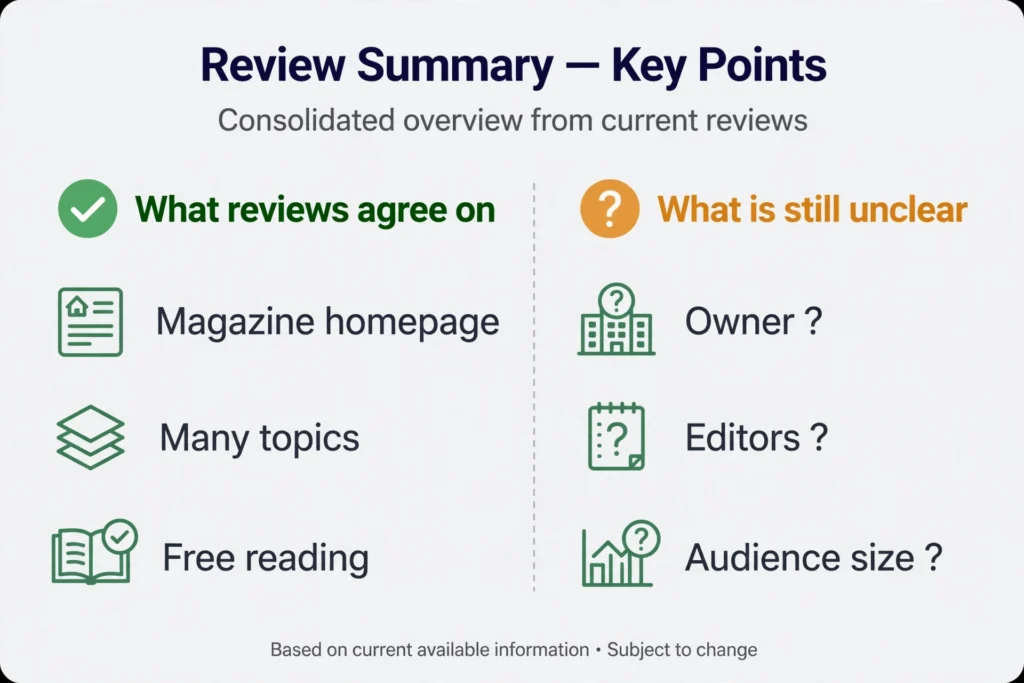
It helps to put the whole picture into three columns.
Verified or consistently reported by independent reviews:
- Magazinepanda.com is a general-interest online magazine and multi-topic content platform.
- Its reported topics span technology, business, finance, education, health, travel, digital marketing, law, automotive, lifestyle, and entertainment.
- Third-party domain reviews report a registration date of 9 March 2021.
- Third-party checks report HTTPS support.
- Articles are described as accessible without a paid subscription.
Claimed by some third-party pages, but not independently confirmed:
- That the content is “data-driven” or strategically researched.
- That the site is a platform for writers and brands, with open contributions.
- Any specific audience size, traffic figure, or authority score. Scans disagree, and no single figure should be quoted as fact.
- That every category mentioned in every review is currently active and regularly updated.
Unknown from the public sources reviewed:
- Who owns the site, and where its editorial operation is based.
- Who writes, edits, and reviews its articles, and what their qualifications are.
- Whether it has a formal editorial policy, a corrections process, or a named editor.
- Its funding beyond the display-advertising model described by reviewers.
- Its current terms, privacy policy, contact details, and submission rules.
That last column is not a verdict against the site. Many small online magazines publish with little public information about their owners. But it does mean you cannot borrow trust from a brand name, a founder’s reputation, or an editorial board — because none of those is publicly confirmed here. The trust has to come from the article in front of you.
Who Will Find It Most Useful?
Magazinepanda.com is most likely to be useful for:
- Casual readers exploring different subjects in one place
- Students beginning general research and learning basic terminology
- Professionals looking for a plain-language introduction to an unfamiliar topic
- Entrepreneurs collecting business and marketing ideas to test further
- Readers interested in lifestyle, productivity, and everyday problem-solving
It is less suitable as a sole source for:
- Academic research, where primary evidence and peer-reviewed sources are expected
- Medical diagnosis or treatment decisions
- Legal decisions or compliance questions
- Investment planning or financial advice
- Advanced technical implementation, where version numbers and official documentation matter
A practical workflow for students makes the point well. Read the magazine article for a basic overview. Write down its central claims. Follow any credible references it provides. Then search for primary or academic sources, and cite the strongest original evidence instead of the summary article. That routine works for any general-interest site, and it protects you whether the original article was excellent or sloppy.
How to Check Any Article on Magazinepanda.com Before You Trust It
Use this short check every time an article asks you to believe something important or act on it. It takes a few minutes, and it catches most problems.
1. Check the exact domain
Look at your address bar. Is it exactly magazinepanda.com? Similarly named domains — including magazine-panda.com, magazinepandas.com, and magazinepanda.org — are separate addresses. Other domains with “magazine panda” in the name, such as themagazinepanda.com and mymagazinepanda.com, present themselves as their own publications. Do not assume they share an owner, a policy, or an editorial standard with magazinepanda.com.
This is also where a basic check for whether a website is a scam helps: missing ownership details, missing contact and policy pages, and vague author information are warning signs on any unfamiliar site, not just this one.
2. Check the date
Find the publication or update date. If there is none, treat time-sensitive claims with extra caution. Technology guides, prices, laws, and health recommendations all age badly.
3. Check the author
Look for a full name, a biography, and relevant experience. A credible author profile explains why that person is qualified to write about that subject. A generic label such as “expert” or “specialist,” with no background behind it, proves very little.
4. Check the evidence
Look for links to original research, government sources, official documentation, or recognised institutions. A link to a reputable institution only counts if the linked material actually supports the claim being made. If an article makes precise claims without showing any supporting evidence, treat those claims cautiously.
5. Cross-check anything high-stakes
Verify important claims through at least one independent, authoritative source. Confirm medical advice with a qualified healthcare provider, legal requirements on official government websites, financial information with a regulated professional, product specifications on the manufacturer’s website, and software steps in the official documentation.
6. Check the domain record — but know its limits
You can look up a domain’s public registration record through ICANN’s lookup tool. That can confirm basic facts such as the registration date. It will not tell you who edits the site, whether its articles are accurate, or whether it is a good place to publish a guest post. Treat it as background, not as a trust verdict.
7. Separate facts from promotion
Watch for phrases such as “best,” “guaranteed,” “always,” and “risk-free.” They deserve extra scrutiny, especially when an article promotes a product or service. Check whether advertising is clearly distinguishable from editorial content, and whether a recommendation benefits the site or an advertiser.
Should You Use It for Guest Posting or SEO?
This question comes up a lot with multi-topic magazines, and it needs a blunt answer: do not assume magazinepanda.com has SEO value for your site just because it is old, multi-topic, or described as accepting content.
One independent review explicitly warns marketers not to buy a placement based only on domain age, a seller’s authority score, or the promise of a dofollow link. Another third-party analysis questions the platform’s guest-posting value and recommends checking traffic, backlinks, and indexation independently before paying anything.
If you are considering a placement, check these things yourself, on the live site, before you spend money:
- Whether recent articles are actually indexed and attracting visible engagement
- Whether the site’s content is topically relevant to your own site
- Whether author information and editorial standards are visible
- Whether sponsored content is disclosed
- What link attributes are used, and whether the placement is genuinely editorial
- Whether the seller can show you the exact page and terms, rather than a generic domain pitch
If a seller cannot show you those things, or pressures you to decide on the basis of a domain-age or authority-score claim alone, walk away. A link from a general-interest site with unclear editorial standards may do little for you, however old the domain is.
Common Mistakes to Avoid
Trusting every article equally. A useful lifestyle article does not prove expertise in law, medicine, or finance. Evaluate each page on its own merits.
Ignoring the date. Old information can stay visible in search results long after it becomes inaccurate.
Relying on the headline alone. Headlines simplify complex issues to attract attention. Read the full explanation, including its limitations and evidence, before forming a conclusion.
Confusing lookalike domains. A small difference in spelling or punctuation can lead to an entirely different website. Confirm the address is exactly magazinepanda.com before you subscribe, sign up, or share personal information.
Treating general content as professional advice. General articles cannot account for your medical history, your financial position, or your legal jurisdiction. For those decisions, talk to a qualified professional.
Quoting a review instead of checking the site. Third-party guides about magazinepanda.com are unusually repetitive, and repetition is not evidence. When something matters, open the live site and check it yourself.
Who Should Read It, and Who Should Look Elsewhere?
If you enjoy browsing across topics and you want readable introductions, magazinepanda.com fits that habit. You can dip into technology, business, health, or travel content without committing to a specialist publication, much like you would with any other general-interest site treated as a starting point rather than a final authority.
If you need a definitive answer — for a paper, a diagnosis, a contract, an investment, or a technical build — look elsewhere for verification, even if you start your reading here. Use the magazine article to understand the question, then confirm the answer with a primary source, an official document, or a qualified professional.
That is not a harsh judgement. It is simply the right way to use a general-interest magazine. Enjoy the breadth, but do not outsource consequential decisions to it.
Frequently Asked Questions
What is magazinepanda.com?
Magazinepanda.com is a general-interest online magazine and content platform. Independent reviews describe it as a multi-topic site publishing informational articles on technology, business, finance, education, health, travel, digital marketing, law, automotive, lifestyle, and entertainment.
Is magazinepanda.com free to read?
Third-party reviews indicate that its informational articles are generally accessible without a paid subscription. Access conditions can change, so confirm the current terms on the live website before assuming anything about accounts or subscriptions.
Is magazinepanda.com safe?
Third-party checks report that the domain supports HTTPS, which encrypts the connection between your browser and the site. HTTPS does not verify the accuracy of articles or the safety of every advertisement or external link, so content still needs to be checked separately. Avoid entering sensitive personal or payment information on a site that only publishes articles.
Is magazinepanda.com a news website?
It is better described as a general digital magazine or informational publishing platform. Its content appears to combine topical discussions with evergreen guides, rather than focusing exclusively on breaking news.
Who owns magazinepanda.com?
No dependable ownership information was confirmed in the public sources reviewed for this article. Readers should consult the website’s official About, Contact, Terms, and Privacy pages for current details, and treat any ownership claim from a third-party guide as unverified until the live site confirms it.
Can students cite magazinepanda.com?
That depends on the assignment and the institution’s sourcing rules. Students should usually trace important claims back to academic, governmental, or primary sources, and cite the strongest original evidence rather than a general summary article.
Is every article on magazinepanda.com professionally reviewed?
Publicly available information does not establish that every article receives expert review. Check individual pages for author credentials, editorial notes, and supporting sources before relying on them.
Is magazinepanda.com useful for guest posting?
Its value depends on current traffic, indexation, audience relevance, and editorial standards, none of which should be assumed from domain age or a seller’s authority claim. Conduct an independent check of the live site before purchasing or submitting any sponsored content.
What is the difference between magazinepanda.com and similar domains?
Magazinepanda.com is one specific address. Similarly named domains, such as magazine-panda.com, magazinepandas.com, and magazinepanda.org, are separate addresses and should not be assumed to share their ownership or standards. Other “magazine panda” domains present themselves as their own publications. Always verify the exact address in your browser.
Bottom Line
Magazinepanda.com is a general-interest online magazine, not a shop, an app, or a specialist authority. Its strength is breadth: readable, plain-language introductions across technology, business, health, lifestyle, and many other topics, in one place.
Its weakness is the same as its strength. Broad coverage means authority varies by article, ownership and editorial details are not publicly confirmed, and third-party guides about the site repeat each other far more than they verify each other.
So use it the way you would use any general magazine. Enjoy it for discovery and orientation. Check the date, the author, and the evidence before you trust an important claim. Verify high-stakes decisions through primary or authoritative sources. And never confuse a domain that loads normally, or a domain registered in 2021, with proof that everything it publishes is true.
Read it with curiosity, check it with care, and let the individual article — not the site’s name, and not a review of the site — earn your trust.