AI Regulation News: What Changed in Late 2026, and What Applies to You
As of 29 October 2026, ai regulation news has a clear centre of gravity, and it is not a single global law. It is a cluster of different decisions, made at different speeds, in different places: child-safety rules for chatbots are moving fastest, workplace rules for AI are being phased in state by state, and in Europe the argument has shifted from what the rules should say to who will enforce them and when.
That is why this topic is easy to misread. A voluntary accord, a council negotiating position, a bill passed by one house of parliament, and a law that takes effect on 1 January 2027 are four different things. Most of the confusion in current coverage comes from treating them as if they were the same. This article keeps those labels separate, so you can tell at a glance what is already binding, what is coming, and what is still only proposed.
The late-2026 timeline at a glance
| Date | Development | Place | Status |
|---|---|---|---|
| 2 August 2026 | EU AI Act transparency duties, Article 50 | European Union | In force |
| 1–2 September 2026 | Carolina Principles for emerging technologies | G20 | Non-binding principles |
| 29 September 2026 | White House Accord on Super Intelligence | United States, federal | Voluntary accord |
| 30 September 2026 | No Robo Bosses Act, SB 947, signed | California | Signed, operative 1 July 2027 |
| 1 October 2026 | SB 5, first duties begin | Connecticut | In force, phased |
| 21 October 2026 | Digital Omnibus GDPR position, Article 88bis | European Union, Council | Negotiating position, not yet law |
| 23 October 2026 | Legislative Decree 179/2026 | Italy | In force |
| 28 October 2026 | Prohibition on Unsafe AI Companion Features for Minors, signed | New York | Signed, effective 1 January 2027 |
| 28 October 2026 | Online Safety Amendment (Digital Duty of Care) Bill 2026 passes the House | Australia | House-passed, Senate still to decide |
One correction is worth making before anything else. Saying “the EU AI Act is now in force” is true, but incomplete. Its transparency duties are in force, while its high-risk duties were delayed by the Digital Omnibus, with Annex III duties moving to 2 December 2027 and Annex I product duties to 2 August 2028. The Act arrived in stages, and it is still arriving.
The pattern behind the headlines: child safety came first
If you only followed one thread through October 2026, it would be this: governments are no longer starting with the most powerful models in the abstract. They are starting with the product a child can open on a phone.
Why chatbots, and why now
Companion chatbots are designed to keep a conversation going. They remember details, mirror tone, and respond in a way that can feel personal. That is the point of the product, and it is also the reason regulators have singled it out. The question they are asking is not whether a chatbot is useful, but whether a system built to feel like a friend should be allowed to behave like one when the user is a child.
New York and Australia reached that question in the same week, and they answered it in different ways. That difference matters, because it shows that even countries moving in the same direction are not writing the same rule.
New York’s line: features, not a ban on chatbots
New York’s law, signed by Governor Kathy Hochul on 28 October 2026, does not ban children from using chatbots, and it does not ban ChatGPT, Claude, or Gemini outright. It bans a list of 12 unsafe companion features for users under 18, or for any user whose adult status has not been established.
Those features include presenting a chatbot as human, alive, or experiencing human emotions, claiming a personal, romantic, professional, or authority-figure relationship, and using flattery or sycophancy in a way that builds emotional dependence. The law also covers using a child’s private health or personal information from earlier conversations, encouraging secrecy or isolation from parents and trusted adults, and promoting self-harm, eating disorders, or drug and alcohol use.
The enforcement route is the state attorney general, with civil penalties of up to $25,000 per violation, and possible orders covering unlawfully obtained data and models trained on it. The law takes effect on 1 January 2027, which gives operators a short window to decide between two practical routes: verify age, or switch the restricted features off by default for users who have not been verified as adults.
That choice is where the argument will be fought. Industry groups, including Tech:NYC, have criticised the language as vague, on the grounds that it is hard to draw a clean line in ordinary conversation between empathy and emotional dependence, or between encouragement and flattery. Supporters argue that the line is the point: design choices that create dependence should be treated as a product-safety issue, not left to a warning label. Both claims will be tested in how companies actually change their products before January, and almost certainly in court afterwards.
For a fuller account of the law’s scope and penalties, the reporting on New York’s chatbot law sets out the core restrictions and the attorney general’s enforcement role.

Australia’s different route: a duty, not a feature list
Australia’s Online Safety Amendment (Digital Duty of Care) Bill 2026, passed by the House of Representatives on 28 October 2026, takes a broader approach. Instead of listing banned features, it would place a general duty of care on covered online services, including social media, games, apps, and AI chatbots, to protect users, with particular attention to children.
An amendment accepted by the government would prohibit material or conduct that simulates emotional intimacy and fosters a child’s dependence on a chatbot in place of human relationships. Proposed penalties for breaching the duty are up to A$109.2 million for corporations.
The important word there is “proposed”. The bill still has to go through the Senate, and its final text, start date, and transition period are not settled. The Australian government’s introduction of the bill describes a duty covering online services, including AI chatbots, and a set of minimum safety standards, which is a useful guide to the framework, but it is not the same as the law as it will finally be enacted.
So New York gives companies a list to remove, while Australia, if the bill passes in its current form, would give them a duty to satisfy and leave much of the detail to risk assessments and regulator guidance. A homework assistant and a romantic companion app would both fall under the Australian duty on paper, but their risk assessments would look nothing alike. That is a feature of a duty-based model, and also its weakness: it is flexible, but it is harder for a company to know in advance whether it has complied.
The United States: no federal law, but states are not waiting
At the federal level, there is still no comprehensive AI law in this set of developments. What happened in Washington in September was a voluntary agreement, and it is best understood as a placeholder, not a substitute.
Washington chose a voluntary accord
On 29 September 2026, President Donald Trump and the leaders of Anthropic, Google, Meta, OpenAI, Nvidia, and xAI signed the White House Accord on Super Intelligence. The accord asks each company to put robust internal controls in place for its most capable models, covering areas such as cybersecurity and biosecurity, to empower an internal team to check that those controls work, to partner with an independent external auditor, and to set up a board committee to receive the auditors’ reports and oversee fixes.
Trump described the accord as “morally binding”. That phrase is doing a lot of work, because the accord itself carries no penalties for falling short, no requirement to publish audit results, and no rule that a regulator must appoint the auditor. Each company chooses its own auditor, and the findings go to its own board committee, not to a regulator or the public.
That does not make the accord meaningless. It creates a shared template for what a frontier AI company is expected to do, and its own text says the steps may eventually be codified into law. But it does not change what a company is legally required to do today, and anyone reporting it as a federal AI regulation is overstating it.
California: a human must stand between the system and the firing
California went in the opposite direction, with a narrow, concrete rule. The No Robo Bosses Act, SB 947, was signed by Governor Gavin Newsom on 30 September 2026 and becomes operative on 1 July 2027. It applies to public and private employers using an automated decision system to discipline or terminate a current employee.
Under the Act, an employer may not rely solely on an automated decision system for such a decision. If it primarily relies on one, a human reviewer must corroborate the decision using the data behind the output or other supporting information, such as evaluations, personnel files, work product, peer reviews, or witness interviews. If the output cannot be corroborated, or the reviewer finds it inaccurate, incomplete, or misleading, the employer cannot use it as the basis for the decision.
The worker must also receive a plain-language written notice explaining that the employer primarily relied on an automated system, that a human reviewed and corroborated the decision, how to contact a person for more information, and that retaliation for exercising these rights is prohibited. Violations carry a civil penalty of $500 per violation, enforced through the Labor Commissioner or a public prosecutor.
The reporting on California’s No Robo Bosses Act confirms the human-corroboration requirement, the notice duty, and the July 2027 start date. It is worth noting that SB 947 was part of a wider 30 September package, including a requirement for technology-displacement notices when a layoff is caused in whole or substantial part by AI, and limits on workplace tools that infer emotional state or collect neural data. Those are separate rules with separate dates, and they deserve their own careful reading rather than being folded into a single “California AI law” headline.
Crucially, SB 947 does not ban AI in employment decisions. It bans a decision with no human in the loop. That distinction is the whole rule, and it is the distinction most summaries get wrong.

Connecticut: one law, several clocks
Connecticut’s law is the hardest to summarise in one sentence, because it deliberately phases in over more than a year. Substitute Senate Bill No. 5, Public Act No. 26-15, was signed on 27 May 2026 and is an omnibus AI and online-safety statute covering companion chatbots, frontier model governance, and AI in employment decisions.
Its first core duties began on 1 October 2026. From that date, subscription AI providers must give Connecticut consumers written key-term disclosures and obtain written acceptance, frontier developers above a very high compute threshold must post whistleblower notices and bar retaliation, and employers can no longer use an automated employment decision tool as a defence to a discrimination complaint. The law also starts a WARN Act AI-disclosure obligation for layoffs linked to AI.
Later phases follow into 2027, including companion requirements and, from 1 October 2027, fuller deployer duties to provide point-of-interaction disclosures and pre-decision notices for automated employment tools. Enforcement of the consumer-protection layer rests solely with the attorney general, with a discretionary 60-day cure window for violations alleged on or before 31 December 2027.
Connecticut is therefore a useful case study in why dates matter more than headlines. A company that reads “Connecticut passed an AI law” and assumes it is fully in force will miss both the duties that already apply and the ones that do not apply until late 2027.
Europe: the rules are now enforceable, and the enforcers have names
Europe’s story in late 2026 is less about new ideas and more about machinery. The rules that were announced in earlier years now have dates, enforcers, and fines attached to them.
The EU AI Act’s transparency duties are live
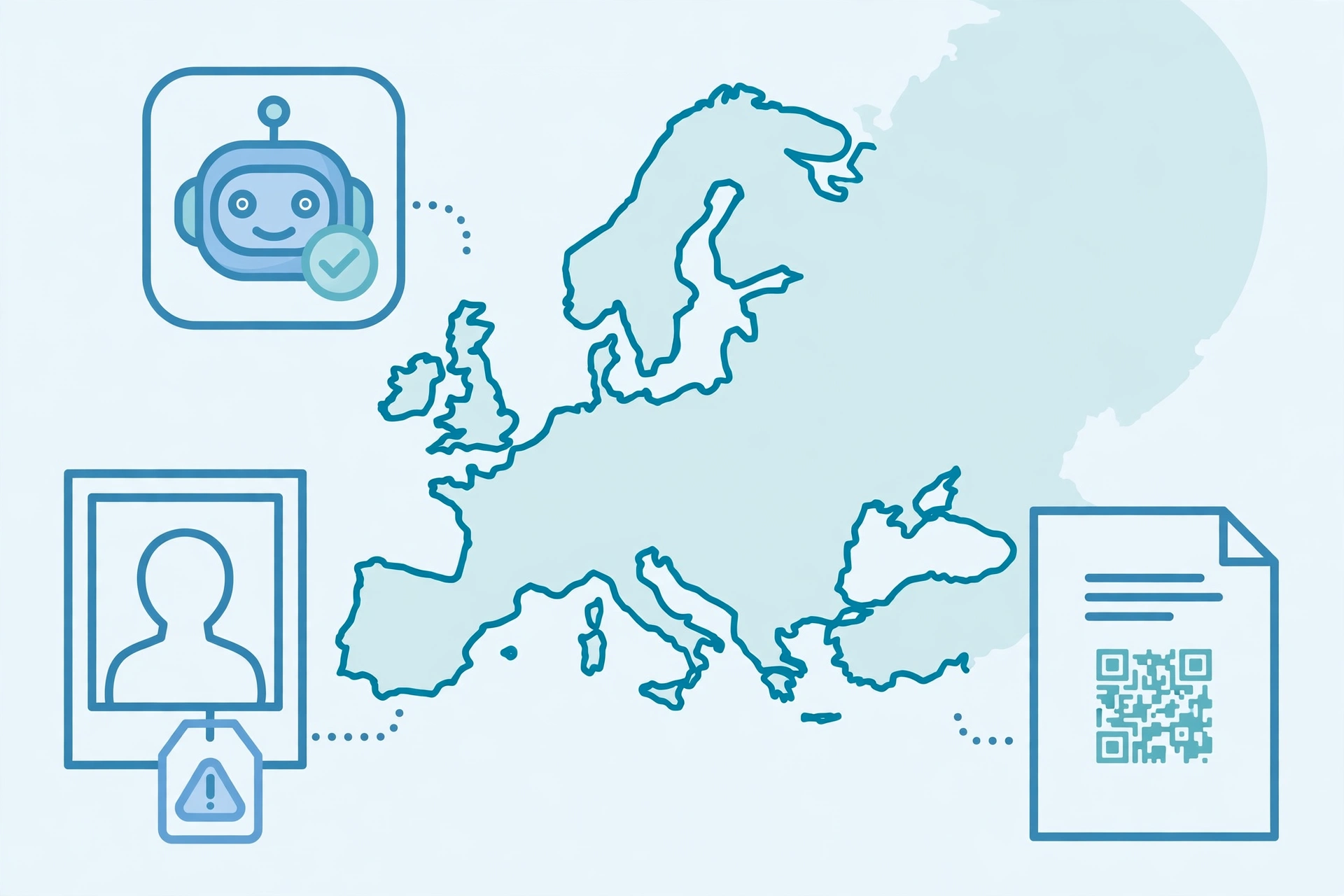
Since 2 August 2026, Article 50 of the EU AI Act has applied. In practical terms, that means chatbots must disclose that users are interacting with AI, AI-generated content must carry a machine-readable mark, and deepfakes must be disclosed. Emotion recognition and biometric categorisation systems must inform the people exposed to them.
There is a limited grace period: for generative systems already on the market before 2 August 2026, the marking duty has until 2 December 2026. Deepfake labelling has no such delay. Transparency breaches can attract fines of up to €15 million or 3% of worldwide annual turnover.
The Act follows the user, not the headquarters. A company with no EU office that places an AI system on the EU market, or whose output is used in the EU, is still in scope. That is why the Article 50 date matters even for companies that think of themselves as American, British, or Australian: if EU users interact with the chatbot or see the generated content, the disclosure duty travels with them.
An explainer on what took effect under the EU AI Act on 2 August 2026 sets out the Article 50 duties, the delayed high-risk timetable, and the Digital Omnibus changes in one place.
Italy shows what enforcement looks like in practice
Italy is the clearest example of a member state turning the EU rulebook into a working system. Legislative Decree 179/2026, in force since 23 October 2026, names the Agency for Digital Italy, AgID, as the notifying authority for conformity assessment bodies, and the National Cybersecurity Agency, ACN, as the authority for general market surveillance of AI systems. The Bank of Italy, CONSOB, and IVASS take sector roles for high-risk AI in banking, investment, and insurance.
Fines for prohibited AI practices can reach €35 million or 7% of worldwide annual turnover. The decree also includes a rule with direct consequences for workers: final decisions on establishing, modifying, or terminating an employment relationship, including disciplinary measures and performance evaluations, cannot be adopted solely on automated processing. The definitive decision must be reserved to a natural person, worker consent is not an exception, and a dismissal issued in breach is null and void.
That is a stronger employment rule than California’s corroboration duty, and the contrast is instructive. California requires a human to check the machine’s output. Italy, in this provision, requires the human to make the final decision. Companies operating in both places need to build for the stricter rule where it applies, not average the two together.
The GDPR change is a position, not a law yet
One of the most misreported developments of October is the EU Council’s position on AI and personal data. On 21 October 2026, the Council approved its negotiating position on the Digital Omnibus, including a new Article 88bis that would allow processing of personal data in the context of developing and operating an AI system or model to rely on legitimate interest under Article 6(1)(f) of the GDPR.
That is a negotiating position, not a law. The European Parliament still has to set its own position, and the Council and Parliament still have to agree a final text. The Council text also includes a limit that many summaries leave out: the development and operation of an AI system does not in itself constitute a legitimate interest, and the assessment must be made case by case, taking into account the underlying purpose of the processing, with appropriate safeguards including the right to object.
So the honest summary is narrower than “the EU removed consent for AI training”. Consent was never the only legal basis in the GDPR, and this change, if it survives negotiation, would give AI developers a clearer legitimate-interest footing, not a blank permission to use any personal data for any purpose. Anyone planning a data strategy around the Council text alone is planning around a draft.
The UK took a different, earlier path
The United Kingdom is a useful contrast, because it was already discussing rules for the most powerful models in 2024, before EU transparency duties came into force in 2026. The site’s earlier coverage of how the UK government planned to work on rules for the most powerful models shows that discussion at a stage when it was still largely about future rules and product safety, rather than named enforcers and fines.
That contrast is the point. The UK conversation in 2024 was about what should be regulated. The EU conversation in late 2026 is about who enforces it, by what date, and with what penalty. Reading the two together makes the shift in the whole field easier to see, without pretending that a 2024 discussion document is current law.
What this means in practice
If you use chatbots, especially with children
The practical change is in product design, not in whether chatbots exist. In New York from 1 January 2027, a chatbot that cannot verify a user as an adult will have to drop the restricted companion features for that user. Parents and schools should therefore expect to see more age checks, more visible “you are talking to AI” disclosures, and more variation between products, because companies will make different choices about whether to verify age or simplify the product for unverified users.
In Australia, nothing changes for users until the Senate decides and a transition period runs. That is not a reason to ignore the bill, but it is a reason not to write as if it were already law.
If you employ people or buy hiring and performance tools
California and Connecticut both point in the same direction, but they do not impose the same timetable. California’s rule is specific: no sole reliance on an automated system for discipline or termination, human corroboration where reliance is primary, and a written notice to the worker. Connecticut’s rule is broader and phased: it removes the “the system did it” defence to discrimination claims from October 2026, and adds disclosure duties through 2027.
For an employer, the practical work is therefore threefold: keep a record of which tools were used for which decisions, keep the underlying data and supporting information that a human reviewer actually relied on, and make sure the human reviewer is a real check, not a rubber stamp. A reviewer who cannot explain why they agreed with the system has not satisfied the spirit of either law, even if a form was signed.
If you build or sell an AI product
The checklist that follows from late 2026 is short, but it is not optional:
- Map every place your product interacts with users, generates content, or makes a decision about a person, and map it by jurisdiction, not just by product.
- Separate in-force duties from proposed ones in your own planning documents, with a date next to each one.
- Build disclosure into the product: chatbot disclosure at first interaction, machine-readable marking for generated content, visible labelling for deepfakes.
- Build a human-review path for employment decisions, and keep evidence of what was reviewed, not just a claim that review happened.
- Treat age assurance as a design decision, not a pop-up. New York’s model rewards companies that can either verify age reliably or offer a simpler product to unverified users.
What is still unclear, and what to watch next
Several questions that will decide how these rules actually work have not been answered yet.
In New York, the scope for general-purpose assistants is disputed. The law’s definition reaches beyond apps marketed as companions, but how regulators and courts will apply it to a general assistant that occasionally behaves in a companion-like way is untested. Age-assurance methods, and how they will work for users who do not want to share government ID, are also unresolved.
In Australia, the Senate’s final text, any amendments, and the transition period will decide whether the duty is a broad safety obligation or a more specific set of requirements. The proposed A$109.2 million penalty figure has attracted attention, but a penalty ceiling is not the same as a penalty in practice.
In Europe, the Parliament’s position on the GDPR change, the finalisation of marking standards, and the high-risk deadlines in December 2027 and August 2028 are the next milestones. In the United States, the open question is whether the voluntary accord is codified, and whether more states copy the New York, California, or Connecticut models, creating a patchwork that companies must navigate state by state.
Dates worth putting on a watch list are 2 December 2026, when the EU marking grace period ends, 1 January 2027, when New York’s chatbot law and further Connecticut phases take effect, 1 July 2027, when California’s No Robo Bosses Act becomes operative, and 1 October 2027, when Connecticut’s fuller employment disclosure duties take effect.
Frequently asked questions
Is there a single global AI regulation law?
No. There are national and state laws, EU-wide rules, non-binding principles, and voluntary accords, and they apply to different people, products, and places. Any article that talks about “the AI regulation” as if it were one thing is oversimplifying the field.
Does New York ban children from using chatbots?
No. New York bans 12 unsafe companion features for users under 18, or for users whose adult status has not been established, from 1 January 2027. A chatbot can still be used by a child if the restricted features are switched off, and operators can choose to verify age or to offer a simpler version of the product to unverified users.
Does California ban AI in hiring and firing?
No. California’s No Robo Bosses Act, operative from 1 July 2027, bans sole reliance on an automated decision system for discipline or termination, and requires human corroboration where reliance is primary, plus a written notice to the worker. It does not ban AI assistance in employment decisions altogether.
Does the EU AI Act already apply to every AI system?
No. Its transparency duties under Article 50 have applied since 2 August 2026, and prohibited practices and general-purpose model duties were already in force, but high-risk duties were delayed by the Digital Omnibus to December 2027 and August 2028. The Act is being rolled out in stages.
Can AI companies now use my personal data without consent under GDPR?
Not on the basis of the October 2026 Council position alone. The Council approved a negotiating position that would allow AI development and operation to rely on legitimate interest, assessed case by case, with safeguards including the right to object. The Parliament still has to set its position, and a final text still has to be agreed. Consent was also never the only legal basis in the GDPR.
Is Australia’s chatbot ban already law?
No. The Digital Duty of Care Bill passed the House of Representatives on 28 October 2026 and now goes to the Senate. Until the Senate passes it and it receives assent, its duty, penalties, and start date remain proposed, not settled law.
The skill that matters now is reading the status label
The most useful thing to take from late 2026 is not a list of laws to memorise, because that list will be out of date within months. It is a habit: whenever you read a piece of ai regulation news, check the status label first. Is this in force, signed with a future start date, passed by one house, proposed by a council, or volunteered by companies?
That habit is what separates a reader who is informed from a reader who is merely alarmed. A voluntary accord does not protect you in the way a law does, a Council position does not change your data rights today, and a House-passed bill does not change what a chatbot can do tomorrow. At the same time, a law with a January start date is not a distant threat; it is a product deadline, and the companies that treat it that way will be the ones that are ready when it arrives.
Regulation in 2026 is no longer a debate about whether AI should be governed. It is a map, with different rules, different enforcers, and different clocks in each place. The people and companies who learn to read that map, place by place and date by date, will spend less time reacting to headlines and more time building products, workplaces, and family rules that actually hold up when the next headline lands.