Helonium Meaning: The Universe’s First Molecule, Explained in Simple Words
If you searched for “helonium meaning” and expected one simple definition, you are not wrong to be confused. Most search results point to real science, but some point to a very different, playful internet use. This article sorts out both, starting with the verified one.
The Short Answer
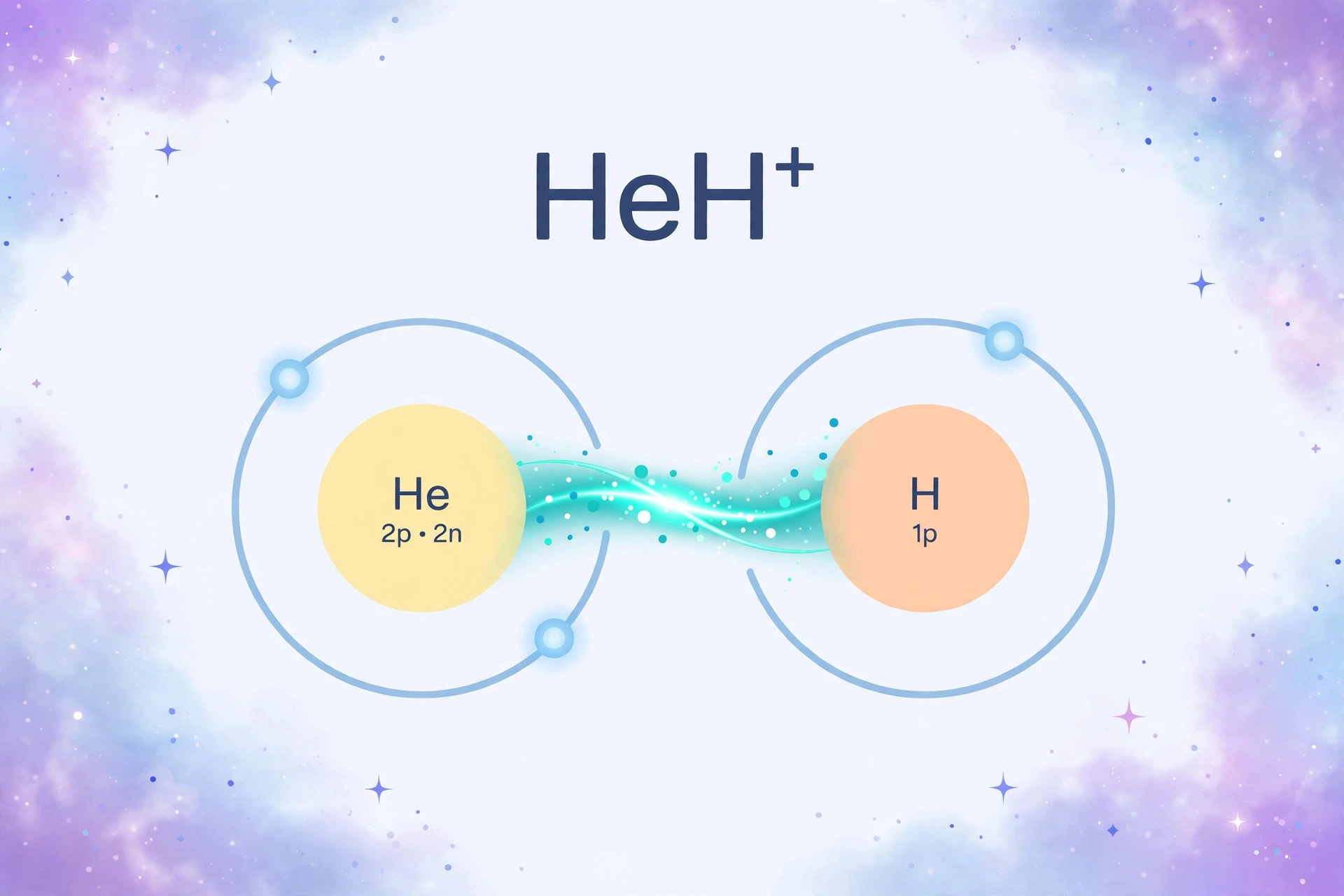
Helonium meaning, in science, is the helium hydride ion, written as HeH+. It is a positively charged ion made from one helium atom bonded to one hydrogen atom, with one electron removed. It is also called hydridohelium(1+) or simply helium hydride.
Scientists believe helonium was the first compound, or molecule, to form in the universe after the Big Bang. That is why it matters far more than its tiny size suggests: it was the first step from separate atoms to chemistry itself.
There is also a second, separate use online. Some slang pages use “helonium” to describe a light, floaty, very happy feeling, like emotional helium. That slang use is not in a standard dictionary, and it is not the scientific meaning. If you see the word in a science article, it means HeH+. If you see it in a meme or casual chat, it probably means the happy feeling.
Helonium Meaning in Simple Words
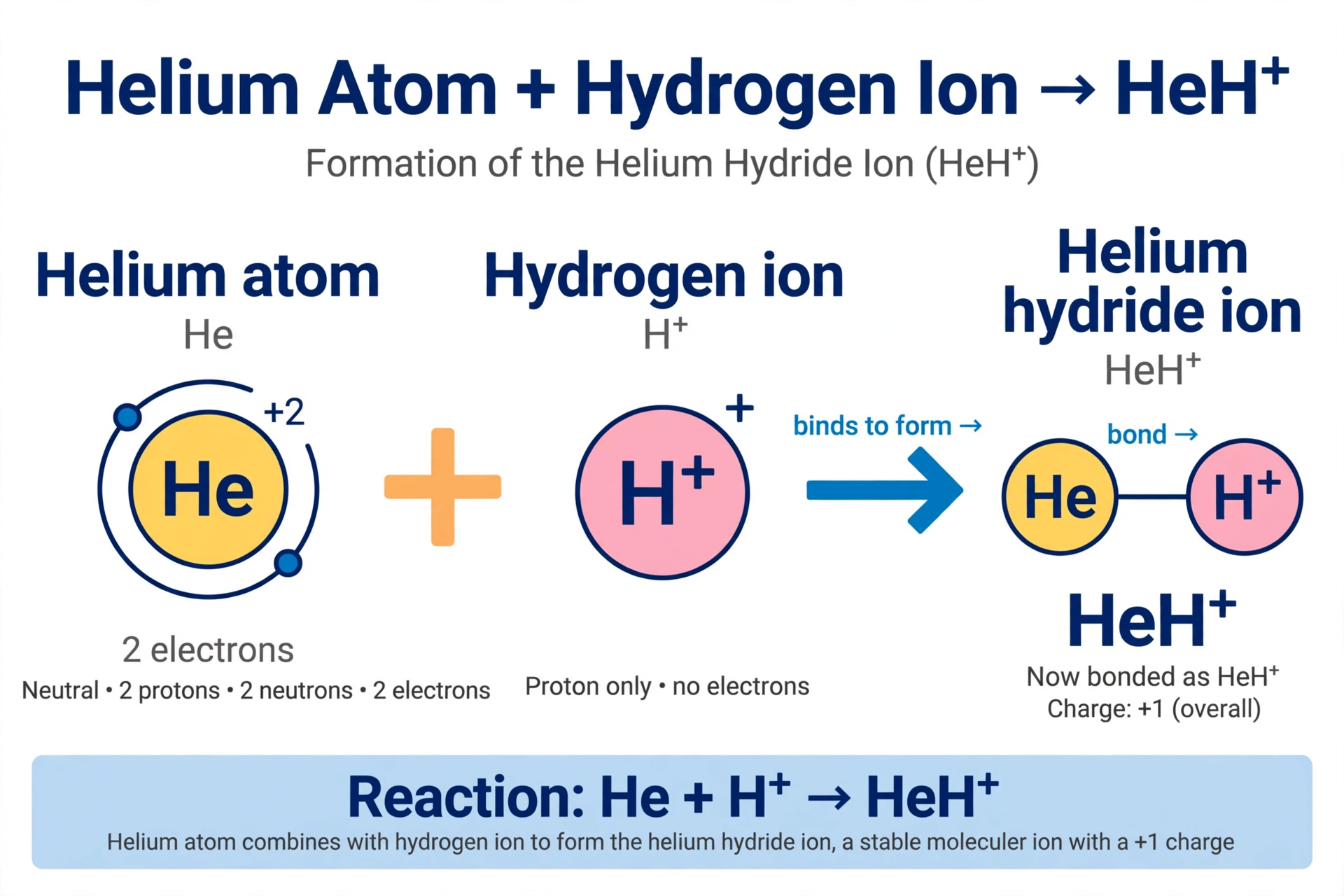
To grasp helonium meaning in simple words, think of helonium as a two-piece team that should not normally work together. Helium is a noble gas, famous for not reacting with almost anything. Hydrogen is the simplest and most common element in the universe. In the very early universe, under extreme conditions, a helium atom bonded with a hydrogen ion, which is basically a proton.
The result was HeH+:
- He stands for helium.
- H stands for hydrogen.
- + shows that the whole ion carries a positive charge.
Because it has lost an electron compared with a neutral pair, helonium is called a cation, which is just the technical word for a positively charged ion. It is also called the lightest heteronuclear ion, meaning the lightest ion made from two different elements.
Its formal name, hydridohelium(1+), sounds complicated, but it describes exactly the same thing: helium plus hydrogen, with a +1 charge. Wiktionary gives the same short definition in plain form, calling helonium a synonym of helium hydride, from helium plus the suffix -onium, which is commonly used for positively charged ions.
Why Helonium Is Called the First Molecule
After the Big Bang, the universe was far too hot for atoms, let alone molecules. As it expanded and cooled, the first elements formed were mainly hydrogen and helium. That left a simple question: what was the first chemical bond?
The answer scientists give, and the core of helonium meaning, is helonium. A helium atom combined with a hydrogen ion to form HeH+, and that bond marked the start of molecular chemistry. From there, chemistry could build toward molecular hydrogen, written as H2, which later played a huge role in cooling gas clouds and helping stars form.
This does not mean helonium is still floating around everywhere today in its original form. The helonium detected in space in modern times formed in specific cosmic environments, not left over unchanged from the Big Bang itself. But its role in early-universe models is why astronomers spent decades trying to find it in space: if the models were right, it had to exist somewhere.
A quick timeline

- 1925: Helonium was first produced in a laboratory, in ionization experiments by Hogness and Lunn. Scientists could make it, but only under controlled conditions.
- 1970s onward: Scientists predicted that it should also exist in the interstellar medium, the gas and dust between stars.
- 1979 onward: Laboratory spectra of the ion were measured in infrared light, giving astronomers a fingerprint to look for in space.
- April 2019: Astronomers finally detected helonium in space, in the planetary nebula NGC 7027, using the airborne SOFIA telescope.
That long gap between lab and space detection is part of the story. Helonium was not missing because the theory was wrong. It was hard to spot because one of its strongest spectral lines sits very close to lines from another molecule, making it difficult to separate in observations from the ground.
What Is Helonium Made Of, and What Does It Do?
In terms of helonium meaning in chemistry, helonium is diatomic, meaning it has just two atoms. Its bond length is extremely short, about 0.772 angstroms, and most of its electron charge sits closer to the helium nucleus than to the hydrogen nucleus. It also has a permanent dipole moment, which is one reason its spectrum can be studied at all.
Its most striking property is reactivity. Helonium is described as the strongest known acid, because it gives up its proton so readily. In practice, that means it reacts with almost anything it touches. It can protonate oxygen, ammonia, sulfur dioxide, water, and carbon dioxide, among other substances.
That reactivity explains two things at once:
- Why it is so important in theory: it can kick off reactions that lead to other molecules.
- Why it is so rare in ordinary conditions: it cannot be stored in a bottle or kept on a shelf. It would react with the container or with any nearby molecule first.
Scientists therefore study it by creating it in place, in very low-pressure or highly controlled environments, rather than by preparing it in bulk. In space, it survives mainly in hot, ionized, low-density environments such as planetary nebulae, where the conditions match the chemistry that forms it.
The 2019 Discovery in NGC 7027
NGC 7027 is a planetary nebula about 3,000 light-years away, near the constellation Cygnus. Despite the name, a planetary nebula has nothing to do with planets. It is the glowing shell of gas thrown off by a dying Sun-like star, with a hot white dwarf left at its centre.
In April 2019, a team led by Rolf Gusten reported the detection of HeH+ in NGC 7027 in the journal Nature. They used SOFIA, the Stratospheric Observatory for Infrared Astronomy, a telescope carried aboard a modified Boeing 747SP aircraft. Flying high above most of Earth’s atmosphere let SOFIA observe the infrared line at about 149 micrometres that ground-based telescopes struggle to separate from nearby lines.
The detection mattered for a simple reason: it confirmed that a molecule predicted by early-universe chemistry really does form in space under the right conditions. It also gave astronomers a new tool for studying ionized gas in nebulae, white dwarf atmospheres, and other helium-rich environments, where helonium can affect how gas cools and how light moves through it.
If you want the official version, NASA’s own summary describes SOFIA finding helium hydride, a combination of helium and hydrogen, in NGC 7027 as the first type of molecule ever formed in the early universe. Link: NASA first molecule found
What Helonium Is Not
Because the name sounds like an element, helonium meaning is easy to misunderstand. Here is what helonium is not:
- It is not helium. Helium is the element with symbol He. Helonium is helium bonded to hydrogen, with a positive charge.
- It is not a new element on the periodic table. There is no element called helonium. The -onium ending here marks an ion, not an element.
- It is not a gas you can buy or breathe. You will not find a bottle of helonium, and you should not trust any product that claims to sell it.
- It is not the same as neutral helium hydride. The neutral molecule HeH is not stable in its ground state, although an excited form, called an excimer, has been observed. The stable, scientifically important species is the ion HeH+.
- It is not a medicine, supplement, or energy product. Any health or energy claim attached to the name has no connection to the verified science.
If a page promises helonium as a product, a treatment, or a downloadable app, treat that as a warning sign. The same habit helps with any unfamiliar claim online: check whether a real developer, seller, or source is named, and whether the claim appears anywhere trustworthy. Tech2Explore’s guide on how to check an unfamiliar website before you trust it walks through those trust signals step by step.
Helonium as Internet Slang: A Separate, Unverified Use
Now for the second helonium meaning you may meet online. A slang site describes helonium as a feeling of emotional euphoria mixed with floating, as if you had inhaled helium and felt light and happy. In that use, someone might say they are “feeling helonium” after good news, a funny meme, or a moment of pure joy.
That slang use is playful, and it is easy to see why it caught on: helium already means floating balloons and squeaky voices, and adding -ium makes it sound like a science-y mood. But there are important limits to it:
- It is not listed as a standard dictionary definition. Wiktionary’s entry for helonium covers only the chemistry meaning.
- The slang page itself says it is not officially a word in any dictionary yet, and that it comes from meme culture and online chats.
- No standard source confirms that this slang is widely used. It appears to be a single site’s playful explanation, not an established term with a documented history.
So use the slang meaning only in casual contexts, and only if the people you are talking to already understand it. In any science, school, or formal context, helonium means HeH+, full stop.
How to tell which meaning someone intends
- Science context, space, chemistry, or the early universe: it means the helium hydride ion.
- A formula, HeH+, NGC 7027, SOFIA, or the Big Bang nearby: it definitely means the ion.
- A meme, chat, or social post about feeling happy and floaty: it probably means the slang feeling.
- A product, download, or health claim: it is neither verified meaning, so be cautious.
Similar Words That Cause Confusion
A few lookalike words make this topic harder than it needs to be:
- Helium: the element He, a noble gas. Not helonium.
- Helionium: a different term listed as a related word, referring to a system containing a helium nucleus and an antihelium nucleus. Do not swap it for helonium.
- Argonium, neonium, kryptonium, xenonium: related ions formed from other noble gases plus hydrogen. They follow the same -onium pattern, but they are not helonium.
- Hydrogen: the element H. Helonium contains hydrogen, but it is not hydrogen on its own.
When in doubt about helonium meaning, look for the formula. If HeH+ is present, you are dealing with helonium in its scientific sense.
Frequently Asked Questions
What is the meaning of helonium?
In science, helonium meaning is the helium hydride ion, HeH+, a positively charged ion made of one helium atom and one hydrogen atom. It is believed to be the first molecule formed in the universe after the Big Bang.
What is the formula of helonium?
The formula is HeH+. The + sign shows its positive charge. Its systematic name is hydridohelium(1+).
When was helonium discovered?
It was first produced in a laboratory in 1925. It was first detected in space in April 2019, in the planetary nebula NGC 7027, using the SOFIA airborne telescope.
Why is helonium important?
It marks the beginning of chemistry in the universe. Its formation was the first chemical bond, and it helped lead toward molecular hydrogen, which was essential for star formation.
Can helonium be found on Earth?
Not in any stable, everyday form. It is extremely reactive and cannot be stored in bulk. On Earth it exists only briefly under specialized laboratory conditions.
Is helonium the same as helium?
No. Helium is an element. Helonium is a compound ion made from helium and hydrogen, with a positive charge.
Is helonium a slang word too?
Some online slang pages use it to mean a light, euphoric, floaty happy feeling. That use is informal, unverified by standard dictionaries, and separate from the scientific meaning.
Is helonium dangerous?
You are very unlikely to encounter it outside a laboratory or a cosmic environment. Its extreme reactivity is a laboratory and astrophysics fact, not an everyday hazard, and no product sold under this name should be trusted on that basis.
Bottom Line
Helonium meaning is clear once you separate the science from the slang. Scientifically, helonium is HeH+, the helium hydride ion, and the first molecule believed to have formed in the universe. It was made in a lab in 1925, predicted in space for decades, and finally found in NGC 7027 in 2019.
The slang feeling of floating happiness is a separate, informal use from internet culture. It is fun in a chat, but it is not the definition you need for science, school, or any serious reading.
So if you remember one line, make it this: helonium is helium plus hydrogen, with a positive charge, and it was chemistry’s first step.