
Is Peter Orszag Bald? What Recent Photos Show — and the Career Behind the Search
Intro
You typed “peter orszag bald” into a search box, and you probably expected a quick yes-or-no answer.
Here it is, up front: no, recent public photographs do not show Peter Orszag as completely bald.
They show visible hair, worn short and now largely gray or silver. That is the part you can check with your own eyes in current professional portraits and conference photographs.
Everything beyond that — whether he wears a hairpiece, whether he had a procedure, whether he has a particular medical condition — is a different kind of claim. It needs evidence that a photograph alone cannot give you, and no reliable public evidence for any of those claims was found in this reading.
That gap is worth understanding, because it explains why this search exists at all. Orszag is not a celebrity in the usual sense. He is an economist who became unusually visible: first as a budget official in Washington, then as a senior executive at one of the world’s best-known advisory firms. When a person stays in public view for nearly twenty years, people compare old photographs with new ones, and small changes in colour, lighting or hairstyle can turn into a whole search trend.
This article keeps the two stories separate. First, it answers the appearance question factually and briefly, without mockery. Then it focuses on what actually made Orszag a public figure: his education, his work on budgets and health care costs, and his path from government to Lazard.
A note on method
This article is based on a fresh search for the keyword and a full reading of the strongest competing pages on 30 October 2026, including his biographical entry, his World Economic Forum profile, and several appearance-focused articles that rank for this exact search.
What was checked:
- His career dates, education and current role, against biographical and institutional profiles.
- What recent photographs are actually said to show, across several competing articles.
- Where those articles agree, where they disagree, and which claims rest on a statement, a report or a primary source — and which rest only on comparing photographs.
What is not claimed here, because it was not verified:
- Any net worth figure, compensation figure, or private family detail.
- Any medical diagnosis, treatment history, or hairpiece claim.
- Any statement from Orszag himself about his appearance, because none was found in this reading.
The Short Answer
No. Peter Orszag does not appear completely bald in recent public photographs.
Recent professional images show visible hair across his head, generally worn short and appearing predominantly gray or silver. That is noticeably different from the darker hair in many of his earlier Washington-era photographs, but a change in colour is not the same thing as having no hair.
Two cautions belong with that answer:
- “Bald” is used loosely online. Some people use it to mean no hair at all. Others use it for a receding hairline or thinner-looking hair. Only the first meaning can be answered clearly from recent photographs, and the answer to that meaning is no.
- Photographs cannot prove a medical or cosmetic claim. They can show what a person looked like in one image, under one set of lights, from one angle. They cannot show why hair looks a certain way, or whether any treatment took place.
If you came here only for the short answer, you have it. The rest of this article explains why the question keeps circulating, and who Peter Orszag is beyond the search term.
Who Is Peter Orszag?
Peter Richard Orszag, born on December 16, 1968, in Boston, Massachusetts, is an American economist and business executive.
As of this writing, he is the chief executive officer and chairman of Lazard, the global financial advisory and asset management firm. He joined Lazard in 2016, later led its Financial Advisory business, became CEO on October 1, 2023, and added the chairman role effective January 1, 2025.
Before Wall Street, he held two of the most important budget jobs in Washington:
- Director of the Congressional Budget Office (CBO), from January 2007 to November 2008.
- Director of the Office of Management and Budget (OMB) under President Barack Obama, from January 20, 2009, to July 30, 2010.
That combination — a technical economist who ran the government’s budget office during a financial crisis, and who now runs a major advisory firm — is why his name still appears in economic and business coverage, and why his photographs span so many years.
The Public Career in Order
Early education
Orszag grew up in Lexington, Massachusetts. He graduated with high honors from Phillips Exeter Academy in 1987.
He then earned an A.B. in economics from Princeton University in 1991, graduating summa cum laude. As a Marshall Scholar, he went on to the London School of Economics, where he earned an M.Sc. in 1992 and a Ph.D. in economics in 1997.
His doctoral thesis was titled Dynamic Analysis of Regime Shifts under Uncertainty: Applications to Hyperinflation and Privatization. You do not need to understand that title to understand his career. The useful point is simpler: he trained as a technical economist, not as a political campaigner, and his early reputation was built on numbers and analysis.
The Clinton administration and Brookings
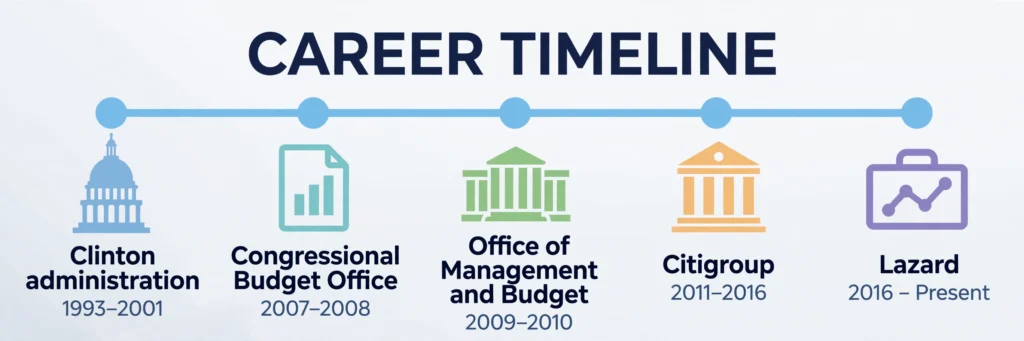
Orszag served in the Clinton administration as a Senior Economist and Senior Adviser on the Council of Economic Advisers, and as Special Assistant to the President for Economic Policy.
Between government posts, he worked at the Brookings Institution as a senior fellow and deputy director of economic studies. In 2006, he co-founded and directed The Hamilton Project, a Brookings initiative focused on economic policy, and he also directed the Pew Charitable Trust’s Retirement Security Project.
He also taught macroeconomics as a lecturer at the University of California, Berkeley, in 1999 and 2000.
Director of the Congressional Budget Office, 2007–2008
The CBO is Congress’s nonpartisan budget scorekeeper. It estimates what legislation will cost and what the long-term budget outlook looks like. Running it is a job for an analyst, not a spokesperson, and Orszag used it to push one argument again and again: rising health care spending was the key driver of the government’s long-term fiscal problem.
During his time at the CBO, he added 20 full-time health analysts, bringing the total to 50, so the agency could analyse health care reform properly. A Committee for a Responsible Federal Budget account of a 2007 CBO study (https://www.crfb.org/cbos-peter-orszag-releases-study-rising-cost-health-care) records the same focus: health care costs, he argued, were “the key” to understanding the long-term fiscal outlook.
That work matters because it explains his next job. When President-elect Obama chose his budget director in late 2008, he was choosing someone who had already spent two years warning that health care costs would decide the budget debate.
Director of the Office of Management and Budget, 2009–2010
The OMB is the White House arm that crafts the federal budget and oversees how federal programs work. Orszag was announced as Obama’s nominee on November 25, 2008, and served from January 20, 2009, to July 30, 2010.
Those were extraordinary months. The financial crisis was at its worst, the government was responding with stimulus spending, and health care reform was being debated line by line. Orszag was therefore on television, in hearings and in press photographs far more often than most budget directors ever are.
That visibility is part of the appearance story. A budget director is not normally a familiar face. Orszag became one, at exactly the moment high-definition television was making every detail of a public appearance easier to scrutinise.
After leaving the OMB, he wrote as a contributing columnist for the New York Times op-ed page and for Bloomberg Opinion.
Citigroup, 2011–2016
In 2011, Orszag joined Citigroup, where he served as Vice Chairman of Corporate and Investment Banking and as Chairman of the Financial Strategy and Solutions Group.
The move from Washington to Wall Street drew comment at the time, but it followed a familiar pattern for senior economic officials: government service, then a senior advisory role in finance. What set Orszag apart was that he kept writing and speaking about fiscal policy and health care economics while working in banking.
Lazard, 2016 to today
Orszag joined Lazard in May 2016 as Vice Chairman of Investment Banking and managing director. He was named Global Co-Head of Healthcare in July 2018, then Head of North American Mergers & Acquisitions, and in April 2019 he took over as CEO of Lazard’s Financial Advisory business, overseeing advisory work for companies and governments around the world.
While in that role, he created Lazard Geopolitical Advisory in 2022 and expanded the firm’s work in data analytics and artificial intelligence for banking and asset management.
He was announced as Lazard’s incoming CEO in early 2023 and assumed the role on October 1, 2023. In September 2023, he said his aim as CEO would include doubling Lazard’s revenue by 2030 — a public target that, whether or not it is met, tells you how he framed his leadership from the start.
Effective January 1, 2025, his role expanded to CEO and chairman. His World Economic Forum profile (https://www.weforum.org/people/peter-orszag) describes him in the same terms: CEO and Chairman of Lazard, previously Director of the OMB and Director of the CBO, with earlier service in the Clinton administration at the Council of Economic Advisers.
He is also a member of the National Academy of Medicine, the Council on Foreign Relations and the Aspen Economic Strategy Group, and he serves on the boards of the Institute for Advanced Study, the Peterson Institute for International Economics and Mount Sinai Hospital.
So Why Do People Search “Peter Orszag Bald”?
There is no single verified origin story for the search term, but the pattern is clear from the competing articles, and it has three parts.
1. A long, visible public record
Orszag has been photographed in official portraits, congressional hearings, television interviews, conferences and corporate portraits for nearly twenty years. That gives anyone with a search engine a large set of images to compare.
When you compare photographs taken years apart, differences stand out: darker hair becomes grayer, a haircut looks shorter, lighting changes how much scalp is visible. None of that is unusual. It only becomes a search trend when the person is photographed often enough for people to notice.
2. An old hairpiece rumour that never had a source
One detailed competing account traces the hairpiece discussion to a 2010 New York Observer profile of Joseph Paris, a Manhattan hairpiece specialist. According to that account, Paris was shown photographs of public figures during an interview about his own business and made a dismissive remark about Orszag’s hair. The account also stresses what is often left out of retellings: Paris had never met Orszag, had never examined him, and was commenting on photographs, not reporting a fact.
A separate line in the Los Angeles Times around the same time is said to have noted a resemblance to a person wearing a toupee, again without citing a source or a specialist examination.
Treat that history carefully. It comes from a competing blog’s reconstruction, not from a primary document quoted in full in this reading. What can be said with confidence is narrower: no reliable report, statement or examination confirming a wig or toupee was found, and the discussion has largely repeated itself ever since.
The important point for you as a reader is this: a joke or an offhand remark about a photograph is not evidence. Repetition does not turn it into evidence either. Five articles repeating one remark are still one remark.
3. The word “bald” travels with the wig question
A hairpiece only makes sense if there is hair loss to cover. That is why the two searches travel together: once people ask whether someone wears a hairpiece, they also ask whether the person is bald underneath.
But the logic only works in one direction. Asking the question does not prove the premise. Recent photographs show visible hair, so the premise itself — complete baldness — does not match what current images show.
What Recent Photographs Actually Show — and What They Do Not
Here is the careful version, because the competing articles do not all agree on the details:
- What most competing articles agree on: Recent professional photographs show Orszag with visible, short, predominantly gray or silver hair. They do not show a completely bald head.
- Where they disagree: One low-authority article claims visible thinning and a significantly receded hairline, and describes it as consistent with a common pattern of age-related hair loss. Other articles describe a full head of hair with no thinning, or simply note visible hair without judging density.
- What photographs cannot settle: Whether any thinning, if present in a given image, is a medical condition, a trick of lighting, a short haircut, or simply how that photograph was taken. A single image, or even several images, cannot diagnose a condition or prove a treatment.
That disagreement is exactly why this article does not give you a confident claim about thinning or a hairline. If you read an article that states one as fact based only on photographs, you are reading an interpretation, not a verified finding.
The most visible change that is not in dispute is colour. Older photographs show darker hair. Recent photographs show much grayer hair. Gray hair also changes how dense hair looks in a photograph: dark hair creates stronger contrast against the scalp, while gray or silver hair can look softer under bright light. That alone can make the same hairstyle look different from one decade to the next.
What Is Verified — and What Is Not
Use this table as a quick filter before you believe any claim you see about this search term.
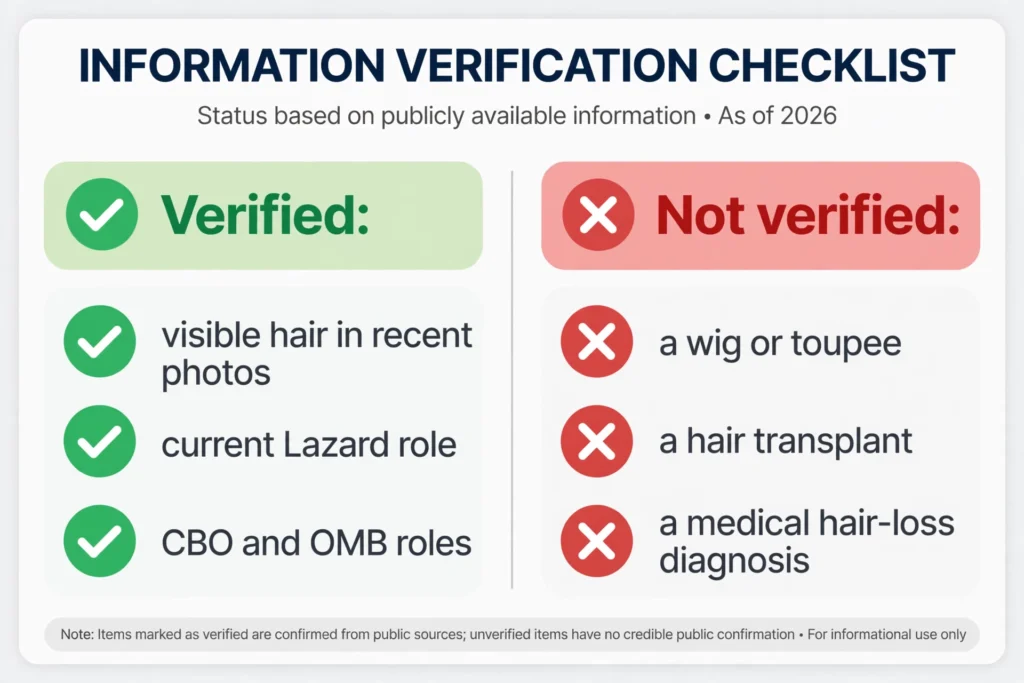
Verified, or well supported by institutional profiles
- Peter Richard Orszag was born on December 16, 1968, in Boston, Massachusetts.
- He graduated summa cum laude in economics from Princeton in 1991, and earned an M.Sc. in 1992 and a Ph.D. in 1997 from the London School of Economics as a Marshall Scholar.
- He directed the Congressional Budget Office from January 2007 to November 2008.
- He directed the Office of Management and Budget from January 2009 to July 2010.
- He joined Lazard in 2016, became CEO on October 1, 2023, and became CEO and chairman effective January 1, 2025.
- Recent public photographs show visible short hair, now largely gray or silver, not a completely bald head.
Not verified, and not claimed as fact here
- That Orszag wears a wig or toupee.
- That Orszag had a hair transplant or any other hair treatment.
- That Orszag has a specific medical hair-loss condition.
- Any net worth figure for Orszag. Figures circulating on low-authority blogs are estimates without a cited primary source, and they are not repeated here.
- Any claim about Orszag’s private life beyond his public career. This article deliberately leaves that out, because it is not what the search is really about, and it is not needed to answer it.
If a page gives you one of the “not verified” items as a certainty, check its source. If the source is another blog, a social media post, or a photograph with a caption, that is not verification.
How to Check a Claim Like This Yourself
You can use this same method for any public figure, not just Orszag. It takes a few minutes, and it stops a photograph from turning into a rumour in your head.
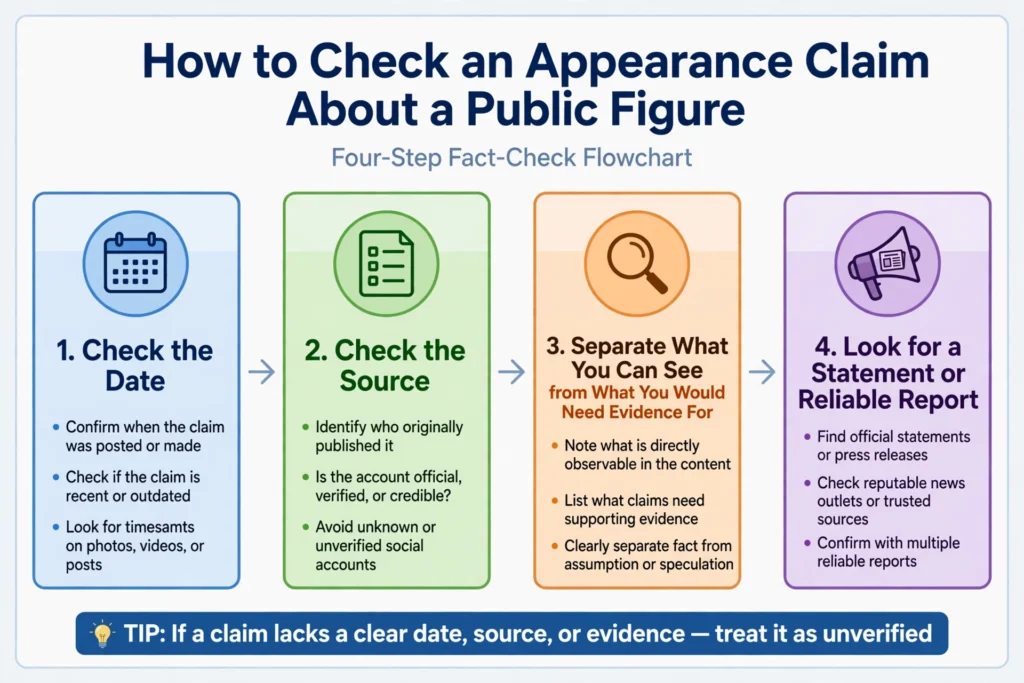
Step 1: Check the date of the photograph
An undated photograph proves nothing about today. Look for the event, the publication date, or the caption. A 2009 hearing photograph and a 2025 conference portrait are not the same evidence, and comparing them without dates will mislead you.
Step 2: Check who published it
An official portrait from Lazard, a government archive, or a reputable news agency carries more weight for appearance than a cropped screenshot on a rumour blog. Ask yourself: does this source have a reason to get the image right, and does it say where the image came from?
Step 3: Separate what you can see from what you would need evidence for
You can see:
- Whether hair is visible.
- Its approximate colour and length.
- Its general style in that image.
You cannot see from a photograph alone:
- A medical diagnosis.
- Whether a hairpiece is being worn.
- Whether a procedure took place, and if so, when or where.
- Why hair looks different from an older photograph.
If a claim jumps from the first list to the second list without new evidence, stop there. That jump is where speculation begins.
Step 4: Look for a statement or reliable reporting
A genuine fact about a private choice usually comes from one of three places: a direct statement by the person, reporting by a reputable outlet with a named source, or a document such as a filing or an official record. A blog repeating another blog is none of those.
The same care applies to other kinds of online claims. If a page makes a bold promise about a website, a product or a person, treat it the way you would when checking whether a website is a scam (https://www.tech2explore.com/scamalytics-explained/): look for the primary source, check the date, and do not let repetition stand in for proof.
Step 5: Ask what would change your mind
This is the simplest test of all. If no photograph, statement or report could ever convince a page that its claim is wrong, that page is not investigating — it is repeating. A reliable article tells you what evidence would settle the question. For Orszag’s appearance, that evidence would be a statement or credible reporting, and neither has appeared in this reading.
Why the Career Matters More Than the Search Term
It is easy to forget, while reading appearance articles, how unusual Orszag’s career actually is.
Few economists run both the CBO and the OMB. Fewer still then run a global advisory firm. His CBO work put health care costs at the centre of the long-term budget debate, years before that argument became standard in Washington. His OMB tenure put him in charge of the federal budget during the worst financial crisis in decades. His Lazard leadership, including the public goal of doubling revenue by 2030, put him in charge of a firm whose advice shapes mergers, restructurings and government deals around the world.
None of that depends on his hairstyle. That is the point. Search trends attach themselves to whatever is most visible about a person, not to whatever is most important about them. For a budget director on high-definition television, the visible thing happened to be his hair. For the rest of his career, the important thing was his analysis.
If you remember one thing from this article, make it this: Orszag’s public record is a record of budgets, health care economics and financial leadership. The appearance search is a footnote to that record, not a summary of it.
Frequently Asked Questions
Is Peter Orszag bald?
No, not in the sense of being completely bald. Recent public photographs show visible short hair, now largely gray or silver. Photographs alone cannot establish whether he has experienced any particular type of hair loss, and no reliable source gives a medical answer to that question.
Does Peter Orszag still have hair?
Yes, according to recent professional photographs. His hair is worn short and appears predominantly gray or silver. How full it looks can vary with lighting, camera angle, haircut length and image quality.
Is Peter Orszag’s hair gray now?
Yes, in recent photographs it appears largely gray or silver, compared with the darker hair seen in many photographs from his Washington years. That change in colour is the clearest visible difference between older and newer images.
Does Peter Orszag wear a wig or toupee?
There is no reliable public confirmation that he does. The discussion traces back to remarks about photographs made in 2010, not to an examination, a statement or a report. Without stronger evidence, the claim remains unverified.
Did Peter Orszag have a hair transplant?
There is no reliable public confirmation that he did. Before-and-after photograph comparisons cannot prove a transplant, because lighting, haircut, styling, camera angle and the passage of time can all change how hair looks in images.
Why does Peter Orszag’s hair look different in some photos?
Lighting, camera angle, hair length, styling, image resolution and graying can all change how hair appears. A photograph taken under bright overhead light can make more scalp visible than a softly lit portrait, even when the hairstyle is the same.
Who is Peter Orszag, in one paragraph?
Peter Richard Orszag is an American economist and business executive, born on December 16, 1968, in Boston, Massachusetts. He directed the Congressional Budget Office from 2007 to 2008, directed the Office of Management and Budget under President Barack Obama from 2009 to 2010, and has served as CEO of Lazard since October 2023, adding the chairman role in January 2025.
What is Peter Orszag known for?
He is best known for his work on long-term fiscal policy and health care costs at the CBO, for running the federal budget at the OMB during the financial crisis and the health care reform debate, and for leading Lazard’s advisory business and then the whole firm.
Where can you verify Peter Orszag’s career?
Start with institutional profiles and biographical entries that cite their sources, such as his World Economic Forum profile (https://www.weforum.org/people/peter-orszag) and his biographical entry (https://en.wikipedia.org/wiki/Peter_Orszag). For his CBO work specifically, the Committee for a Responsible Federal Budget’s account of his 2007 health care study (https://www.crfb.org/cbos-peter-orszag-releases-study-rising-cost-health-care) is a useful primary-adjacent source. Treat appearance-focused blogs as interpretations of photographs, not as career sources.
Bottom Line
Peter Orszag is not completely bald in recent public photographs. He has visible short hair, now largely gray, and the clearest change from his earlier public appearances is colour, not the absence of hair.
Claims about a wig, a toupee, a transplant or a medical condition remain unverified. They rest on photograph comparisons and repeated remarks, not on a statement, an examination or reliable reporting, and competing blogs do not even agree on whether thinning is visible.
What is verified, and what will last longer than any search trend, is his public career: Princeton and the London School of Economics, the Council of Economic Advisers, the Congressional Budget Office, the Office of Management and Budget, Citigroup, and Lazard, where he is now CEO and chairman.
That is the answer to the search, and the reason the search itself is only a small part of the story.