WallPostMedia.com: 7 Essential Facts Before You Trust It or Pitch It
Intro
You searched for wallpostmedia com, and the results did not agree with each other.
One page calls it a multi-topic blog. Another page calls it a publishing platform. Another describes something that sounds like a wall art shop with AI tools. A fourth talks about guest posting and backlinks, as if the whole point of the site is to sell placements.
That confusion is the real story here. It is also the reason a short, confident answer would be misleading.
WallPostMedia.com is best understood as a multi-topic online publication that readers can browse for free. That much is consistent across the reviews read for this article. Almost everything that matters after that — who runs it, how thoroughly its articles are checked, whether it accepts your guest post, what a link from it is worth, and whether it is safe in any complete sense — is either mixed, incomplete, or simply not publicly verified.
This article separates what was observed from what was not. It does not call the site a scam. It does not call it definitively safe, either. It gives you the checks that let you decide for yourself, whether you are a reader, a writer, or a marketer thinking about paying for a placement.
A note on method
This article is based on a full reading on 29 Oct 2026 of ten pages: detailed reviews of wallpostmedia com, plus the homepages of three similarly named sites.
What was checked:
- The structure, categories, and claims in each review, and where those reviews agreed or disagreed.
- The homepages of wallpostmedia.net, wallpostmedia.org, and thewallpostmedia.com, to see how similar names present themselves.
- Google’s published guidance on linking to other sites, including when to qualify a paid link.
- The published definition of Domain Authority as a third-party metric, to avoid treating it as a Google score.
What could not be verified in this reading:
- The legal owner or parent company of wallpostmedia.com.
- A current Domain Authority score, backlink profile, or ranking outcome for wallpostmedia.com.
- A verified price list, guest-post acceptance policy, link policy, or turnaround promise.
- A complete technical safety audit, malware scan, or privacy review.
- Any wall-art or AI art product, creator dashboard, analytics suite, or writer revenue program as a confirmed feature of the publishing site.
- Whether similarly named domains share an owner, copy content, or behave maliciously.
Where reviews disagreed, this article says so. A disagreement between two reviews is not
proof that either one is lying. It is proof that you should not repeat the claim as settled fact.
The Short Answer
WallPostMedia.com is a free-to-read, multi-topic publishing website.
You can browse articles about business, health, technology, finance, education, lifestyle, fashion, and real estate without, according to the reviews read, hitting a paywall or a login wall. Articles carry individual author bylines, and the site is presented as a general-interest publication rather than a specialist journal, a social network, or a software app.
That is where the confident part ends.
Ownership is not publicly verified in the material read. Author credentials are not shown in a way you can check from the site alone. No complete, verified guest-post policy, price list, or link policy was found. No safety audit was completed. And several similarly named domains use the same brand words, without any proven relationship to each other.
So use it the way you would use any small, general-interest site: fine for a quick overview, not a final source for a health, money, or legal decision, and not a placement to buy until you have asked the publisher direct questions and received clear, written answers.
What Is WallPostMedia.com?
What it actually publishes
WallPostMedia.com publishes informational articles across many subjects in one place.
The reviews describe a conventional blog layout: a homepage feed, category pages, article titles, author names, publication dates, and category labels. You pick a topic, open an article, and read it. There is no app to install and, on the evidence read, no account you must create to read the public articles.
That format matters, because it clears up one common misunderstanding. This is not presented, in the publishing-site reviews, as a tool you log into to manage social media, schedule posts, or track analytics. If a page promises you a creator dashboard, a reporting suite, or a collaboration workspace for WallPostMedia.com, treat that as an unverified claim until the site itself documents it.
Categories at a glance
The category lists vary slightly from review to review, which is itself a useful warning. Do not treat any one list as an official sitemap.
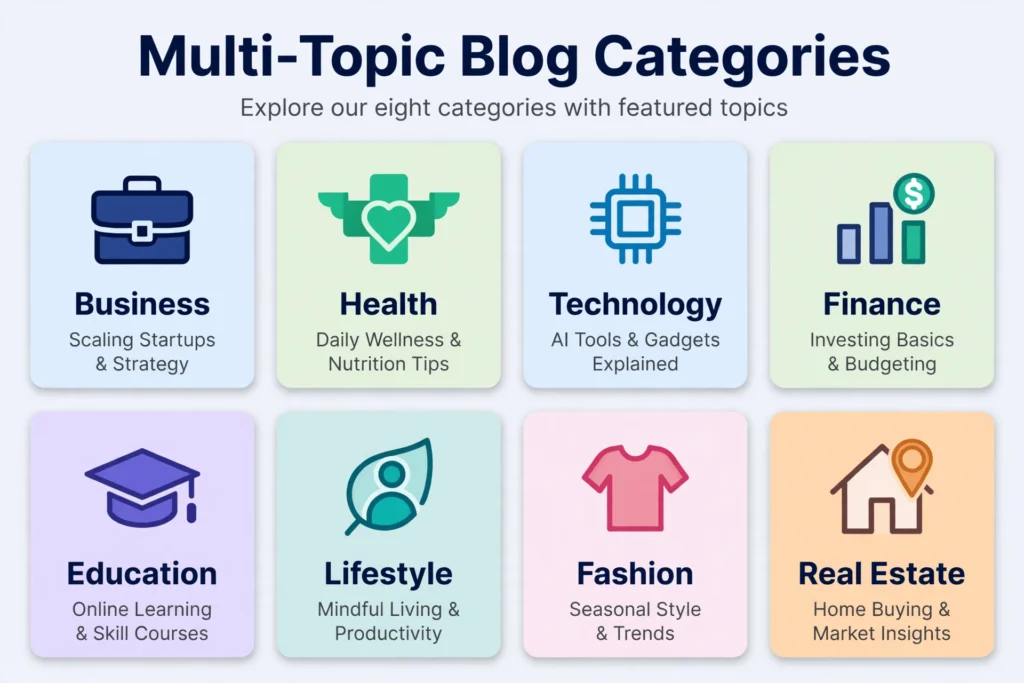
Across the reviews read, these categories appear repeatedly:
| Category | What reviewers say you will find there |
|---|---|
| Business | Small-business guides, business valuation, operations, and professional topics |
| Finance | Budgeting, money habits, investing basics, and financial terminology |
| Technology | Artificial intelligence, software, apps, digital trends, and gadget topics |
| Health | Wellness explainers, health conditions, and everyday health topics |
| Education | Study guides, certificates, exams, and learning topics |
| Lifestyle | Everyday living, practical guides, and general-interest topics |
| Fashion | Style, fabric, and fashion coverage |
| Real Estate | Property and housing-related topics |
Some reviews also mention entertainment, sports, or marketing as areas of coverage. That variation may reflect different snapshots in time, different category pages, or different similarly named sites. For your own decision, open the category you care about and judge the actual articles there, not the category label alone.
Who writes for it, and what a byline does not prove
Articles are credited to individual writers, not to a generic staff byline, according to the stronger reviews.
That is helpful, but limited. A name on a page does not, by itself, prove identity, qualifications, employment, or specialist expertise. The reviews read found no author bio pages, credential listings, or linked social profiles that would let you verify a writer’s background from the site alone.
The practical effect is simple. A finance article is not automatically written by a finance professional. A health article is not automatically written by a medical professional. The same contributor may write across very different topics in the same period.
That does not mean every article is wrong. It means you should judge each article on its own evidence: what it cites, how specific it is, how current it is, and whether its claims hold up elsewhere.
How the site is organised for readers
For a reader, the path is straightforward:
- Browse the homepage feed or pick a category.
- Open an article and check its title, date, author, and sources.
- Follow any links that matter to their original source, rather than trusting a summary alone.
- Compare important claims before acting on them.
No subscription step was documented in the reviews read for ordinary reading. If you ever hit a paywall, a forced sign-up, or a download prompt on a page claiming to be WallPostMedia.com, stop and check the exact domain first. That behaviour was not described as part of the publishing site in the reviews read.
The Domain Confusion
This is the section most competing reviews handle poorly, and it is the section that will save you the most time.
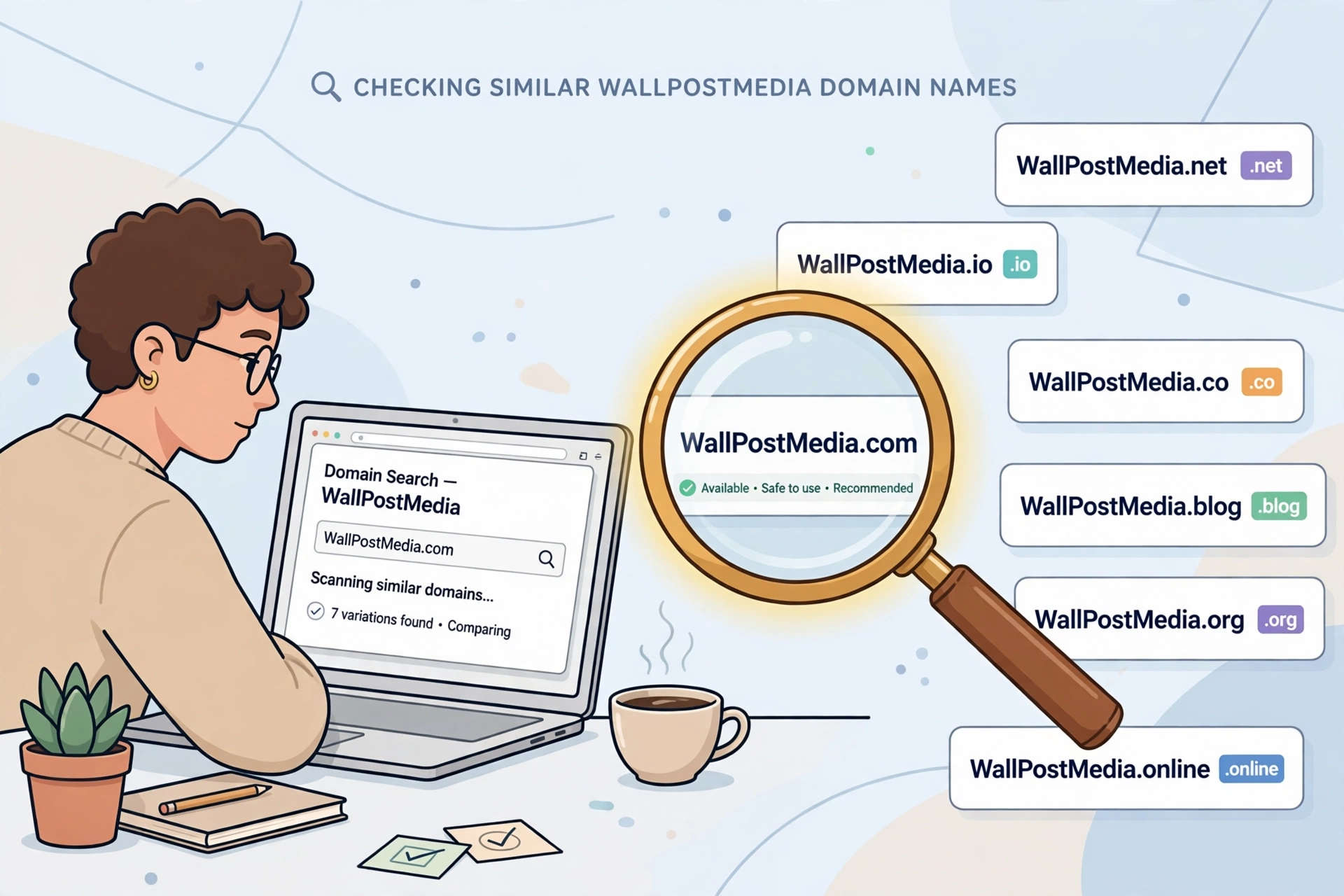
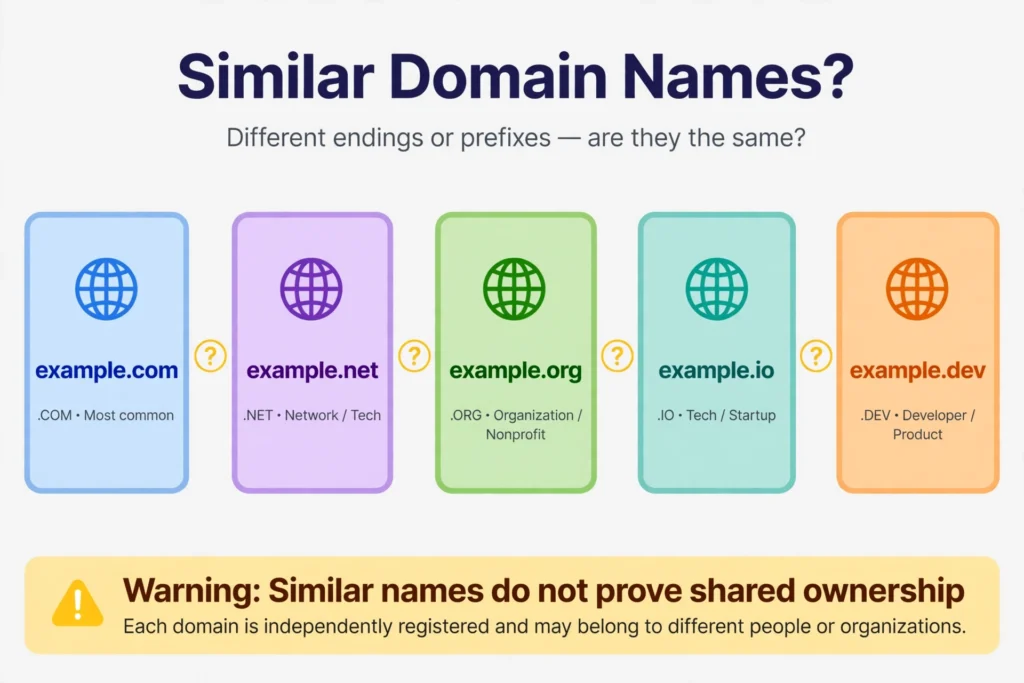
Search results mix at least five similar names. Similar names do not prove shared ownership, copying, or bad intent. They do prove that you must read the full domain before you trust, cite, or pay anything.
Table: similar domains, what was observed, and what is not proven
| Domain | What was observed in this reading | What is NOT proven |
|---|---|---|
| wallpostmedia.com | A multi-topic publishing website as described by several reviews, with category archives, article bylines, and a public contact route for editorial and business inquiries | Legal ownership, a complete safety audit, a verified guest-post policy, a verified price list, and a verified Domain Authority score |
| wallpostmedia.net | A homepage presenting itself as a news and media site, with Fashion, Latest News, Business, and Trending News sections, and page metadata showing a first publication date in 2021 and an update in August 2026 | Any ownership relationship to wallpostmedia.com, and whether its content, operator, or commercial terms match the .com site |
| wallpostmedia.org | A homepage presenting News, Insights, Trends, and Stories, with Business, Sports, Technology, Health, Fashion, and lifestyle coverage | Any ownership relationship to wallpostmedia.com, and whether it is the same publication under a different ending |
| thewallpostmedia.com | A homepage presenting Technology, Marketing, Lifestyle, News, and Trends as structured insights, with a focus on clarity over volume | Any ownership relationship to wallpostmedia.com; note the extra word “the” at the start, which makes this a different domain |
| wallspostmedia.com | A similarly spelled variant mentioned in review research, with an extra “s” in “walls” | Ownership, affiliation, copying behaviour, and security status; do not label it a clone or a threat without direct, reproducible evidence |
Read that table twice before you cite any of these sites. Trust does not transfer from one domain to another just because the names look alike.
Why wall art and guest-post service claims appear in search results
Two separate confusions keep appearing.
First, at least one search result describes WallPostMedia.com as a premium wall art and AI art hub, with accounts, templates, high-resolution downloads, and print integration. That description was not corroborated by the publishing-site reviews or by the .net, .org, and thewall homepages read for this article. No primary evidence was found in this reading linking that wall-art product to the .com publishing site.
Do not import those features into your picture of the publishing site. If you were looking for wall art, posters, or an AI image tool, you are looking for a different kind of product, and you should judge that product on its own site and terms, not on the publishing reviews.
Second, several pages describe WallPostMedia.com in guest-post and content-marketing terms. That is closer to the publishing picture, but it is still not the same as a verified policy. Third-party services sell placements, and reviewers discuss contributor publishing, but a seller’s offer is not the publisher’s policy. Keep those two things separate throughout this article.
How to check you are on the right domain
Check the exact spelling
Read the address bar letter by letter. Check for the extra “s” in wallspostmedia, the extra word “the” in thewallpostmedia, and the ending: .com, .net, or .org. A logo or a page title is not a domain check.
Check the About and contact pages on that specific domain
Do not carry an About page, a contact address, or a category list from one domain over to another. Open the About and contact pages on the exact domain you intend to use, and note what they actually say on the day you check. As the next section explains, even reviewers disagree about the About page for the .com site, so your own dated check matters more than a repeated claim.
Treat warnings as a reason to pause
If you see an unexpected redirect, a download prompt, a browser security warning, or a payment request you did not expect, stop. Do not enter payment details or sensitive personal information until you have independently verified who you are dealing with and what you are buying.
7 Essential Facts About WallPostMedia.com
Fact 1: It is a multi-topic blog, not a software app
The strongest pattern across reviews is that WallPostMedia.com is a general-interest publishing site. It is not presented, in the strongest reviews, as a tool you install, a marketplace you join, or a platform with a user dashboard.
That distinction matters because several search results use platform language loosely. A site can call itself a platform while still being, in practice, a set of articles with categories. Judge it by what a reader can actually do: read articles, browse categories, and follow links. On that test, the publishing description fits best.
Fact 2: It is free to read, with no paywall or login wall found
No review in this reading documented a subscription, paywall, or account requirement for ordinary reading. That is consistent with a small advertising- or contributor-supported blog model, although no revenue model was verified.
Free to read does not mean free of trade-offs. Free general-interest sites often rely on volume, search traffic, and contributed content. That can mean uneven depth, uneven sourcing, and uneven updating. Read the article, not the business model you assume.
Fact 3: Ownership and company details are not publicly verified
This is the most important gap. Reviews do not agree on a verified owner, parent company, headquarters, or founding date for wallpostmedia.com, and no such verified company record was established in this reading.
That does not prove the site is hiding something. Many small blogs publish little about their operators. But it does mean you cannot responsibly repeat a company name, a founder, or a location as fact without a primary source. If a seller, a review, or an About page gives you a name, check it against an independent record before you use it in a pitch, a citation, or a payment decision.
The About-page disagreement illustrates the problem. Some reviews describe an About page that presents the site as a general publishing project. Others describe the About content differently, or focus on contributor and category claims rather than on ownership. Treat any single About summary as a snapshot, not as a settled company history.
Fact 4: Authors are named, but credentials are not shown
Reviews consistently say articles carry individual author names. That is a positive sign compared with fully anonymous content farms, but it is not, on its own, proof of expertise.
In the material read, author pages or bios did not provide verifiable qualifications, professional histories, or independent profiles that would let a reader confirm expertise in finance, health, or law. For a general-interest overview, that may be enough. For a decision that affects money, health, or legal rights, it is not.
The rule is simple: if the claim matters, check the author’s evidence, not just the author’s name.
Fact 5: Publishing pace is uneven, and freshness varies
Reviews describe a site with a large archive and ongoing publication, but not a steady, clearly dated editorial rhythm that a reader can rely on. Some categories look fuller than others, and some articles may age without a clear update note.
That matters because advice changes. A finance, health, or technology article from an earlier year may no longer reflect current rules, products, or evidence. Always check the date, and compare any time-sensitive claim with a current primary source before acting on it.
Fact 6: Guest posting is discussed, but no complete official policy was found
This is where marketers most often over-claim. Reviews and third-party sellers discuss contributor publishing and guest posts on WallPostMedia.com, and some describe it as a place where writers can publish and gain exposure or links. What was not found in this reading is a complete, current, official guest-post policy on the .com site itself that settles, in one place:
- Who may submit, and on what topics.
- Whether links are dofollow, nofollow, or sponsored.
- Whether placements are permanent, and under what removal terms.
- What editorial review, disclosure, or quality checks apply.
- What, if anything, is charged, and by whom.
Until you have those answers in writing from the publisher, treat any seller’s promise as unconfirmed. The next section gives you the exact questions to ask.
Fact 7: Safety and SEO value cannot be settled from HTTPS or a third-party score alone
Two shortcuts mislead people here.
The first is HTTPS. A padlock means the connection is encrypted. It does not mean the content is accurate, the operator is verified, or the site is safe to pay. Do not use HTTPS as a trust verdict.
The second is Domain Authority. Domain Authority is a third-party metric from Moz, not a Google ranking factor. It is a comparative, modelled score, not a guarantee of traffic, ranking, or safety. A score quoted by a seller, without a date, a source, and a current backlink profile, proves very little.
If you are offered a placement, judge it on the live page, the audience, the link terms, and the editorial standard — not on a single number or a padlock icon.
WallPostMedia.com for Readers
How to use it well
Treat WallPostMedia.com as a starting point, not a final authority. It is best for getting an overview of a topic, finding the vocabulary around it, and seeing what questions to ask next.
For general topics — a lifestyle explainer, a study-guide overview, a fashion or real-estate summary — that level of use is reasonable. For anything that affects your money, health, safety, or legal position, move to a primary or specialist source before you act.
When not to rely on it alone
Do not rely on a single WallPostMedia.com article alone when:
- The claim affects a financial decision, an investment, a tax position, or a business contract.
- The claim affects a health decision, a treatment, a diagnosis, or a safety practice.
- The article gives no sources, no date, and no author information you can check.
- The article’s claims conflict with a specialist source, an official source, or another credible publication.
- You are being asked to pay, subscribe, or share sensitive information on the basis of the article.
In those cases, the article has done its job if it helped you ask better questions. It has not done the job of answering them.
A practical reading checklist for a single article
- Who wrote it, and can you verify anything about that author?
- When was it published, and has it been updated since?
- Does it cite sources you can open, or does it only assert?
- Do its key claims match at least one independent source?
- Does it separate fact, opinion, and promotion clearly?
- Would you still trust the advice if you removed the site’s name and branding?
If most answers are no, treat the article as background only.
WallPostMedia.com for Writers and Marketers
How a pitch would realistically work
If you want to pitch, start from the publishing picture, not from a seller’s package. A realistic pitch would be an original, useful article in one of the site’s established categories, with a clear angle, a credible author, and sources a reader can check.
Do not pitch a thin promotional page, a copied article, or a piece built only around a link. Even if a third party promises placement, a low-quality article harms your own reputation and is unlikely to hold value.
Before you pitch, read several recent articles in your target category. Note their length, tone, sourcing, and structure. If your draft would look out of place there, revise it before you contact anyone.
What to ask before you pay or submit
Get answers in writing, from the publisher or from a contact who can prove they act for the publisher. Do not rely on a marketplace listing alone.
Link type: dofollow, nofollow, or sponsored?
Ask exactly how the link will be coded. A dofollow link, a nofollow link, and a sponsored link are not interchangeable, and Google’s guidance treats paid links differently from editorial links. If you are paying for a placement, the link should be qualified appropriately, and you should understand what that means for SEO value before you pay.
If the seller cannot tell you the link type, or promises a dofollow link on a paid placement without qualification, treat that as a warning sign, not a selling point.
Permanence and removal: how long will the article stay live?
Ask whether the article is permanent, for how long it is guaranteed, and what happens if the site changes, the category changes, or the article is removed. Ask what refund or replacement terms apply if the article is deleted, the link is changed, or the page is noindexed.
Get the answer in the same message, email, or contract as the price. A verbal assurance is not enough when you are paying for a lasting asset.
Editorial review and disclosure: who edits, and what is disclosed?
Ask who will edit the article, whether the publisher can change your text or links, and whether paid placements are disclosed to readers. A site that discloses paid content clearly is easier to trust than one that presents paid content as independent editorial.
If the article will be labelled as sponsored, contributed, or partner content, decide in advance whether that label fits your brand and your SEO goals.
No ranking guarantee: what is actually being sold?
No honest seller can guarantee a ranking, a traffic number, or a Domain Authority increase from a single placement. If you are promised a specific ranking outcome, walk away.
What you are actually buying, at most, is a published article on a specific domain, with specific link terms, for a specific period. Judge that offer on its own merits, and compare it with other placements you could buy for the same budget.
How to judge a placement on its own merits
Check:
- The exact live URL, not a category homepage or a screenshot.
- The article’s date, author, and surrounding content.
- Whether the page is indexed, and whether it ranks for anything relevant.
- Whether the site’s recent articles look edited, sourced, and current.
- Whether the price matches the audience, the permanence, and the link terms — not a quoted score.
A placement that fails most of those checks is not worth buying, even if the domain name looks familiar.
A note on third-party sellers
Many guest-post offers for WallPostMedia.com come from resellers, not from the publisher. A reseller may not control the article, the link, or the removal policy, and may not be able to fix a problem after payment.
If you buy through a third party, get the publisher’s terms in writing before you pay, keep a dated copy of the live page, and check the page again after publication. If the link changes, the article disappears, or the page is deindexed, raise it immediately, in writing, while you still have payment protection.
WallPostMedia.com vs Medium vs HubPages
Readers often ask whether WallPostMedia.com is like Medium or HubPages. The short answer is: similar in format, different in scale, tools, and verifiability.
Medium is a large, well-known publishing platform with accounts, publications, distribution, and a large, established audience. HubPages is a long-running network of niche sites with author accounts, revenue-sharing history, and a large archive. WallPostMedia.com, as described in this reading, is a smaller, general-interest blog-style publication without the same verified account tools, audience scale, or public company footprint.
That does not make it useless. It makes the comparison uneven. Do not borrow Medium’s or HubPages’ reputation and apply it to WallPostMedia.com, and do not judge WallPostMedia.com by Medium’s feature set.
| Feature | WallPostMedia.com | Medium | HubPages |
|---|---|---|---|
| Main format | Multi-topic blog-style articles | Publishing platform with accounts and publications | Network of niche article sites |
| Reader access | Free to read, as found in this reading | Free and paid content, with membership options | Free to read, with advertising |
| Writer accounts | Individual bylines described; no verified account or dashboard system established in this reading | Full writer accounts, profiles, and publications | Author accounts with profiles and site history |
| Ownership transparency | Not publicly verified in this reading | Public company and platform | Public network with a long published history |
| Best use for a reader | Quick general overview, then verify elsewhere | Reading established writers and publications | Niche explainers and how-to articles |
| Best use for a writer | A possible small publication outlet, only after written terms are confirmed | Building an audience under your own profile | Building niche articles within an established network |
Use the table as a starting point, not a verdict. If your goal is audience, tools, or a verified publishing record, the larger platforms offer more that you can check in advance. If your goal is a single small placement, judge WallPostMedia.com on the live page and the written terms, as the previous section explains.
Trust Checklist
Use this checklist before you trust an article, cite a claim, or pay for a placement. If you cannot answer an item, that is your next step — not a reason to guess.
- Confirm the exact domain in the address bar, letter by letter.
- Open the About and contact pages on that exact domain, and note what they actually say today.
- Check the article’s date, author, and sources, and open at least one source yourself.
- Compare any important claim with at least one independent, credible source.
- Check whether the author has verifiable expertise for a money, health, or legal claim.
- Look for disclosure: is the article editorial, contributed, or sponsored?
- If you are paying, get link type, permanence, removal terms, and price in writing first.
- Ignore HTTPS and a single third-party score as proof of safety or SEO value.
- Watch for redirects, download prompts, security warnings, or unexpected payment requests — and pause if you see them.
- Keep a dated record of the live page and the terms, especially before payment.
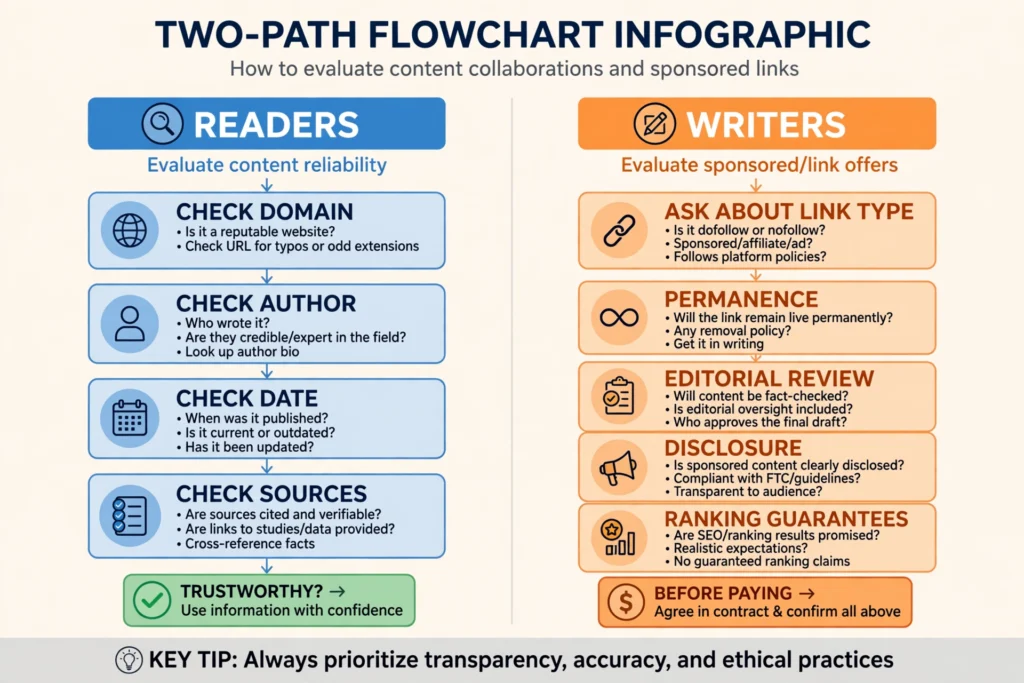
If several checks fail at once, treat the site as a starting point for research, not as a final authority. That is not a punishment. It is proportionate caution.
How to check any website in five minutes
If you only have five minutes, do these five things in order:
- Read the full domain.
- Open the About and contact pages on that exact domain.
- Open one article in the category you care about and check its date, author, and sources.
- Search for the site’s name plus “guest post” or “review” and note whether the claims you find are repeated without evidence.
- For any commercial offer, ask for link type, permanence, editorial review, disclosure, and price in writing before you pay.
That five-minute check will prevent most avoidable mistakes, on this site and on the next similar site you find.
Frequently Asked Questions
What is wallpostmedia.com?
WallPostMedia.com is a multi-topic online publishing website. Its articles cover business, health, technology, finance, education, lifestyle, fashion, and real estate, among other general-interest subjects. It is best described as a publication you read, not as a software app or a social network.
Is wallpostmedia.com legit?
That question needs to be split into two questions.
As a functioning website, it is real: reviews describe an active site with category pages, article bylines, and a public contact route. As a trusted authority, legitimacy is not settled by existence alone. Ownership is not publicly verified, author credentials are not shown in a checkable way, and no published editorial policy was verified in this reading. Treat it as a smaller, less-established source, not as an authoritative outlet, until stronger transparency evidence appears.
Is wallpostmedia.com safe to browse?
No definitive safe or unsafe verdict is justified on the evidence in this reading.
The site was accessible as a normal content website in the reviews read, and ordinary browsing precautions apply. No complete security audit, malware scan, or privacy review was completed. HTTPS alone does not prove safety, accuracy, or operator identity. Check the domain spelling, heed browser warnings, avoid unexpected downloads, and do not share payment details or sensitive personal information unless you have independently verified the recipient.
Who owns wallpostmedia.com?
The legal owner or parent company was not independently verified in the material read.
A contact route and, in at least one review, an About page describing the site as a blogging platform were reported, but those details do not by themselves establish legal ownership. Other reviews report no visible About page naming a company or founder. Do not repeat an ownership claim about this site unless you have primary evidence for it.
Can I submit a guest post to wallpostmedia.com?
That has not been verified as a complete policy.
The site invites editorial and business inquiries through its published contact route, and its own content discusses contributor publishing. That is an indication that inquiries are possible. It is not proof that unsolicited guest articles are accepted, that every writer is eligible, that publication is free or paid, or that a submission will be published. Ask the publisher about eligibility, topics, standards, links, fees, review, and timing before you prepare a full draft.
Does wallpostmedia.com charge for guest posts?
No verified price list was found in this reading.
The presence of a business contact does not prove a price, a free placement option, or a specific turnaround. Third-party sellers may quote their own prices for placements, but a seller’s price is not the publisher’s official price. Confirm cost, link type, disclosure, and permanence in writing before you pay.
Are backlinks from wallpostmedia.com good for SEO?
No verified link profile, authority score, outbound-link sample, or ranking-outcome study was available in this reading to support a specific rating.
Judge a link on relevance, article quality, placement, link qualification, audience fit, and commercial terms, not on a quoted score or a ranking promise. Paid links should be qualified as sponsored or nofollow under Google’s guidance, and no single link guarantees a ranking.
Is wallpostmedia.com the same as wallpostmedia.org?
That relationship was not established.
The two domains use similar names and publish multi-topic content, but similarity does not prove shared ownership or affiliation. The same applies to wallpostmedia.net, thewallpostmedia.com, and wallspostmedia.com. Check each domain separately.
Is wallpostmedia.com a wall art or AI art platform?
On the evidence read, no. The publishing site described by the reviews is a written-content site, not a wall art shop or AI image generator.
A separate search result describes a premium wall art and AI art hub under a similar name, with accounts, templates, and print features. That description was not corroborated by the publishing-site reviews or by the similarly named homepages read for this article. Do not treat those art features as features of the publishing site.
Bottom Line
WallPostMedia.com is useful in a narrow, honest way, and misleading if you stretch it further than the evidence allows.
For a casual reader, it is a free, easy-to-read starting point for general topics. You can browse a category, get a quick overview, and move on. That is a real benefit, and it is how most readers should use it.
For anyone who needs a reliable answer — for health, money, legal, or technical decisions — it is not enough on its own. Check the date, the author, and the sources. Then verify the important claims elsewhere, with a primary source or a qualified professional.
For a writer or marketer, it is an inquiry, not a confirmed opportunity. There is no verified price, policy, link promise, or ranking outcome to rely on in this reading. Ask about link type, permanence, editorial review, disclosure, and cost in writing. If you cannot get clear answers, do not pay, and do not treat a seller’s promise as the publisher’s policy.
And for anyone confused by the name, remember the simplest rule in this article: read the full domain. WallPostMedia.com, wallpostmedia.net, wallpostmedia.org, thewallpostmedia.com, and wallspostmedia.com are different addresses. Similar names do not make them the same site, the same owner, or the same level of trust.
Use WallPostMedia.com for what it verifiably is — a broad, free, general-interest publication — and verify everything that matters before you trust it, cite it, or pay for a placement on it.