Troozer.com Explained: What It Really Is, Why Reviews Disagree, and Is It Safe?
If you searched for “troozer.com” and came away more confused than when you started, you are not doing anything wrong. One article calls it an all-in-one productivity platform. Another calls it an online marketplace. A third calls it an AI tool finder. A fourth calls it a simple content site.
They cannot all be right. And when you actually open the site, the answer turns out to be much plainer than most of those descriptions suggest.
Here is the short version: troozer.com is a multi-topic digital publication. You visit it, you read articles, and you leave. It is not a shop, not a workspace app, and not a tool you sign up for — at least, nothing on the public site shows any of those things. The confusion comes almost entirely from third-party articles about the name, not from the site itself.
That distinction matters, because it changes how you should treat it. A site you only read from needs a different level of caution than a site you pay, sign up for, or hand personal data to. This article separates what is verified, what is claimed by others, and what is simply still unknown.
The Short Answer
Troozer.com is best understood as a general-interest online magazine, not as a product:
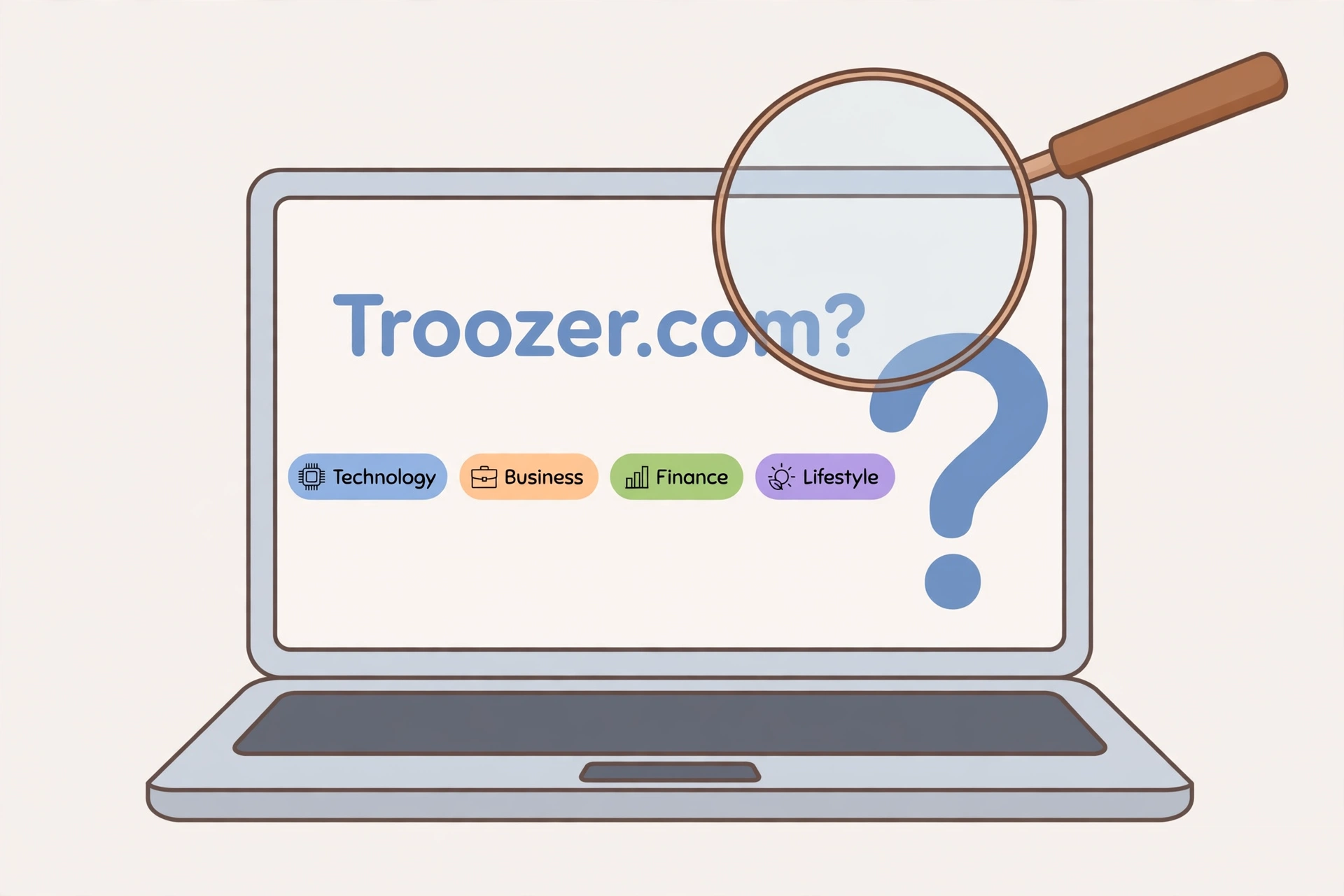
- What it visibly is: a website that publishes articles and guides across many topics, including technology, business, finance, gaming, education, and lifestyle. Its own homepage describes it as a modern digital publication built around the idea that content should be useful, interesting, and worth reading.
- What it is not, on the visible evidence: a verified marketplace, a project-management tool, a cloud storage service, an AI app, or a payment service. No working storefront, workspace, pricing page, or app listing for those services appears on the public site.
- What it costs to read: nothing, according to the site’s own FAQ section, which says its articles are available without a subscription or payment unless a specific piece or feature states otherwise. No price list for any other service was verified, because no such service is visibly offered.
- Is it safe to read? For casual reading, reviewers consistently describe the risk as low, and no widely reported scam findings or public breach reports were found in the sources reviewed for this article. That is not the same as a clean bill of health — ownership and editorial details remain unclear, and the absence of reports proves little on its own.
- What is still unconfirmed: who owns and runs the site, who writes and edits its articles, how large its audience really is, and whether it accepts guest posts through any public process.
If you only want to read an article there, you can do that with normal caution. If someone asks you to sign up, pay, or download something in the name of Troozer, stop — that does not match how the real site works.
What Troozer.com Actually Is
Open troozer.com and the picture is straightforward. The homepage opens with the tagline “Learn, adapt, and stay ahead” and introduces the site as a digital publication featuring articles, guides, insights, and stories.
The sections it promotes on its own homepage include:
- Technology and AI — new tools, digital trends, gadgets, and emerging innovations
- Business and finance — startups, markets, personal finance, investing, and the economy
- Education and learning — explainers and learning resources for complex subjects
- Home and living — practical ideas for home improvement, organisation, pets, and everyday living
- Gaming and entertainment — games, digital culture, and entertainment stories
- News, trends, and culture — noteworthy developments and changing conversations
Other reviewers who browsed the site’s category navigation report a similar spread, adding health, law, sports, and travel to the list. The exact category labels vary a little depending on which page you land on, but the pattern is consistent: broad, general-interest coverage, not one specialist niche.
How it works for you as a reader is equally simple. You open the site in any normal browser, browse by category or by whatever catches your eye, and read. You do not need an account, an app, or a payment to read the public articles. One reviewer notes that a WordPress login page exists for the site, but that is the standard way a WordPress publication’s admins and contributors manage content — readers do not need credentials just to view posts.
That structure — a category-driven feed of dated posts with author bylines — is the single most important thing to hold on to in this article. Almost every wilder claim about Troozer falls apart the moment you compare it with that visible reality.
What You Will Find When You Read It
Most articles on the site aim to explain things simply. Expect plain-language explainers, how-to guides, and trend pieces written for a general reader rather than a specialist.
That has an upside and a downside, and you should know both before you rely on anything you read there:
- The upside: if you are curious about a tech trend, a finance basic, or a general lifestyle question, you may find a readable overview in one place without jumping between several niche sites.
- The downside: a site that covers everything will struggle to show deep expertise in anything. Articles can vary in depth and accuracy, and a general magazine is a starting point for research, not a final authority — especially on money, health, or legal questions.
The site’s own homepage makes some bold claims about itself, including “500+ articles published” and “100K+ readers reached,” alongside reader testimonials. Treat those as the site’s own marketing claims, not as independently verified facts. No traffic figure, audience measurement, or reader count for troozer.com was verified from an independent primary source for this article, so none is repeated here as fact.
The same caution applies to its mission statement. The site says it values clarity, usefulness, originality, and trust, and that it wants to make valuable information easier to discover. That is a statement of intent. A mission statement tells you what a publication aspires to, not whether every article lives up to it. The honest test is the articles themselves: do they name authors, cite sources, carry dates, and hold up when you check their key claims elsewhere?
Why So Many Reviews Disagree About Troozer.com
This is the heart of the confusion, so it is worth laying out plainly.
The claims you will see elsewhere
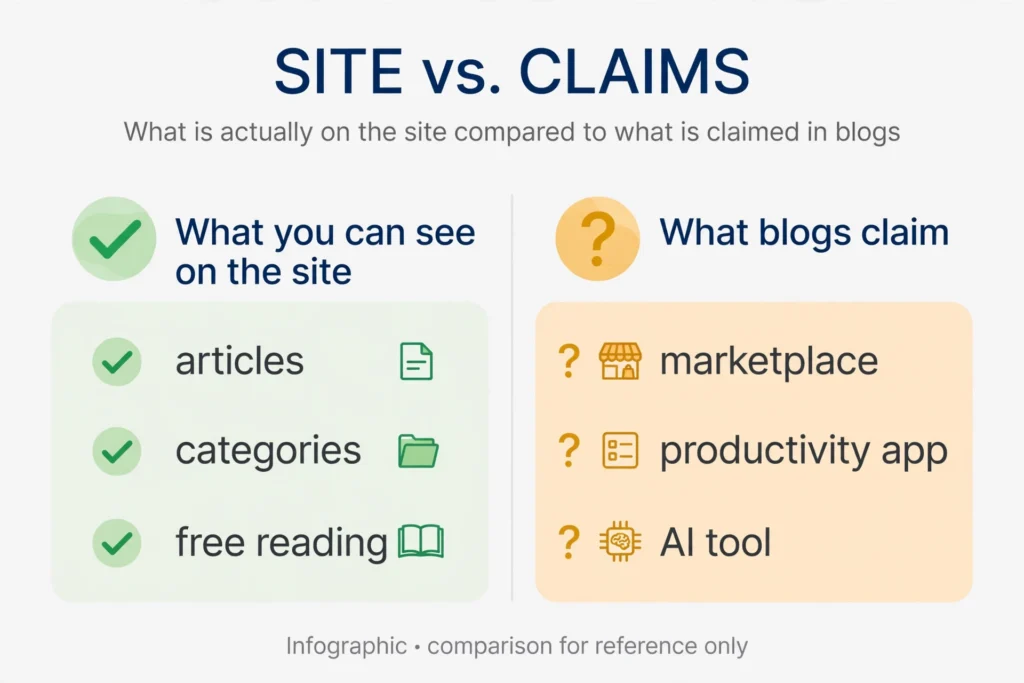
Across third-party write-ups, troozer.com has been described as at least four different things:
- An online marketplace. One detailed write-up describes structured product listings, seller verification badges, in-platform messaging, card payments, digital wallets, and an escrow system for high-value purchases.
- An all-in-one productivity platform. Several write-ups describe a dashboard combining project management, cloud storage, team messaging, and automation, sometimes with AI features for follow-up emails and invoice reminders. Some compare it to tools like Trello, ClickUp, or Monday.com.
- A smart tool finder or search assistant. Other write-ups describe a curated search engine for digital tools, using web crawling, AI algorithms, and data analytics to return only the most relevant tools.
- A shopping aggregator. Still others frame it as a place to search, compare, and shop, with pricing data pulled from e-commerce platforms.
What the visible site shows
None of those four descriptions matches what a visitor sees on troozer.com itself. There are no product listings to buy from, no workspace dashboard, no tool-search interface, and no checkout flow. One recent reviewer puts it bluntly: the site’s own review page states plainly that it is not a SaaS product, not an e-commerce marketplace, and not a financial or transactional service.
So why do these descriptions exist? The most likely explanation, offered by more than one reviewer, is that many of these articles were written to rank for a trending keyword rather than to describe the website accurately. Once one write-up invents or repeats a feature list, later write-ups copy and expand on it, and repeated claims start to look like facts.
That is a pattern worth recognising anywhere, not just here. When you are reading another .com name explained the same way, the same rule applies: judge a site by what it shows you today, not by what a string of blogs promise it does.
How to test a software claim in 30 seconds
Whenever a blog describes an unfamiliar website as software, run this quick test before you believe it:
- Look for a visible sign-up or login page for ordinary users, not just a content-management login.
- Search for a pricing page with real plans and real prices.
- Check for documentation, a help centre, or a product tour.
- Find an app-store listing from a named developer, if an app is claimed.
- Read the terms of service for a company name and address.
- Look for independent user reviews on trusted platforms from people who actually used the product.
If you cannot find those things, treat the software claim as unproven. Troozer.com fails that test for every software version of itself — which is exactly why the publication explanation is the one that holds up.
What Troozer.com Is Not
Clear boundaries prevent expensive mistakes, so here they are in one place:
- Not a verified project-management tool. No public workspace, demo, or team feature appears on the site.
- Not a verified online store. Visitors read content. They do not open online stores, add items to a cart, or check out.
- Not a cloud storage service. Do not upload files based on a blog claim that it offers storage.
- Not a bank, wallet, or payment service. Never enter card details for a “Troozer account” without proof that such a service exists — and right now, there is none on the visible site.
- Not a verified AI tool. No AI product, API, or tool interface is visibly offered to readers.
If a page claiming to be Troozer asks you to do any of those things, it does not match the real site’s behaviour. Treat it as suspicious until proven otherwise, however professional it looks.
Is Troozer.com Safe and Legitimate?
Safety here depends on what you mean by “use.” Reading an article and handing over payment details are very different actions, and they carry very different risks.
Signals that support trust
- It is a working site with a steady flow of articles. The homepage shows recent posts, category pages, and clear navigation, and one reviewer notes archive pages going back several years, including month archives from 2020.
- Reading is free and needs no account. Nothing on the public pages asks you for payment or personal details just to read.
- No widely reported scam findings. Reviewers who searched for scam reports, breach reports, and security warnings found none tied to the site in the sources they reviewed.
- An established domain record. Third-party domain records list the domain as registered on 15 March 2013, with Cloudflare nameservers. Domain age alone proves nothing about quality, but a long-registered domain is a different signal from a domain created last week to run a quick scam.
A business-database profile also exists for the name, describing it as a publishing platform focused on technology, finance, and business. Treat that as a claim, not an audit: such profiles usually rely on details the company supplies itself.
Signals that limit trust
- Ownership is unclear. No owner, founder, or leadership team is reliably confirmed in public sources. That is common for smaller publications, but it still matters: if something goes wrong, you do not know who is accountable.
- Editorial transparency is thin. No clearly documented editorial, sourcing, or correction policy was verified, and author credentials are not consistently established across the site.
- Descriptions clash across the web. As shown above, third-party claims about the site contradict each other and contradict the site itself.
- Content quality will vary. A broad, keyword-heavy publishing style across many unrelated niches is a known pattern for search-driven content sites. Some articles may be solid explainers; others may be shallow. You cannot assume a uniform standard.
The fair verdict
The fair verdict, matching the more careful reviewers, is this: troozer.com operates as a legitimate but still developing content platform. It is not a proven scam, and it is not a hidden tool or marketplace either. It is a general-interest publication with limited transparency, best used for casual reading and as a starting point — not as a source you act on for money, health, or legal decisions without checking elsewhere.
Two things that were deliberately not claimed in this article: no malware scan result, and no authority or domain-rating score. No such scan or score was verified from a primary source, so presenting one would have been invention, not reporting.
How to Check a Troozer-Named Site Before You Trust It
This section is the practical part. Use it for troozer.com, and reuse it for any unfamiliar site that shows up in your search results.
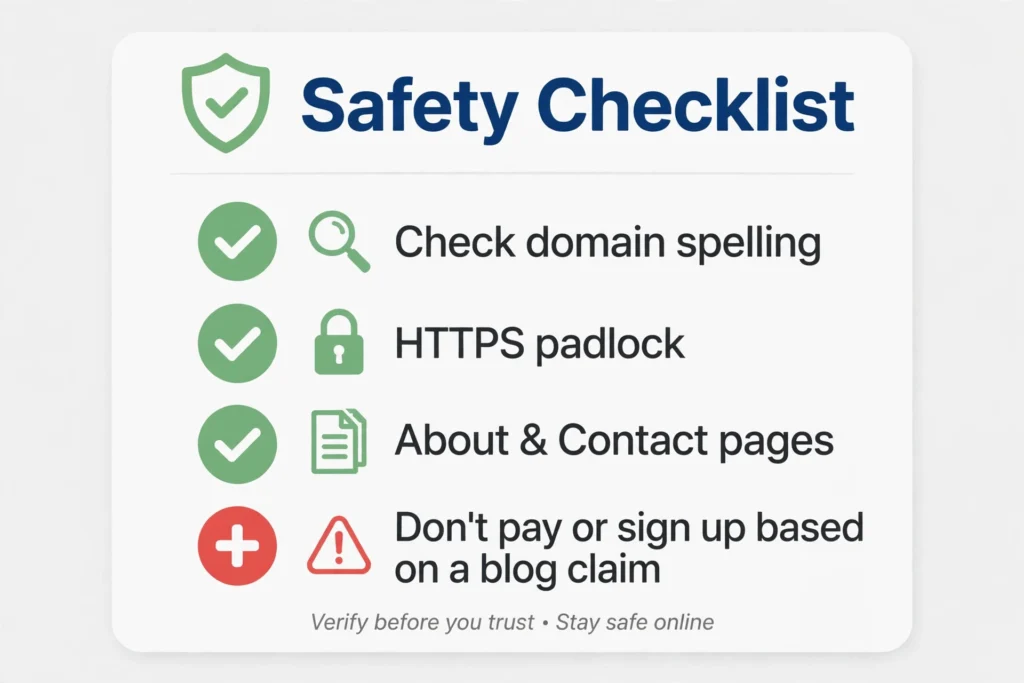
1. Check the exact domain spelling
Type the address yourself rather than clicking a link in a social post, an ad, or a download guide. Look at the address bar character by character. One wrong letter, or a different ending, can lead you to an unrelated business — and that risk is real here, because similarly named domains exist (see the lookalike section below).
Bookmark the exact domain only after you have verified it.
2. Confirm HTTPS, then stop there
Look for the padlock icon and an address starting with https before you type anything into a page. HTTPS means your connection to that site is encrypted. It does not mean the site is honest, well-run, or safe to pay. A scam site can have HTTPS too, so treat it as a minimum, not a guarantee.
3. Match the site against its own claims
Browse at least two or three categories and open a few full articles. Ask yourself:
- Does the homepage actually offer what the review you read promised — a store, a dashboard, a tool?
- Do the articles carry dates, named authors, and links to primary sources?
- Do the “About,” “Contact,” and privacy pages name a real operator and a real way to reach them, or are they vague?
If the site’s own pages do not back up the claims made about it, believe the site, not the claims.
4. Check the domain’s history
Use ICANN’s registration data lookup to review registration details such as the registrar and key dates for the domain. You can also use the Internet Archive’s Wayback Machine to see how the site looked in earlier years. Big shifts in topic, branding, or promises are a reason to slow down, while a stable publishing history over time is a reassuring — though not decisive — signal.
5. Never pay, sign up, or download on the strength of a blog claim
If any troozer-named page asks you to create an account, enter card details, or download a file, pause. That does not match how the real troozer.com works for readers. Use a unique password if you ever do create an account on an unfamiliar site, decline unexpected downloads and notification prompts, and never type a verification code into a page you reached through a search result or social post unless you are certain it is the official service.
The same warning applies when you are checking whether a website is a scam more generally: missing ownership and policy details are warning signs, not minor gaps to overlook.
6. Report a suspected impersonator
If you find a page pretending to be Troozer — or any site — and asking for money or personal data, do not engage with it further. You can report suspected fraud to the FTC at ReportFraud.ftc.gov. Reporting helps regulators track patterns even when one individual page looks small.
Who Should Read Troozer.com, and Who Should Skip It?
Troozer.com suits you if you are:
- A casual reader who wants a quick, plain-language explainer on a wide range of topics.
- A beginner who wants the simple version of a subject before going deeper elsewhere.
- A student or curious browser collecting starter ideas before doing proper research.
It is not the right place if you are:
- Looking for a tool. You will not find a project manager, a cloud drive, or an AI app here, whatever some blogs say.
- Shopping. There is no storefront to buy from, and product information on a general content site should never be your final check before a purchase.
- Making a money, health, or legal decision. For finance, verify claims on official sources such as Investor.gov or with a licensed adviser. For health, confirm advice with your doctor or with sources such as the CDC and NIH. For law, consult a licensed attorney. Treat any general-interest article — on this site or any similar one — as background, not as advice.
That last point is the same habit that applies to a similar multi-topic .com explainer: general-interest sites are useful for orientation, and they are not substitutes for primary sources or professionals.
Lookalike and Related Names: Do Not Mix Them Up
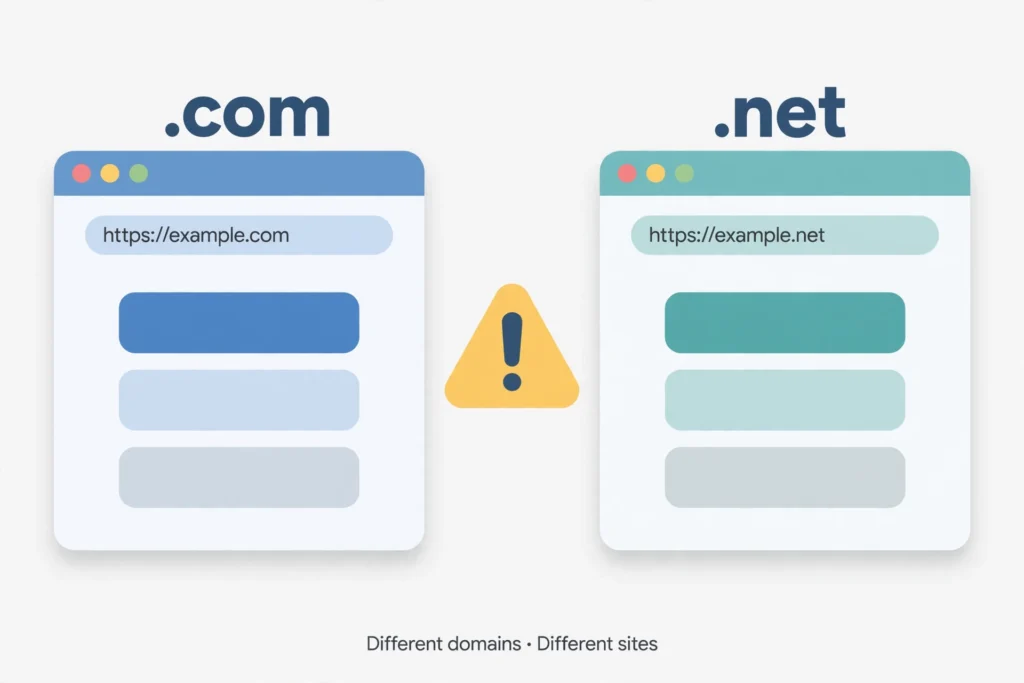
Other domains use the same name. The most notable is troozer.net, which publishes its own descriptions of the brand. Reliable public sources do not clearly confirm any relationship between troozer.net and troozer.com, and the two domains publish separate descriptions.
Treat them as different sites until affiliation is proven. The same rule applies to any other spelling variation, hyphenated version, or new ending you come across. A shared word in a domain name is not evidence of a shared owner, and it is a classic way that copycat or misleading pages gain attention.
Can You Write or Publish on Troozer.com?
Some people search for troozer.com because they want to contribute an article or get a guest post published there. Like many multi-topic publications, it may accept outside contributions, but there is no widely documented public submission process, and no published rates or guidelines were verified for this article.
If that is your goal, look for a contact page on the site itself and reach out directly. Be wary of third-party sellers offering guaranteed placements on the site, since you cannot easily verify their claims — and one reviewer notes that the domain’s presence in guest-post marketplaces may help explain why its content spans so many unrelated niches. That observation is about publishing incentives, not proof of any particular deal, and it should not be read as a recommendation to buy a placement.
Frequently Asked Questions
What is troozer.com?
Troozer.com is a multi-category digital publishing site. It publishes articles and guides across technology, AI, business, finance, gaming, education, health, lifestyle, and more. Some third-party pages claim more, but the visible site shows content.
Is troozer.com legit?
It operates as a working content website, and reviewers found no widely reported scam findings or public breach reports tied to it. Still, unclear ownership and thin editorial transparency limit confidence, so verify anything important elsewhere before acting on it.
Is troozer.com safe to browse?
For reading articles, the risk is low with normal precautions: check the exact domain spelling, confirm HTTPS, and do not share banking or private details on a content site. Decline unexpected downloads. The absence of breach reports is reassuring but does not guarantee future safety.
Is troozer.com a software platform or app?
No, on the visible evidence. One set of reviews describes an all-in-one dashboard, but other reviewers find no workspace, pricing page, or app listing on the public site. Treat software and app claims as unproven until you see working pages.
Is troozer.com an online store or marketplace?
No. Troozer.com publishes articles and does not operate as a shop or e-commerce platform. Do not enter payment details on any page claiming to be its store.
Is troozer.com free?
According to the site’s own FAQ, its articles are available to readers without a subscription or payment, unless a specific piece or feature states otherwise. No verified price list for any other service exists, because no such service is visibly offered.
Who owns troozer.com?
Reliable public sources do not clearly confirm the owner, founder, or leadership team. A business-database profile exists, but such profiles usually rely on self-reported details. Contact the site through its official channels if you need an official answer.
Is troozer.net the same as troozer.com?
No confirmed link exists. Sources do not clearly confirm any relationship between the two domains, and they publish separate descriptions. Treat them as different sites until proven otherwise.
Does troozer.com accept guest posts?
No widely documented public submission process, rate card, or set of guidelines was verified. Ask through the site’s official contact route, and avoid resellers who claim to represent the site without proof.
Why do reviews of troozer.com disagree so much?
Different writers appear to have sampled different pages, and some repeated earlier claims rather than checking the live site. Others wrote sales-style copy aimed at ranking for the keyword. Always check the live site yourself before trusting a review.
Should I create an account on troozer.com?
You do not need one to read the site. If any page asks you to create an account or pay in Troozer’s name, that does not match how the real site works for readers — pause, verify the exact domain, and do not enter personal or payment details.
Bottom Line
Troozer.com is a general-interest digital publication, not the marketplace, workspace, or AI tool that many third-party articles describe. You can read it for free, in any browser, without an account — and for casual reading, that is a low-risk use, with the usual cautions about checking anything important elsewhere.
What it is not is a verified product you can buy, sign up for, or trust with your money or personal data. Its ownership is unclear, its editorial standards are not clearly documented, and the boldest claims made about it come from other blogs, not from anything you can see on the site itself.
So use it the way its visible reality suggests: as a place to discover a simple explanation, then verify the things that matter somewhere authoritative. And if you ever land on a troozer-named page that asks you to pay, sign up, or download something, remember the simplest test in this article — the real site just lets you read — and close the tab.