Wachappe Explained: Is It an App, a Greeting, or Something Else?
If you searched for “wachappe” and expected one clear answer, you are not alone — and you are not missing something obvious. The word shows up online in very different contexts, and some of those contexts contradict each other.
Here is the short version: there is no verified, standalone messaging app called Wachappe that you can safely download from an official source. What you will actually find is a casual online greeting, a Mauritian community described on Facebook, and a string of articles claiming an app exists without giving you a developer, an official website, or a store listing you can check.
That distinction matters. If you download something just because it uses this name, you could end up with an unrelated app, a copycat, or a file from a site you should not trust.
The Short Answer
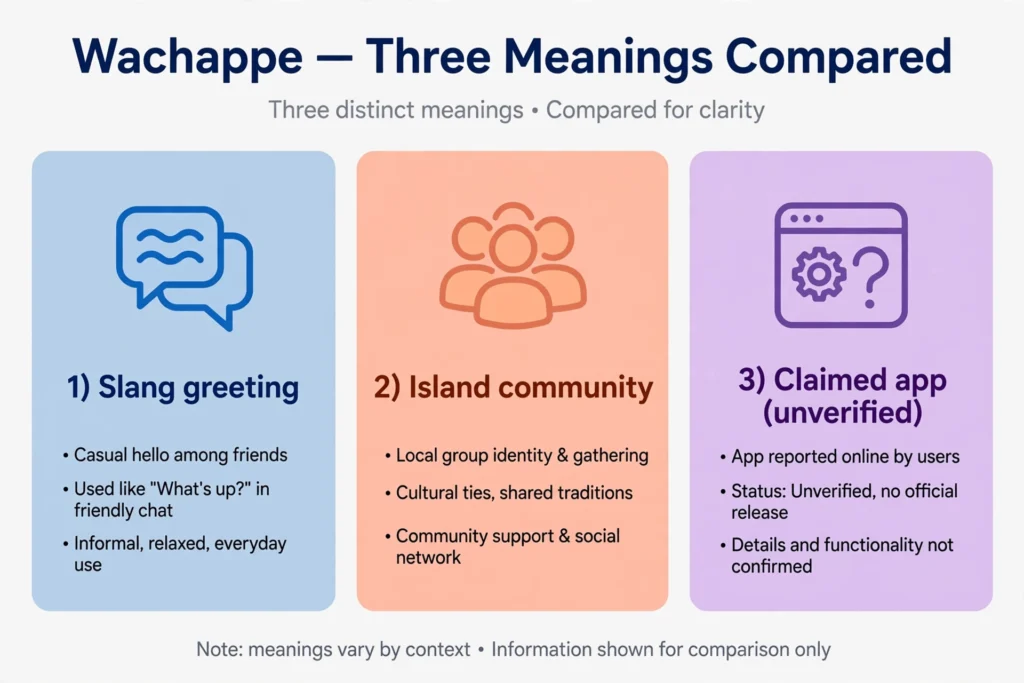
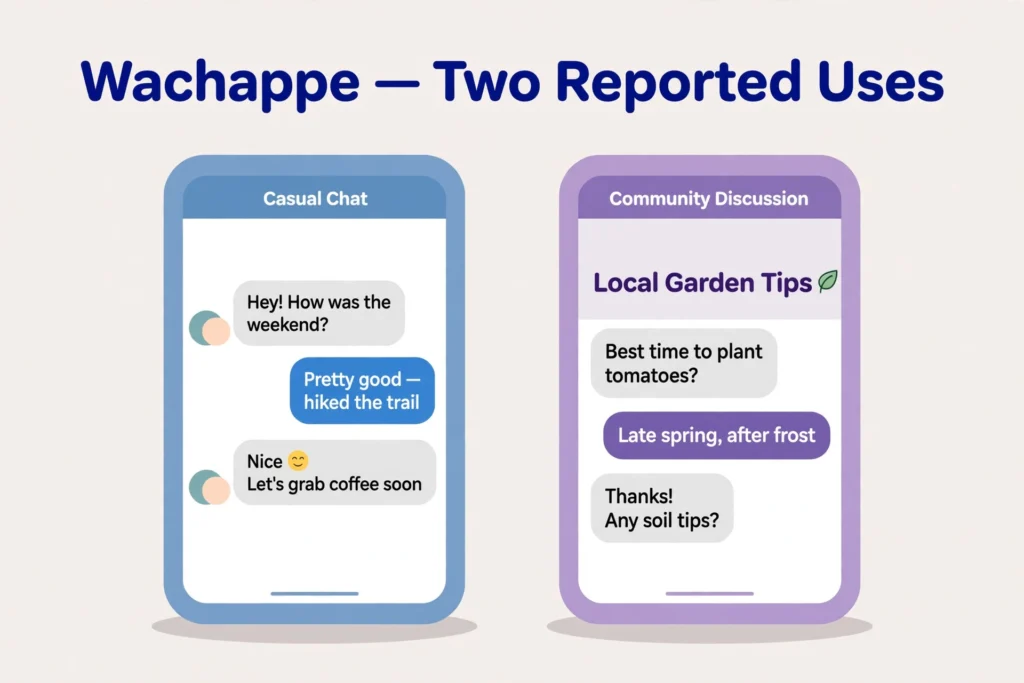
Wachappe is best understood as an online term with more than one reported meaning, not as one confirmed product:
- As slang: a casual, playful greeting, similar to “what’s up” — used in texts, DMs, and social media comments.
- As a community name: a grassroots Mauritian community platform described as living mainly on Facebook, built around local news, memes, and discussion.
- As an app: claimed by several articles, but not verified. No identifiable developer, official download page, or privacy policy has been reliably established.
Wachappe is also not WhatsApp, and no official connection between the two names has been verified. The similar sound is almost certainly why so many people confuse them.
What Does Wachappe Mean as Slang?
In its simplest reported use, “wachappe” works like a friendly opener.
You might see it at the start of a message, in a group chat, or under a friend’s post. It means roughly the same as “Hey, what’s up?” — but with a more playful, internet-style tone.
Examples of how it is used:
- “Wachappe? What are you up to today?”
- “Wachappe everyone, welcome to the group!”
- “Wachappe, you free later?”
It fits casual settings: friends, peers, and informal online communities. It does not fit a work email, a formal introduction, or a message to someone who has never seen the word before. In those cases, a plain “Hi” will do the job better.
Where did it come from? No single creator has been documented, and that is normal for internet slang. Words like this usually bubble up in forums, gaming chats, and social platforms, then spread because people copy a tone they like.
Some writers describe it as a blend of “what’s up” and “WhatsApp,” because it sounds like both. That is a plausible explanation for the spelling, but it is still an explanation, not a proven origin story. Treat it as a theory, not a fact.
Why slang like this spreads
Short greetings do a lot of work in a few letters. They set the tone before the real message starts, signal that you are relaxed and open to chat, and show that you know the shorthand of the group you are talking to.
That is also why slang can confuse outsiders. If you do not share the reference, a word like wachappe looks like a typo, a brand name, or a foreign word. Context is everything: who said it, where they said it, and what conversation it opened.
What Is the Mauritius Wachappe?
A second, quite different use of the name comes from Mauritius.
One detailed account describes Wachappe as a grassroots Mauritian community platform on Facebook, where young Mauritians discuss local news, politics, culture, and everyday life, alongside memes and social commentary. In that account, it works less like an app and more like a digital town square: regular people post updates, share photos, and start discussions that spread quickly across the island.
The same account says the community speaks the way Mauritians actually talk — mixing Creole, French, and English — rather than using the formal language of a newspaper. Speed is part of the appeal: a local incident, a political statement, or a funny moment can be posted and debated immediately, instead of waiting for the next day’s news cycle.
That picture is interesting, but you should read it with care. The account does not name a single verified page or group, give follower numbers from a primary source, or link to an official Wachappe presence you can check yourself. It also makes at least one statistical claim about youth engagement without showing its source, so that claim should not be repeated as a fact.
So the fair summary is this: a Mauritian Facebook-based community use of the name is reported in detail, but its size, ownership, and exact pages remain unverified from the material available. It is not evidence that a separate Wachappe app exists, and it should not be confused with the slang greeting either — even though all three uses share the same word.
Why community platforms like this can mislead
Community-driven pages have real strengths. They surface small local stories that big outlets skip, they let readers talk back instead of just reading, and they move fast.
They also have a built-in weakness: anyone can post, and posts often travel before anyone checks them. A rumour, an old photo presented as new, or a joke taken literally can spread just as quickly as a genuine local update.
If you follow a community like this, use it as one input, not your only source. Cross-check anything important — especially anything about safety, money, health, or politics — against a mainstream outlet or an official announcement before you share it.
Is Wachappe a Real App You Can Download?
This is where the online picture gets messy, and where you need to be most careful.
Several articles describe Wachappe as a messaging app with features such as instant messaging, voice and video calls, group chats, file sharing, and end-to-end encryption. Some even give download instructions: search the Google Play Store or Apple App Store, or visit an official website for a desktop version.
Here is the problem: those articles do not agree on the details, and none of them points to a verifiable official product.
- No developer or company behind a Wachappe app is reliably identified.
- No official website for a Wachappe app is consistently cited. In at least one download guide, the “official website” link does not lead to a Wachappe product page at all.
- No official app-store listing for an app called Wachappe was established in the research for this article. Searches for the name return WhatsApp and unrelated apps instead.
- No privacy policy, terms of service, or security documentation for a Wachappe app has been reliably published.
An article describing features is not proof that a working app offers them. Anyone can write that an app has encryption, AI features, or cross-device sync. Until a real developer publishes those claims alongside a real product you can inspect, they are just claims.
That does not mean every page using the name is a scam. It means you cannot treat “Wachappe” as a single, trusted product. If you find an app or download link using this name, you are looking at one specific, unverified offering — not at an established service.
What about the claimed features?
The features most often attached to the name are the same features every modern messaging app offers: text messages, voice notes, photos and videos, group chats, and voice or video calls. Some articles add AI assistance, avatars, or business tools.
You should treat all of these as reported or proposed, not confirmed, for Wachappe specifically. There is no reliable official evidence that one working product under this name delivers all of them.
If a download page promises encryption, ask the question that matters: encryption documented where, audited by whom, and published by which company? If the page cannot answer that, the word “encryption” on the page is marketing, not protection.
Wachappe vs WhatsApp: The Confusion, Explained
The two names sound alike, and that is almost certainly the main reason wachappe gets searched so often.
Wachappe: An online term with several reported meanings. Developer: Not reliably identified. Official app: Not verified. Privacy documentation: Not clearly established. Connection between them: No official affiliation verified.
WhatsApp: An established messaging service from Meta. Developer: Meta. Official app: Available on mobile, desktop, and web. Privacy documentation: Published by the provider. Connection between them: No official affiliation verified.
If what you actually want is WhatsApp, go to the real thing: WhatsApp’s official website (https://www.whatsapp.com). Its official download page (https://www.whatsapp.com/download/) covers the supported apps and devices.
Do not assume that a site, app, or download link using a similar-sounding name is an authorised WhatsApp product. Similar spelling is not a partnership, and it is a classic way that copycat or misleading downloads get attention.
How to Check Before You Download Anything Called Wachappe
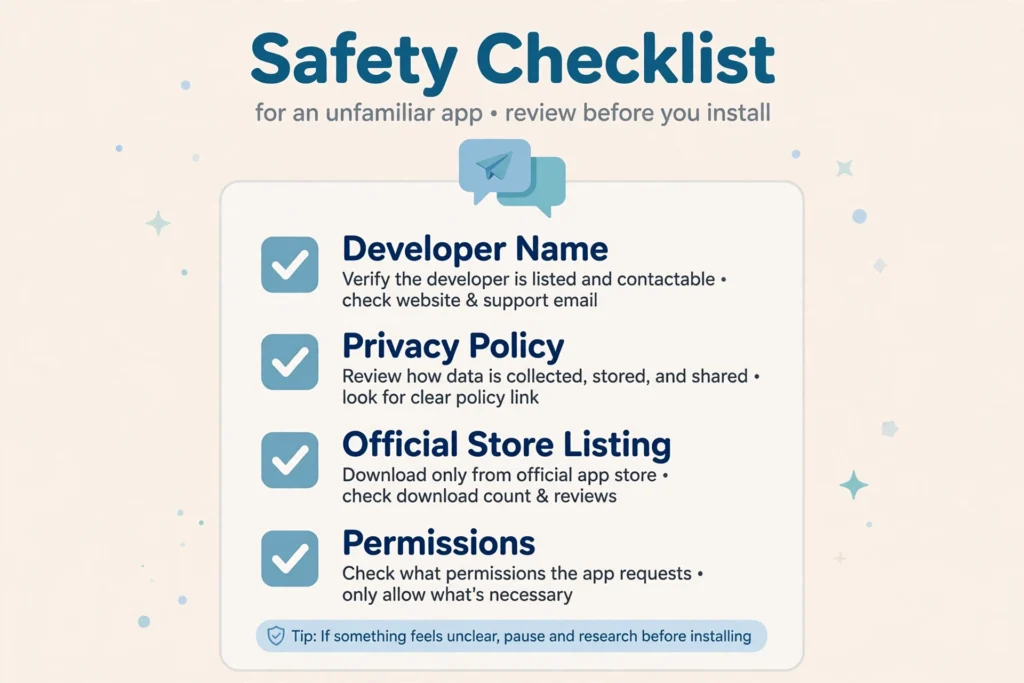
If you still want to investigate a specific link or app using this name, run through this checklist first. It takes a few minutes, and it applies to any unfamiliar app, not just this one.
1. Find the developer
A real messaging app has a real publisher: a company name, a website, and a contact route. Search for that name separately from the app name. If you cannot find a company at all, stop there.
2. Use the official store listing, not a random download button
Prefer Google Play or the Apple App Store, and check the publisher name on the listing, the number and quality of reviews, and when the app was last updated. Be wary of APK files or direct downloads from blogs and file-sharing pages, especially for a messaging app that would handle your contacts and conversations.
3. Read the privacy policy before you sign up
A messaging app deals with your messages, photos, phone number, and contacts. Before you hand those over, the provider should explain in plain terms:
- What data it collects
- Whether messages are end-to-end encrypted, and what that covers
- How long data is kept
- Whether you can delete your account and your data
- Whether data is sold or shared, and with whom
If there is no privacy policy, or it is vague, copied, or hosted on an unrelated site, do not sign up. The same caution applies when you are checking whether a website is a scam — missing ownership and policy details are warning signs, not minor gaps.
4. Check the permissions it asks for
A messaging app reasonably needs contacts, camera, microphone, and storage for media. It does not reasonably need unrelated access — for example, to your SMS inbox, call logs, or device administration — without a clear reason. If the permission list looks greedy, decline the install.
5. Never enter codes on an unfamiliar page
Never type a verification code, password, or one-time code into a page you reached through a search result, a social post, or a download guide unless you are certain it is the official service. This is exactly how account takeovers happen: a lookalike page asks for the code, and the attacker uses it to sign in as you.
6. Compare it with established alternatives
If you cannot verify a Wachappe product, you do not need to go without messaging. Established options with documented features and privacy policies include WhatsApp, Signal (https://signal.org/), and Telegram (https://telegram.org/). They differ on privacy defaults — for example, regular Telegram cloud chats are not end-to-end encrypted by default, while Signal is built around private messaging — so pick based on what matters most to you: privacy, large groups, channels, or everyday convenience.
How to Use Wachappe Correctly as Slang
If you want to use the word itself, rather than download anything, the rules are simple.
Use it when:
- You are messaging friends or an informal group that already uses internet slang
- You want a warm, relaxed opener instead of a stiff “Hello”
- The conversation that follows is casual
Skip it when:
- You are writing to a boss, a client, a teacher, or anyone in a formal setting
- The other person may not know the term and could read it as a typo or a brand name
- Clarity matters more than tone — for example, in instructions, complaints, or anything official
A few natural examples:
- “Wachappe? Long time no chat — how have you been?”
- “Wachappe everyone, quick question about Saturday.”
- “Wachappe, just checking in before I send the photos.”
If the other person looks confused or does not respond in kind, drop it and switch back to a normal greeting. Slang only works when both sides share the code.
What Could Happen to the Word Next?
The future of wachappe is genuinely uncertain, because it is not one thing with one owner.
It could stay as casual slang, used in some circles and unknown in others. Slang often works that way: it spreads fast, feels fresh for a while, then either settles into everyday language or fades when the next term arrives.
It could keep its community meaning in Mauritius, growing into a more recognised media presence — or staying exactly as it is, a loose set of Facebook conversations rather than a formal brand.
It could also be adopted by a real product one day. If that happens, you will know it by the things that are missing now: a named developer, an official website, a store listing, a privacy policy, and features you can actually test.
Until then, the safest way to describe wachappe is as a word in search of a settled meaning — not as an app you should download, and not as a brand you should trust on name alone.
Frequently Asked Questions
What does wachappe mean?
Most commonly, it is used as a casual online greeting, similar to “what’s up.” It is also reported as the name of a Mauritian Facebook-based community. Its meaning depends on the context where you see it.
Is wachappe a real app?
No standalone Wachappe messaging app has been reliably verified. Articles describe one, but no identifiable developer, official website, or official app-store listing has been established. Treat app claims as unverified.
Is wachappe the same as WhatsApp?
No. No official connection between Wachappe and WhatsApp (or Meta) has been verified. The names sound similar, which is why people confuse them. If you want WhatsApp, use WhatsApp’s official website (https://www.whatsapp.com).
Can I download wachappe?
There is no verified official download source to recommend. Do not install files from blogs, file-sharing pages, or lookalike sites just because they use the name. Check the developer, the store listing, and the privacy policy first — and if you cannot verify them, do not install it.
Is wachappe safe?
Its safety cannot be assessed as one product, because no verified product, developer, and privacy policy have been identified. Safety depends entirely on the specific website or file you are looking at, which is why the checklist above matters.
Is wachappe free?
Pricing cannot be confirmed, because no verified standalone service has been identified. Any price — or “free” claim — on an unverified download page should not be trusted on its own.
Does wachappe have end-to-end encryption?
Some articles claim it does, but there is no reliable official documentation confirming encryption for a Wachappe product. Do not assume your messages would be protected.
Who uses wachappe?
As slang, it is mainly associated with younger, highly online users in informal chats and social media comments. As a community name, it is associated with young Mauritians on Facebook. Neither use has a documented founder or official audience.
Why do different articles say different things about wachappe?
Because there is no single official source to settle the question. Some articles treat it as slang, some as a Mauritian community, and some as a new app — and some mix all three together. When sources disagree and none can point to a primary product, the honest answer is that the meaning is unsettled.
What should I use instead if I want a messaging app?
WhatsApp, Signal (https://signal.org/), and Telegram (https://telegram.org/) are established options with documented features and official download pages. Choose based on your priorities for privacy, groups, and everyday use.
Bottom Line
Wachappe is a word you should understand, not a product you should download on trust.
As a greeting, it is simple: a warm, casual “what’s up” for friends and informal chats. As a community name, it points to a reported Mauritian Facebook scene built on local conversation and humour. As an app, it remains unproven — lots of claims, no developer, no official listing, and no privacy documentation you can check.
So if you see the word in a chat, read it as slang. If you see it on a download button, slow down and check the source first. And if what you actually wanted was WhatsApp, go straight to the official site instead of trusting a name that merely sounds like it.